Before You Press Play
- Narration: Ray Porter is ideally suited to this material - his measured, authoritative delivery treats the criminal investigation with the gravity it deserves while sustaining the propulsive energy of the quarter-horse racing world throughout.
- Themes: Cartel money laundering, border identity, the American dream's darker edges
- Mood: Tense and cinematic, with the texture of long-form investigative journalism
- Verdict: Joe Tone's account of Los Zetas infiltrating quarter-horse racing is one of the most richly layered true-crime audiobooks in recent memory, elevated by a narrator who knows exactly how to pace a story this morally complex.
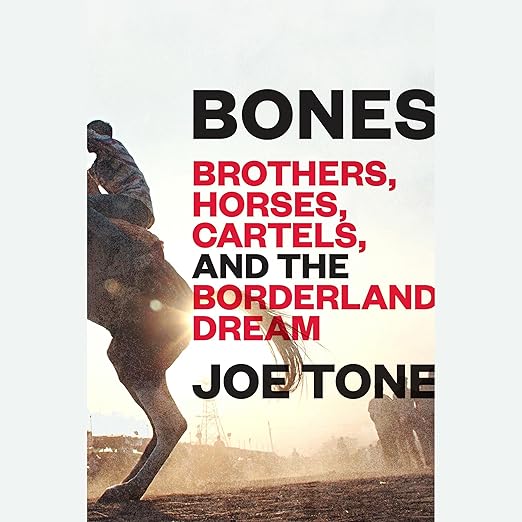
Joe Tone's Bones earns its reputation immediately: this audiobook reads like the best kind of literary crime narrative, one where the facts are stranger and more morally knotted than any novelist would dare invent. Narrated by Ray Porter, whose voice has carried some of the most celebrated audiobooks in the genre, it covers the intersection of Los Zetas cartel money, American quarter-horse racing, and the lives of two brothers whose fates converge at a point of catastrophic violence. The New York Times Book Review called it a masterwork of narrative nonfiction with finely-painted characters, sharp prose, and skillful pacing, and listening to Porter deliver it track by track, that praise feels earned rather than promotional.
At its structural core, Bones follows parallel tracks. José Treviño is a bricklayer and U.S. citizen who crossed from Nuevo Laredo into Texas to look for legitimate work and built a life that looked, from every external angle, like the American dream in modest but honest practice. His younger brother Miguel became something else entirely: one of the most feared figures in the Los Zetas hierarchy, accused of burning rivals alive, murdering Mexican and American law enforcement officers, and launching grenades at a U.S. consulate. What brings these two divergent lives into catastrophic collision is the world of quarter-horse racing, a subculture that thrives along the Texas-Mexico border corridor with its own codes, loyalties, and enormous sums of money moving in ways that attract exactly the wrong kind of institutional attention. The moment José shows up at a quarter-horse auction and bids close to a million dollars on a single animal, a transaction that makes him the biggest buyer in the history of that particular auction, the FBI's interest becomes inevitable.
That FBI interest, channeled through an eager young agent named Scott Lawson and a rancher named Tyler Graham who would eventually breed José's champion horse nicknamed Bones, drives the investigative spine of the audiobook. Tone is meticulous about reconstructing how this infiltration was managed, what it cost the people inside it, and what the ultimate legal outcome revealed about the limits of drug war enforcement as a strategy.
Why Bones Works as an Audiobook
Ray Porter is the right instrument for this material, and the combination of author and narrator is one of those pairings that feels almost inevitable in retrospect. Porter has the ability to hold multiple registers simultaneously: the measured pace of an investigative journalist laying out facts methodically, and the coiled tension of a crime writer who knows exactly when to tighten the screw. When the story shifts between José's world of horse auctions and morning ranch routines and Miguel's world of cartel violence and legend-scale brutality, Porter adjusts his cadence just enough to signal the contextual change without ever breaking the unified tone that Tone built into his prose. The book's layered structure, which the New York Times noted specifically as a strength, is even more effective in Porter's hands than on the page because his pacing makes the parallel construction audible.
The quarter-horse world itself is rendered with the kind of granular specificity that separates great long-form nonfiction from competent summary journalism. Tone clearly spent considerable time inside this subculture, and the audiobook is richer for that immersion. The championship auctions, the breeding operations, the social hierarchies of a sport that exists in a cultural corridor between rural Texas and northern Mexico, the way money and lineage and reputation circulate in a world where many participants have connections on both sides of a border that the U.S. government treats as absolute - all of it arrives as lived texture rather than background research dressed up as scene-setting.
What makes the audiobook particularly compelling is the way Tone handles the moral ambiguity of Tyler Graham's position. Graham, the rancher enlisted to help the FBI infiltrate the money-laundering network, is not a simple informant or a simple victim. He is a man operating in genuinely murky territory, and Tone does not resolve the questions his choices raise. Porter gives Graham's passages the same careful attention he gives to José's quieter domestic scenes, which means the moral complications carry their full weight.
Weak Spots in Bones
The structural achievement of Bones is the way Tone manages to make both brothers sympathetic and comprehensible without softening what either of them has done or allowed. José's culpability sits in an uncomfortable gray zone throughout the audiobook, and Tone does not resolve it into easy moral clarity at the book's conclusion. Some listeners have noted that certain middle sections, where the cartel history expands into territory that contextualizes Miguel's rise, slow the primary narrative. That criticism is fair, and there are passages where the forward momentum gives way to background density. But Porter's pacing through those sections is controlled enough that the loss of narrative velocity never feels catastrophic, and the context he is building is load-bearing for the final third of the audiobook.
The deeper subject of Bones is the drug war itself, and specifically the way it distorts and degrades the lives of ordinary people along the border who are never themselves cartel members but who cannot entirely escape the cartel's gravitational pull. Tone refuses simple verdicts. That refusal is what gives the audiobook its staying power well beyond the true-crime genre's usual shelf life. Listeners familiar with Don Winslow's cartel fiction or Sam Quinones's journalism about the opioid crisis along the same border corridor will find Bones occupying a precise and valuable position: rigorously factual where Winslow is novelistic, more narratively urgent than Quinones's deliberately fragmented approach.
The Right Listener for Bones
Listeners who gravitate toward narrative nonfiction with the pace and texture of literary fiction will find this audiobook absorbing and consistently rewarding. Anyone who loved Killers of the Flower Moon, I'll Be Gone in the Dark, or Don Winslow's border crime trilogy will have strong contextual familiarity with the world Tone is describing. Sports fans with an interest in horse racing, particularly the quarter-horse culture of the American Southwest, will discover a world they likely did not know existed at this level of institutional depth and criminal complexity. This is not a book for listeners who want their true crime served quickly or with easy moral resolution. The complexity is the point, and Porter's narration does justice to every layer of it across eleven hours and forty minutes.