At a Glance
- Narration: Allison Moorer reading her own work is not a performance so much as an act of testimony, intimate, unflinching, and entirely unlike anything a hired narrator would produce.
- Themes: Family trauma, survival and artistic reckoning, the long reverberations of violence
- Mood: Sparse, devastating, and quietly brave. Not background listening
- Verdict: For those willing to meet it on its own difficult terms, Blood is one of the most honest pieces of creative memoir in country music's recent history.
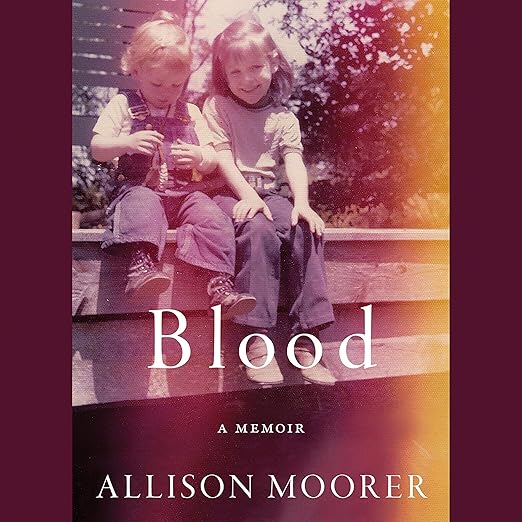
Blood is listed in the arts and entertainment category and tagged under music, which is technically accurate and also somewhat misleading. Allison Moorer's album-and-book companion project is something closer to what scholars of literary memoir would call a creative reckoning: an artist sitting down with the worst thing that ever happened to her and finding out what language is left when you push past silence. Her father shot and killed her mother, then turned the gun on himself. Allison and her sister Shelby Lynne, who became a country singer herself, were witnesses. Moorer was seventeen.
The audiobook edition, released in 2020, is seven hours and fifty-three minutes of Moorer reading her own memoir alongside the music that frames it. I listened to this late on a Sunday evening after a friend had recommended it with the caveat that I should not put it on while I needed to function afterward. That warning was apt. Moorer's voice, which is still extraordinary, carries the text with the same quality that makes her music devastating: absolute control deployed in service of total vulnerability.
What Allison Moorer Delivers
One of the reviewers compared this project to Loudon Wainwright III's album Older Than My Old Man Now, and that comparison is worth sitting with. Both are works of honest evaluation, artists using their craft to process the power of family history and its long damage. Moorer's memoir intersects with the ten songs on the companion album to create something neither book nor music alone could accomplish. She is not illustrating the songs with the prose, or the prose with the songs. She is using both to approach an event from multiple angles, the way trauma actually behaves in memory, never fully available from a single vantage point.
The album itself, described by reviewers as straddling acoustic country and folk with occasional excursions into electric rock, is mostly sparse. That sparseness is structural. Moorer is not interested in production as cushioning. She wants the listener uncomfortable enough to stay honest, and the arrangements cooperate. Several of the songs deal directly with the murder-suicide, while others address the years since, the orphaning, the way she and Shelby Lynne built careers and lives in the long shadow of that night in Alabama.
What Allison Moorer Gets Right
The case for the audiobook over the print memoir is Moorer's voice doing double duty: she narrates with the same deliberate precision she brings to the music, so the prose and the songs exist in the same acoustic space. Reviewers who described this as intimate were responding to something specific and real. There is no mediation here. She is not performing her grief for the listener; she is describing it with the careful language of someone who has been writing around and through it for years.
One reviewer who saw Moorer perform live at a small restaurant in Philadelphia described the experience of listening to her alone, without a crowd, as the correct context for this work. The audio format creates exactly that condition. Blood is probably best listened to alone, as one reviewer explicitly noted, because it demands a kind of attention that company tends to interrupt.
Where Allison Moorer Loses Some Ground
This is not an audiobook that builds toward catharsis or resolution in the conventional sense. Moorer does not wrap the story up. She does not arrive at peace with what happened, or perform the arrival at peace that grief memoirs sometimes offer as their final transaction with the reader. She arrives at something more sustainable and more honest: the recognition that the event shapes everything, that it has shaped her music and her relationships, and that living with it is the ongoing work rather than the finished product.
Listeners who need a book to end in a place of earned comfort should know this going in. Those who find the absence of resolution unsatisfying will not be wrong, exactly, but they may be looking for a different kind of memoir than the one Moorer has written. The honest reviewer who described being stunned was capturing something accurate about the experience of meeting this work on its own terms.
Who Should Pick Up Blood
Blood is for listeners who take country and folk music seriously as a vehicle for literary expression, and who are not made uncomfortable by art that refuses to tidy itself up. It is an essential listen for anyone following Allison Moorer's career, and it works as an introduction to her for listeners who have not encountered her work before, though it is a difficult place to start. Shelby Lynne listeners who want to understand the context for her sister's music will find this illuminating.
This is not the album or book for a casual listen or a mood lift. If you are in a fragile place emotionally, hold off. But if you are ready to spend an evening with something that asks something real of you, Blood rewards that willingness with rare and genuine honesty.
A Few Questions About Blood
Is Blood primarily a memoir or a music album, and does the audiobook include the actual songs?
Blood is a companion project: a written memoir and a ten-song album released together. The audiobook version includes Moorer reading the memoir. Whether the songs are embedded in the audio recording or separate depends on the edition, so check the Audible listing for what is included in the runtime.
Is this audiobook suitable for listeners unfamiliar with Shelby Lynne, who is also referenced throughout?
Yes, the memoir provides enough context about both sisters that prior knowledge of Shelby Lynne is not needed. Moorer writes about their shared experience as survivors, not as a music industry story, so the focus is on their history rather than their careers.