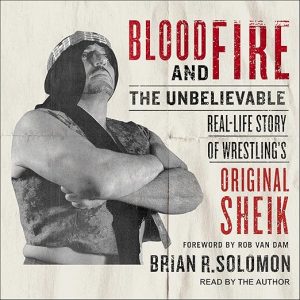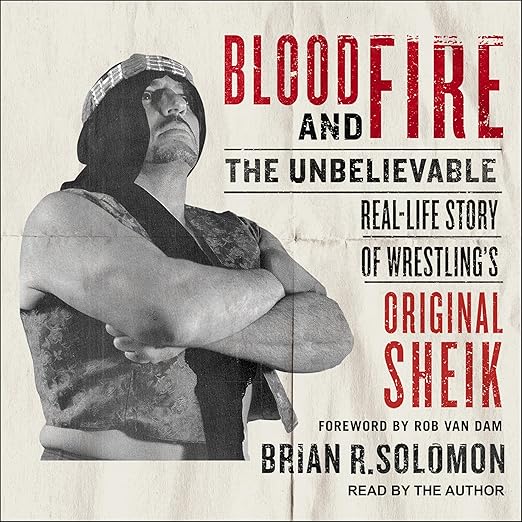
Eddie Farhat grew up in Lansing, Michigan, the son of Arab immigrants who had come looking for the American dream. He served his country in World War II, built a wrestling promotion from the ground up, and drew record crowds across North America for three consecutive decades. He also set fire to his opponents, slashed them with foreign objects, and screamed in a language his fans assumed was Arabic but which nobody around him could actually identify. Brian R. Solomon's audiobook Blood and Fire excavates the man behind the persona with the care of a genuine historian and the passion of a lifelong fan, and he narrates it himself across fourteen hours and thirty-two minutes.
The Sheik is a figure almost incomprehensible to a modern wrestling audience raised on polished television production and carefully managed character arcs. Farhat's character had no coherent backstory, no redemption arc, no heel-to-face turn waiting at the end of the tunnel. He was simply the most terrifying man in the building, night after night, city after city, for decades. Solomon is exceptional at charting how that worked in practice: how Farhat ran World Wide Sports as both promoter and attraction, how he protected his character with a ferocity that sometimes bordered on paranoia, and how his legacy shaped generations of performers who came after him, including his nephew Sabu.
What We Made of It
Solomon's writing has the density of genuine scholarship without the deadening dryness that can plague sports history. He clearly spent years interviewing people who knew Farhat at every stage of his career, and those voices animate the narrative in ways that documentary research alone cannot. Reviewer Christopher J. Williams noted that the annotated notes and match results appended to the text mark the work of someone who takes the historical record seriously. That rigor extends to the prose itself. Solomon is not simply a fan writing a tribute; he is a historian interrogating a complicated legacy.
What the synopsis signals but the prose deepens is the tension at the core of Farhat's life. He was an Arab-American man performing an Arab villain at the height of Cold War xenophobia, and Solomon does not flinch from examining what that performance meant and what it cost. Farhat was simultaneously exploiting ethnic anxiety and, in some complicated way, making space for himself and his community in mainstream American entertainment by any means necessary. Whether that framing holds up under scrutiny is a question the book invites but wisely does not answer for you. One reviewer described the arc from the Dumont network days through to Farhat's final years mentoring Sabu in FWM as a biography that earns its full length, and that is accurate. Each phase of the career reveals a new dimension of the man behind the persona.
Why Blood and Fire Works as an Audiobook
The self-narration is, genuinely, one of the best arguments for choosing this audiobook over the print edition. Solomon reads at a measured pace that suits long-form biography, and his voice carries the quiet authority of someone who has spent years immersed in this world. He is not performing enthusiasm; he does not need to. The material earns the attention. At fourteen hours and thirty-two minutes, the runtime is substantial, but the narrative never stalls. The structure moves chronologically through Farhat's life while circling back to examine the wrestling business itself, and those two threads reinforce each other effectively.
The early chapters, covering Farhat's postwar ambitions and his gradual discovery that he could draw money as a villain, are actually among the book's strongest because they document a period in wrestling that has been almost entirely lost to institutional memory. Solomon reconstructs those years from ring records, promoter correspondence, and the recollections of people who were there, and the reconstruction is meticulous. Listeners who have no prior relationship to this era will come away from those chapters with a genuinely different understanding of how professional wrestling worked as a regional business before national television consolidated everything.
What Might Not Land
Pay close attention to how Solomon handles the economics of Farhat's operation. The Sheik is remembered as a character, but Eddie Farhat was a businessman, and the audiobook is at its most original when it traces how he structured his promotion, managed his talent, and eventually saw the territory he had built collapse around him as national promotions consolidated the industry in the 1980s. There is a genuine tragedy in that arc, one that Solomon renders without sentimentality. Farhat outlived the business model that made him viable, and the consequences were severe.
Also notice the passages devoted to the relationship between performance and belief. Farhat worked so hard to protect his character that many of his contemporaries genuinely were not sure where Eddie ended and The Sheik began. Solomon interviews people who knew both men and lets their contradictions stand. That is good biographical writing: resisting the urge to resolve what the subject himself left deliberately unresolved.
Who Should Pick Up Blood and Fire
Wrestling fans who lived through the territory era will find this essential, but the audiobook earns a wider audience than that. Anyone interested in immigrant stories, in American entertainment history, or in how a single performer can build and sustain a character over a forty-year career without a corporate machine behind them will find Blood and Fire genuinely illuminating. Listeners who want a quick celebrity biography should look elsewhere; this is a book that respects its subject enough to take its time and deliver a portrait that holds up.
In Brief
- Voice: Brian R. Solomon narrates his own biography, and the self-narration pays off handsomely; he brings an insider's cadence to the material, reading with the confidence of someone who spent years in wrestling locker rooms gathering these stories.
- Big ideas: Professional wrestling history, identity and performance, immigrant ambition
- Atmosphere: Kinetic and reverent, with the energy of a packed arena and the intimacy of a locker-room confession
- Worth it?: Solomon's Blood and Fire delivers one of the most rigorously researched accounts of an overlooked wrestling legend, and the self-narration adds a dimension of authority that a hired voice actor could not replicate.
Frequently Asked Questions
Do you need to be a wrestling fan to enjoy this audiobook?
Prior interest in pro wrestling helps with context, but Solomon writes for general readers as well. The book works as a study of American performance culture and immigrant ambition as much as it does as a wrestling biography.
Does Brian R. Solomon narrating his own audiobook create any awkward moments?
Not noticeably. Solomon reads with restraint and authority, and the self-narration actually lends credibility to the research. He does not perform the material; he delivers it.
How much of the audiobook covers The Sheik's wrestling matches versus his personal life?
It is roughly balanced. Solomon traces the character's development through specific matches and feuds while weaving in Farhat's family history, business decisions, and personal relationships. Neither dimension dominates.
Is this audiobook appropriate for listeners unfamiliar with the territory wrestling era?
Yes. Solomon explains the territory system and its economics clearly enough that newcomers can follow the business narrative without prior knowledge.