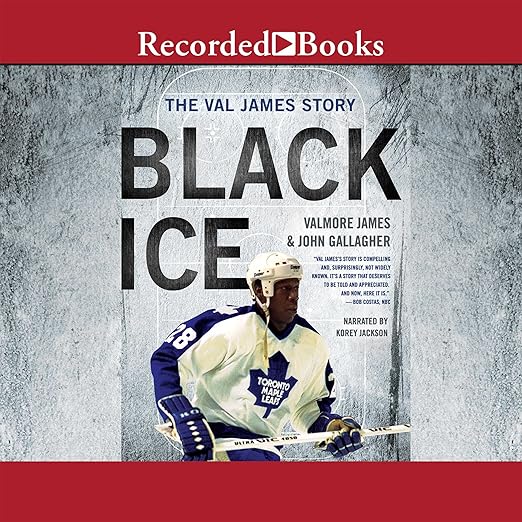
Hockey has never been especially eager to count its firsts, which is part of why this audiobook still felt overdue when it appeared. Val James took the ice for the Buffalo Sabres in 1982 as the first African-American player in the National Hockey League, and in 1987 became the first Black player of any nationality to skate for the Toronto Maple Leafs. Korey Jackson reads the memoir across five hours and twenty-one minutes for Recorded Books, and the version of the story it tells is not the one the milestones imply.
The Review
James did not come to hockey through a hockey family in the conventional sense, and a July 2016 account maps the route better than any summary does: from a Long Island rink where his father worked, through youth hockey and the minor leagues, to the two NHL stints at the end. That same account restates the headline fact with a qualifier the jacket leaves off, calling James the first American born African American player to play in the NHL. Those are not identical claims, and the gap between them is exactly why the qualifier exists at all.
Precision like that runs through the description too, which separates the 1982 milestone from the 1987 one and never blurs the two. The effect on the listening is real. The famous part of this story occupies a small fraction of the runtime, and the book spends most of its hours in buses, junior leagues, and towns where a sixteen-year-old was the only Black person for miles in any direction. Anyone arriving for the NHL debut will find it arrives late and lasts about as long as it did in life.
Why Listen to Black Ice
Long Island supplies the book's most unusual corroboration. A March 2015 response comes from somebody who played at the same arena and knew the family, remembers a father who drove the Zamboni and worked every job around the rink, and confirms that the taunting James describes from youth hockey in Brooklyn happened again to a younger brother four years behind him. Sports memoirs rarely get that kind of witness in public, and it turns one man's account into a pattern that outlasted him by four years in the same rinks.
Slurs are the technical problem this recording has to solve. A first-person memoir about racial abuse contains the abuse; the description says outright that James faced racist taunts at opposing arenas and that the prejudice continued at every level of the game. Korey Jackson has to deliver that material without flinching away from it and without leaning into it, while also carrying a hockey vocabulary of junior leagues, minor pro and pee wee that means nothing to a general listener. Pick a junior-hockey chapter in Canada rather than the NHL debut, and you will hear immediately how the balance is being struck.
Isolation is the book's real subject, more than fighting or firsts. Leaving home at sixteen to play in another country, being the only Black person in the league and frequently in the entire town, having no way to call anybody who would understand: that is the condition the memoir describes, and five hours is long enough to make the accumulation felt rather than summarized.
The Caveats
Candor gets the loudest praise in the column, and one August 2015 response frames it well before turning critical. It admires how directly the story gets told, then objects to the accolades stacked at the end, asking why a player everyone claims to have respected got so little time in the professional game, and why nobody in a position to act did anything while crowds shouted a racial slur from the stands. The same entry calls the book a novel, which it is not. Both things are worth registering: the mislabeling, and a complaint that lands harder than most praise.
Pugilistic skills is the description's chosen phrase, and it is doing a lot of quiet work. James was known as a fighter, which in the hockey of that era meant an assignment rather than a temperament, and a Black player kept in that role is a story about how a league finds a use for someone while limiting what he is allowed to be. The memoir is honest about it. A listener should still notice how often the praise James collects is praise for absorbing punishment.
The hardest content sits in the arenas rather than on the ice. Racist taunting from crowds is reported directly throughout, which is the point of the book and also the reason it is not casual listening. Anyone who wants a sports memoir as company while doing something else should know that the middle hours are relentless, and that the memoir declines the usual comfort of an ending where the sport apologizes.
Who Should Pick Up Black Ice
Players and parents in youth hockey should hear this, particularly anyone in a program where a kid is the only one who looks like themselves in the locker room. Beyond the rink, it belongs with the broader literature of integration in professional sport, and it fills a gap most of that literature leaves open, because hockey rarely gets examined the way baseball and football have been. Listeners who want history delivered without self-pity will find the register almost stubbornly level.
Steer clear if you want a highlight reel. The NHL portion is brief by the nature of the career, the prose does not romanticize, and nobody here is building toward a triumphant final chapter. Anyone who finds sustained accounts of racial abuse distressing should approach carefully rather than avoid it entirely, since the abuse is reported rather than staged. Val James paid for every shift he took, and the memoir keeps the receipt.
A Few Questions About Black Ice
Is this audiobook only worthwhile for hockey fans?
No. The sport supplies the setting, but the story is about being the only one in the room across a decade of moving between towns and leagues. Anyone reading about integration in professional sport will find this fills the gap where hockey usually goes unexamined next to baseball and football.
Does the audiobook draw a comparison with Jackie Robinson?
A July 2023 response makes exactly that comparison and then complicates it, noting that James met similar abuse roughly fifty years later, and that where Robinson was expected not to respond, James was encouraged to fight back. The same entry names Jarome Iginla among the players who came afterward.
Can a teenager who plays the game handle this audiobook?
For a teenager, yes, with an adult available to talk afterward. The subject matter is adult and the language reported from the stands is ugly, but a young player facing anything similar will recognize the situation immediately. For younger children the sustained abuse makes it a poor fit.