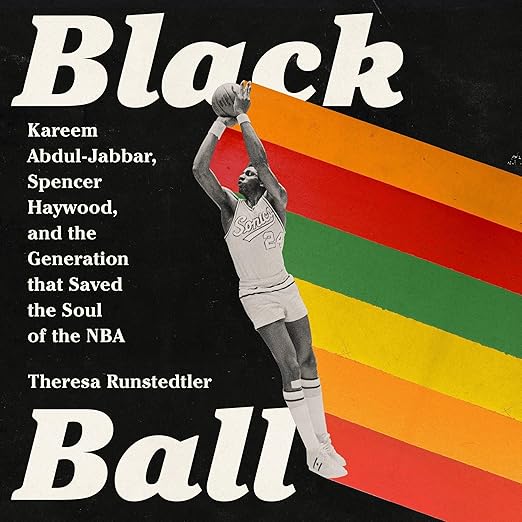
I started Black Ball on a morning when I was catching up on sports history reading that had piled up, and I want to say upfront that Theresa Runstedtler's framing landed for me before the first chapter was done. The premise, that the 1970s NBA has been systematically mischaracterized as a period of decline caused by its own Black players, is stated clearly and pursued with scholarly rigor. That combination of accessibility and academic seriousness is exactly what a history of this kind needs, and Runstedtler delivers it.
The book opens with the stories of Connie Hawkins and Spencer Haywood, two players whose battles against the NBA establishment form some of the most dramatic legal and athletic history of the era. Multiple reviewers identify these early chapters as the strongest material in the book, and I agree. Runstedtler writes these stories with the narrative precision of a true crime author and the analytical depth of a cultural historian. The detail about how primitive and negligent the league was in protecting its players, one reviewer specifically mentions a rookie of the year losing his life to a concussion and a plane crash in the book's first chapter, is genuinely sobering context for everything that follows.
What We Made of It
Runstedtler's central argument is that the press and public narrative of 1970s NBA basketball, which blamed the league's supposed decline on drugs, selfishness, and the increased presence of Black players, was a racial project as much as a sports commentary. She places Kareem Abdul-Jabbar, Oscar Robertson, and others in the context of a post-civil rights moment when the rules of integration had technically changed while the underlying power structures had not. Basketball became a mirror for white anxiety about those changes, and the players who expressed political consciousness, demanded fair contracts, or simply played a style of game that departed from the team-first orthodoxy became symbols of a disorder they had not actually caused.
That argument is more nuanced than a summary can convey, and Runstedtler is careful to distinguish between its structural dimensions. The section on drug use, for example, is not a denial that drug problems existed but a contextualization of how those problems were reported and weaponized in ways that selectively attributed systemic issues to individual Black pathology. At least one reviewer found this section less convincing than the earlier chapters, describing it as cherry-picking, and that tension in the readership is itself worth acknowledging. This is a book with a clear argument, and not every reader will find every part of the argument equally persuasive.
Why Listen to Black Ball
Xenia Willacey's narration handles the book's dual register, part narrative history, part cultural analysis, with consistent clarity. She does not dramatize the analytical sections, which is the right call; Runstedtler's own prose has enough energy that over-performing it would tip into parody. The sentence-level quality of the writing that one reviewer notes is well-served by a narrator who trusts it.
At eleven hours, this is a substantial listen, but the material earns the duration. The cast of characters from the 1970s NBA is extensive, and Runstedtler gives enough context to each figure that listeners unfamiliar with the era can follow without getting lost. For basketball fans who know these players only as statistics or reputations, the biographical depth here is a genuine discovery.
What Might Not Land
The second half of the book, which deals with drug culture and what one reviewer calls a more explicitly interpretive analysis of player behavior, is where Runstedtler's argument becomes more contested. Readers who want a purely narrative history will find the analytical framework increasingly present in the book's latter sections. Readers who engage with cultural history and are comfortable with the author's argumentative position will find it consistently well-reasoned.
The book is also very much a work of a specific scholarly perspective. Runstedtler writes from within a tradition of Black cultural history that has clear precedents and commitments. Readers expecting a neutral survey of the 1970s NBA will find something more interpretive than that, which is both the book's strength and a source of friction for some reviewers.
Who Should Pick Up Black Ball
Essential listening for anyone interested in the racial history of American professional sports, the specific cultural politics of the 1970s NBA, or the broader question of how sports media constructs narratives about Black athletes. Fans of Kareem Abdul-Jabbar, Oscar Robertson, Connie Hawkins, and Spencer Haywood specifically will find their stories given serious, detailed treatment. Less suited for listeners who want purely celebratory sports history or who are uncomfortable with explicit cultural critique as a mode of sports analysis.