
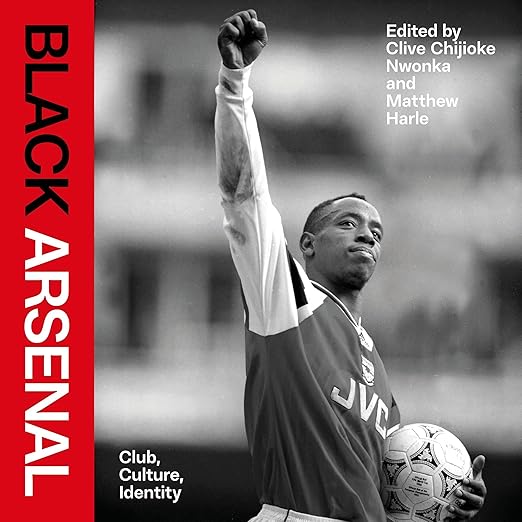
Photographs run through this book like a second text. The copy sells Black Arsenal on a combination of photography and rare archival images, which is a promise the audiobook cannot keep, and that gap is the first thing a buyer has to weigh. What the recording does carry is the writing: a collection assembled by Clive Chijioke Nwonka, running seven hours and fifty-five minutes, that treats a football club as a place where Black British identity was made and remade from the late 1960s onward.
Nothing about the subject matches the sports shelf. This is not a season narrative or a trophy count. It is an argument that decades of fielding iconic Black players, set against the storied histories of the terraces, turned one club into a symbol of what the copy calls an organic and convivial multiculture, and that the symbol then traveled outward into media, music, fashion and politics. June 2025 brought a five-star calling it a brilliant read and crediting it with showing how Black players are integral to the spirit and success of Arsenal FC, which is a supporter's summary of a book that is also doing cultural criticism.
The byline is doing less work than the contents. Only the editor appears in the fields a browser can search, while the description lists former legends Ian Wright and Paul Davis, critical appraisals from Paul Gilroy and Gail Lewis, and personal responses from Clive Palmer, Ezra Collective and Amy Lawrence. Each of those names represents a different kind of writing, and the listing gives you no way to find any of them. Come looking for Ian Wright on Arsenal and the metadata will not tell you that contribution is in here at all.
That mix is also what makes the book unusual rather than merely worthy. A memoir of the terraces and an academic appraisal of iconography rarely share a spine, and the editor has put them within minutes of each other. The claim underneath is that the club's affinity with Black identity ran past football and into everyday social experience, and the structure argues it by simply placing the evidence side by side instead of summarizing it.
Why Listen to Black Arsenal
Bayo Gbadamosi has an anthology problem to solve, and it is a real one. An academic appraisal and a former player's recollection do not sound alike on the page, and one reader has to keep them from sounding alike in the ear without turning each handover into an impression. Just under eight hours is short for a collection this crowded, so the register changes come fast. The payoff, when a single voice manages it, is that the through line stops being invisible: heard straight through, the critical essays and the personal responses start answering each other in a way that flipping between chapters in print tends to hide.
August 24, 2025 produced a five-star singling out the historical material, with the verdict that every gooner should read it. That is the part of the book audio serves best. The chronology, from the earliest hints in the late 1960s that something remarkable was happening up to the club's rise into a global business, is narrative, and narrative survives the move to a recording intact.
The other argument for listening is compression. A collection with this many hands can look forbidding as a printed object, and an audio edition removes the temptation to skim the essays and browse only the plates. Eight hours is a couple of weeks of short walks, and the book rewards being taken in order, because the later contributions keep answering claims made in the earlier ones.
What to Watch For in Black Arsenal
Nothing on the listing says whether the images travel with the download. The description builds the book around photography and rare archival images, which makes the pictures load-bearing rather than decorative, and a listener gets the caption's worth of meaning at best. Ask about a companion file before you buy, because this text was written next to the images and turns to point at them.
What the visible pool mostly grades is a parcel. August 28, 2025 also produced a one-star from Canada saying only that it arrived damaged and taped up, which grades a courier rather than a book. Two of the remaining responses describe buying it as a gift. Strike the damaged-parcel entry and the four surviving visible responses are all fives, an even 5.0 sitting under a posted 4.8 across ninety-seven votes, and what those four grade is an object that came out of a box.
Filing is the third thing to note. The record sits under sports and outdoors with a football tag, which will deliver it to people hunting for match memories and hide it from the cultural-history readers it was written for. Nothing in the fields signals that Black Arsenal is the first dedicated study of the club's relationship to contemporary Black identity, which is the actual pitch.
The Right Listener for Black Arsenal
Arsenal supporters who want the club's cultural weight taken seriously come first, and so does anyone interested in Black British cultural history who has never watched a match. The essays assume that second group exists. January 2026 brought a five-star from a buyer whose husband absolutely loved it, praising the quality and the content in the same breath, which says a lot about how much of this title's life is spent as a present.
The responses also travel. Grades arrived from the United Kingdom, from Canada and from Australia inside six months, which is a small sign that a book about a single club found readers well outside its catchment, and a fair signal for anyone wondering whether the material carries beyond the terraces it describes.
The printed edition is the right purchase for anyone who came for the pictures, and a straight club history this is not. The sports shelf is a poor description of a book that spends its hours on identity, iconography and the terraces rather than on results, and the football tag will pull in listeners expecting dressing-room anecdotes they are not going to get. October 2025 brought another five-star describing it simply as a good gift for a fan, honest about the register a lot of buyers are in. The argument survives the move into audio in full; the archive does not.
- Narrator: Bayo Gbadamosi voices an anthology of essayists, players and musicians solo, with fast register changes across a compact eight hours.
- Subjects: Black British identity and iconography, football fandom as culture, archive and memory, multiculture in the terraces.
- Tone: Celebratory and analytical at once.
- Bottom line: Strong on argument and history, but a book built on photographs loses real content in audio.







