Before You Press Play
- Narrator: Leon Nixon's deliberate, unhurried pace gives Fred Moten's dense critical theory prose real room to settle, a well-matched pairing for this exact material.
- Subjects: Blackness and critical theory, African diaspora arts and politics, resisting fixed identity categories
- Tone: Dense, demanding, intellectually rigorous
- Bottom line: A rewarding audiobook for listeners already working in Black studies or critical theory, not built as an introduction for newcomers to the field.
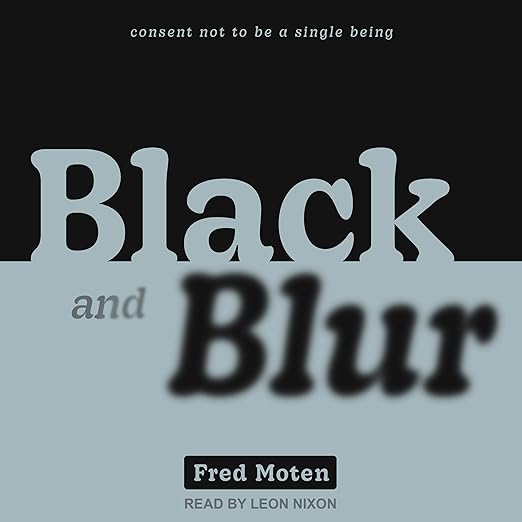
Fred Moten pairs Althusser with the rappers Pras and Ol' Dirty Bastard in the same breath this audiobook takes seriously, and that specific, deliberately unlikely juxtaposition is really the whole method in miniature: what happens when Kant, Adorno, and Shakespeare sit next to Stokely Carmichael, Thornton Dial, and Cecil Taylor without a hierarchy separating high theory from Black vernacular art and politics? Black and Blur is the first volume in Moten's trilogy Consent Not to Be a Single Being, a sustained critical examination of Blackness across African diaspora arts, politics, and everyday life.
Built for Listeners Willing to Pause and Reverse
Leon Nixon narrates at a deliberate, measured pace that gives Moten's dense, compressed academic prose real room to settle rather than rushing past ideas built to be reread rather than absorbed once. He doesn't perform or dramatize the text, correctly so, since Moten's essays work through accumulation and juxtaposition rather than narrative momentum, and a narrator trying to inject false urgency into this material would work against its actual structure rather than serving it.
This is a book built for listeners willing to pause and reverse rather than ones wanting to be carried passively through fourteen and a half hours of continuous audio, since momentum genuinely is secondary to comprehension in critical theory this dense. One reviewer, admitting to having only read parts of it so far, describes it as a book you have to slow down for, by design, and says it rewards exactly that kind of attention rather than punishing an impatient approach to it.
Black and Blur sits at the start of a trilogy, Consent Not to Be a Single Being, whose very title previews Moten's larger project: resisting the idea that Blackness, or identity generally, needs to resolve into one single, stable, easily summarized position. That resistance to easy resolution is audible in the prose itself, sentences that hold multiple ideas in tension rather than settling on one, which is exactly the quality that makes this simultaneously difficult and, per multiple enthusiastic reviewers, genuinely rewarding for a listener willing to meet it on its own terms.
Shakespeare Next to Stokely Carmichael, No Hierarchy
Moten's central argument treats Blackness as a set of social, aesthetic, and theoretical insurgencies responding to a shared modernity founded on the transatlantic slave trade and settler colonialism, not as a fixed identity category to be described from outside. That framing is why the juxtapositions matter rather than reading as academic showmanship: putting Shakespeare next to Stokely Carmichael, or a jazz drummer like Cecil Taylor next to philosopher Theodor Adorno, is Moten's actual method for tracing how Blackness moves across art, politics, and theory without staying contained inside any single discipline's usual boundaries.
One reviewer specifically singles out the sections engaging Marx, C.L.R. James, and Adorno as the parts that spoke to them most directly, a useful data point for a book this wide-ranging: different listeners will likely connect with different intellectual pairings depending on their own background, whether that's jazz and improvised music, Black radical political theory, or continental philosophy. A second, much shorter review simply notes using the book for college, a reminder that this text has real academic-syllabus life alongside general listener interest.
A Rapper's Lyrics Treated Like a Treatise
The book's own stated goal, unsettling normative ways of reading, hearing, and seeing in order to create new means of knowing, is ambitious enough to sound like overreach until the specific essays actually deliver on it: engaging a rapper's lyrics with the same interpretive seriousness as a philosopher's treatise is not a stunt here; it is the book's actual argument that Black vernacular art already contains the theoretical sophistication scholarship sometimes assumes only comes from the academy.
José Esteban Muñoz and Thornton Dial make for a less immediately obvious pairing than the philosopher-and-rapper juxtapositions get credit for: Muñoz, the queer theorist behind Cruising Utopia, and Dial, a self-taught Alabama artist whose sculptural assemblages drew on scrap metal and found materials, represent two very different relationships to institutional recognition, one thoroughly credentialed within the academy, one working entirely outside it. Moten treats both as equally serious interlocutors, which is arguably a quieter but no less pointed version of the same argument the more attention-grabbing philosopher-rapper pairings make more loudly.
4.8 From 47 Ratings, a Small Enthusiastic Audience
That same runtime, spent entirely on compressed academic essay prose that engages Kant and Adorno alongside rap lyrics and visual art in the same paragraph, is a genuinely demanding commitment, and listeners without any prior exposure to critical theory or Black studies vocabulary specifically will hit real friction quickly. This is the first volume of a three-book trilogy, not a standalone argument with its own complete resolution, so listeners should know going in that Black and Blur sets up questions the later two volumes, not part of this listing, continue rather than resolve within this runtime alone. The rating, 4.8 from 47 ratings, suggests a small but genuinely enthusiastic audience rather than broad crossover appeal, consistent with a specialized academic title finding exactly the readership it was written for.
Audio format raises a specific, honest question for material this dense: does hearing sentences built for close, repeated reading work as well spoken aloud as it does on the page, where a reader can physically stop, underline, and reread a single compressed sentence before moving on? Nixon's unhurried pace is the audiobook's actual answer to that problem, functionally encouraging the same pause-and-reverse listening a print reader would do naturally, but a listener driving or exercising without the ability to easily rewind loses something a stationary, attentive listening session would preserve.
Not a Gentle Introduction to Black Studies
Graduate students, academics, and serious readers already working in Black studies, critical theory, or performance studies are the clearest fit, and anyone who has already read Moten's poetry or his other critical work will recognize the same voice and method operating here in essay form. Listeners drawn to the specific intellectual pairing of music criticism and political philosophy, jazz and improvisation discussed with the same rigor as continental theory, will find that combination genuinely rare and well-executed rather than gimmicky.
A gentle introduction to Black studies this is not; listeners new to academic critical theory entirely should recalibrate before starting, since Moten writes for readers already conversant with Althusser, Adorno, and the broader critical-theory vocabulary, and the audiobook doesn't pause to define terms for newcomers. Anyone wanting accessible, narrative-driven nonfiction about race and culture rather than dense academic argument built from philosophical and artistic juxtaposition should look toward a more general-audience title instead. The two remaining volumes of the trilogy, also not included in this specific listing, will matter to anyone who finishes this one wanting Moten's full argument rather than its opening statement.