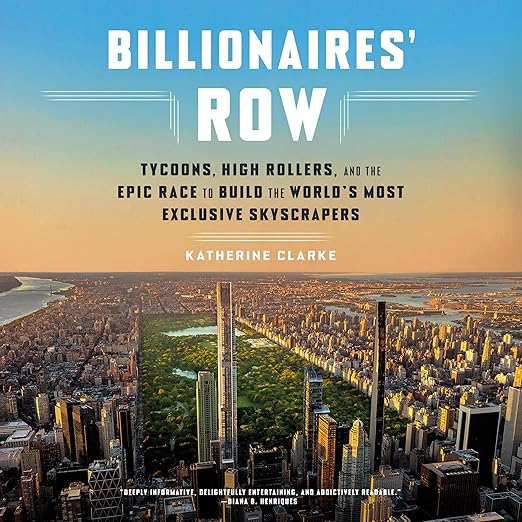
Katherine Clarke's Billionaires' Row, narrated by Kristen DiMercurio, is the story of how a run-down strip of Midtown Manhattan became a forest of slender megatowers selling apartments to the one percent, and it is told with the relentless detail of a Wall Street Journal reporter who spent years building access to the people who made it happen. The audiobook runs twelve hours and seventeen minutes and covers the full arc of the supertall development boom, from the first developer to recognize the potential of air rights above 57th Street through the lawsuits, broken partnerships, and broken marriages that followed the money all the way up to the completed towers. The Financial Times described the book as thrilling, and that is not an overstatement.
Clarke Was in the Room, Not Just Filings
Clarke's access is the book's central asset. She is not reconstructing this story from public filings and quoted press releases; she was in the rooms, or close enough to the rooms that her account reads as fly-on-the-wall rather than synthesized from secondary sources. The developers she profiles, Trump-era veterans going against hungry upstarts in what she calls an ego-fueled race to the sky, are presented with specificity and a certain affectionate contempt. The deal structures, the financing collapses, the moment when a developer signs a contract knowing the anchor sale will never close because the building cannot afford to stop, have genuine narrative drive. A former New York Times correspondent who reviewed the book described it as one of the best well-written business books they had read, which speaks to how Clarke handles the balance between financial granularity and narrative momentum.
What distinguishes this book from standard business journalism is the scale of the ambition it documents. These are apartments sold for a hundred million dollars, sometimes more, to buyers who may never live in them. Clarke does not let that abstraction remain abstract. She traces specific units to specific buyers, documents how the global flow of tech, finance, and foreign capital created a product that exists primarily as a wealth-storage mechanism rather than housing, and connects those individual transactions to the broader machinery of inequality that made them possible. The result is a book that functions simultaneously as a corporate thriller, a social document, and an architectural history of New York City in a very strange decade.
DiMercurio's Dry, Sardonic Take on Bad Taste
DiMercurio's narration is well matched to the material. She brings a dry, slightly sardonic quality to the developer profiles that suits a book that is, at some level, a study in spectacular bad taste executed with genuine genius. When she delivers a line about a developer's strategy for convincing foreign buyers that a paper-thin skyscraper is a reasonable place to store thirty million dollars, the delivery is neither pure comedy nor pure shock; it lands in the register Clarke is aiming for, which is accurate astonishment at how these things actually happen. At twelve hours and seventeen minutes, the audiobook is long enough to build a complete picture of the ecosystem Clarke is describing, and DiMercurio's consistent energy prevents the listen from feeling like a marathon.
The audio format also works well for the book's large cast structure. Clarke is tracking multiple developers, architects, financiers, and buyers across a decade of construction, and keeping them distinct requires a narrator who can differentiate characterization through vocal quality rather than appearance or name tags. DiMercurio manages this effectively throughout the twelve hours: each major player has a consistent register, and the audiobook never produces the confusion that a large cast in a business narrative can generate if narration is undifferentiated.
One Failed Sale From Stopping Construction
The financing chapters are the most technically demanding sections and the most rewarding. Clarke explains how developers used construction loans, condo presales, and debt structures that depended on the building's own sales to finance its continued construction, meaning that some of these towers were, at certain points, one failed sale away from stopping entirely. The fragility of that model is part of what gives the race-to-the-sky framing its genuine stakes: this was not just ambition but structural precarity dressed as certainty to buyers and lenders alike. Listeners who follow the financing closely will understand the drama of the later chapters on a different level than those who skim through the technical sections.
The inequality dimension is also worth tracking throughout the full twelve hours. Clarke does not deliver it as polemic but as documentation: each hundred-million-dollar transaction is set against the housing situation for ordinary New Yorkers at the same moment, and the contrast accumulates into something harder to dismiss than a single editorial argument would be. One reviewer noted the book was sometimes a bit too detailed and technical for their tastes, which is a fair warning for listeners who want momentum over granularity, but for readers of real estate and business journalism, the density is precisely the point.
Wealth as Ridiculous and Fascinating at Once
This audiobook is for anyone who finds extreme wealth simultaneously ridiculous and fascinating, which is a large demographic that extends well beyond the real estate industry. It works for readers of business narrative, New York history, and investigative journalism without requiring specialist knowledge in any of those areas. Those looking for straightforward economic analysis or policy argument will find this more entertaining than instructive; those who want to understand how extreme inequality manifests in physical space will find it both entertaining and genuinely illuminating.
- Performance: Kristen DiMercurio handles the dense real estate deal-making and cast of ego-fueled developers with even pacing and a dry wit that suits the material's inherent absurdity.
- What it covers: extreme wealth inequality, real estate ambition, New York City transformation
- Feel: Gleefully gimlet-eyed
- Our call: Katherine Clarke's account of how 57th Street became the most expensive strip on Earth reads like the most elaborately sourced real estate investigation ever assembled, and DiMercurio's narration delivers every revelation at exactly the right temperature.
Questions Listeners Ask
Does this audiobook require knowledge of real estate finance to follow the story?
No. Clarke builds the financial concepts into the narrative as they become relevant, and DiMercurio's narration handles the technical sections with enough clarity that listeners without real estate background can follow the deal structures without prior knowledge.
Is the audiobook version of Billionaires' Row as detailed as the print edition?
Yes. Clarke's reporting is fully present in the audio version, and DiMercurio's twelve-hour performance covers the complete text. Reviewers who described it as sometimes too detailed noted that the detail is a feature for many listeners rather than a flaw.
Does this audiobook cover specific buildings or is it a general account of the supertall phenomenon?
Both. Clarke profiles specific towers and the developers behind each one in considerable detail, using the individual projects as case studies for the broader economic and cultural dynamics she is documenting. The specific buildings become characters in the larger story.
How does this audiobook handle the question of who actually buys these apartments?
Clarke traces specific units to specific buyers where her access allows, documenting the global flow of tech, finance, and foreign capital that created a hundred-million-dollar apartment market. She connects individual buyers to the broader inequality structures that made them possible without editorializing.