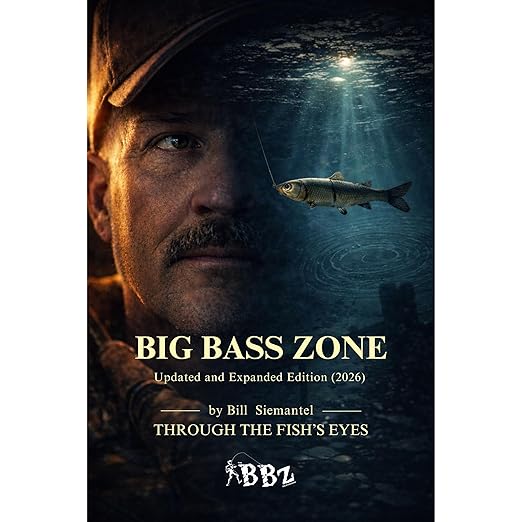
Bill Siemantel's Big Bass Zone (Updated and Expanded Edition 2026) is the audiobook revision of his 2005 landmark, arriving as a genuinely expanded work rather than a lightly refreshed repackaging. At 4 hours and 26 minutes narrated via Virtual Voice, this is a fishing strategy guide organized around a specific philosophy: that the 2 percent of anglers who consistently catch trophy-class bass are not operating on better secrets but on a fundamentally different way of seeing water. The original book, which Siemantel describes as having given a generation permission to hunt rather than simply fish, has now been rebuilt to incorporate two decades of additional observation and the modern sonar technology that he argues validates his foundational theories.
Is Big Bass Zone (Updated and Expanded Edition 2026) Worth Your Time?
Siemantel's central conceptual contributions in this expanded edition are the Universal LLL system, Shadow Theory, and Suspended Animation, each of which extends his original spot-on-spot philosophy into new analytical territory. The LLL framework moves from locating a productive general area down to identifying the specific L-shaped corner within that area where a predator is most likely to be holding, a geometric precision that distinguishes strategic hunting from opportunistic casting. Shadow Theory asks anglers to treat light and darkness as dynamic variables affecting predator movement, essentially functioning as an invisible tide that governs when and where fish hold throughout a day. These are not gimmicks dressed in terminology: the logic behind each framework is developed with the specificity of someone who has spent serious time testing hypotheses on real water.
The Forward-Facing Sonar integration is where the 2026 edition most visibly updates the original. Siemantel's argument is that most anglers use FFS to locate fish and then revert to instinct, missing the behavioral information the technology actually provides. He teaches how to read geometric posture and intention on screen, combining modern digital vision with the predatory psychology framework he has been developing since 2005. For anglers who have invested in FFS equipment and are not seeing consistent results, this section alone justifies the purchase. Reviewer Chris describes it as providing good insightful new perspectives, which undersells it somewhat but confirms the core value is real.
The Suspended Animation concept, which Siemantel describes as the highest form of the hunt, addresses how to make a lure hover and hesitate convincingly in the exact geometric void where a trophy-class predator expects its prey. This is technical craft at the highest level of the sport, and the audiobook explains it with enough precision that experienced anglers can begin applying it immediately rather than waiting to understand the full framework first.
The practical case for the audiobook over the print edition depends largely on how you absorb technical fishing content. The material is conceptually dense: framework builds on framework, and terminology like Universal Predator's Template, Flutter Nymph precision tools, and Synthesized Angler's Creed requires active engagement to absorb and retain. The audiobook works best for anglers who plan to listen to sections repeatedly or who drive significant distances to fishing locations and can use the travel time purposefully. At 4 hours and 26 minutes, the complete audiobook is manageable across two or three long drives, creating a practical alignment between listening and application.
The content value is highest for anglers who have plateaued at an intermediate level and are looking for a conceptual framework to explain why certain patterns produce consistently and others do not. Siemantel's philosophical approach to predator behavior offers something that technique-focused fishing content generally does not: a reasoning structure that transfers across species and conditions rather than a collection of situation-specific tactics. The Universal Predator's Template explicitly extends the framework to pike, muskie, and other ambush species, which broadens the audiobook's usefulness beyond dedicated bass anglers.
Before You Commit to Big Bass Zone (Updated and Expanded Edition 2026)
Virtual Voice narration is a practical limitation here. The conceptual passages that require emphasis and conviction, particularly the sections where Siemantel is arguing for why his framework changes the way anglers should see water, lose something without a human performer's ability to signal importance through pacing and intonation. Listeners may find it useful to note timestamps on sections they want to revisit, since the Virtual Voice delivery makes it harder to use tonal cues as memory anchors the way a skilled human narrator provides.
The organization across Parts IV through VI, which cover the new material not in the 2005 edition, is more advanced than the foundational chapters and assumes familiarity with the original BBZ framework. Anglers coming to Siemantel for the first time through this expanded edition may want to listen to the foundational chapters twice before advancing, since Shadow Theory and Suspended Animation build explicitly on the spot-on-spot foundation. The single available review notes new perspectives on bass fishing, which signals that even readers with prior familiarity find genuine fresh material rather than repackaged content.
Should You Listen to Big Bass Zone (Updated and Expanded Edition 2026)?
Intermediate to advanced freshwater anglers targeting trophy-class fish who want a strategic framework rather than technique instruction will find the most value here. Anglers who have recently invested in Forward-Facing Sonar and are not translating screen information into consistent results should prioritize the FFS synthesis chapters specifically. Beginners looking for foundational fishing instruction will struggle with the density of the conceptual framework before they have the on-water experience to contextualize it. The Virtual Voice narration is a real compromise for listeners who absorb technical content best through audio, but for anglers already familiar with fishing strategy literature who can engage actively while listening, the content quality is high enough to overcome the production limitation.
The Short Version
- Performance: Virtual Voice narration handles the dense technical content with adequate clarity, though the absence of a human performer means the more philosophical passages about predator psychology lack the enthusiasm Bill Siemantel himself would bring.
- What it covers: Predator psychology, strategic fishing versus reactive fishing, the integration of modern technology with foundational technique
- Feel: Dense and methodical, best absorbed in shorter focused sessions rather than extended consecutive listening
- Our call: Siemantel's expanded system is substantive fishing writing for anglers willing to engage with its conceptual framework, though the Virtual Voice narration adds a cognitive layer that human narration would not.
A Few Questions About Big Bass Zone (Updated and Expanded Edition 2026)
Does this audiobook require familiarity with the original 2005 Big Bass Zone book?
Not strictly, but the 2026 expanded edition builds directly on the spot-on-spot foundation from the original. New readers will benefit from paying close attention to the foundational chapters early in the audiobook before the advanced concepts in Parts IV through VI are introduced, as Shadow Theory and Suspended Animation both assume the earlier framework.
Is the Big Bass Zone audiobook useful for species other than largemouth bass?
Yes. Siemantel explicitly frames his Universal Predator's Template as applicable to pike, muskie, and other ambush predators. The geometric and photonic principles he teaches are designed to transfer across species that share similar predatory behavior patterns.
What is Virtual Voice narration, and does it work for this type of technical fishing audiobook?
Virtual Voice is AI-generated narration rather than a human performance. For technical fishing content organized around conceptual frameworks, it handles the material adequately but lacks the tonal variation a skilled human narrator would use to signal importance and maintain engagement across dense passages.
How does the Forward-Facing Sonar section in this audiobook differ from other fishing content covering FFS technology?
Siemantel treats FFS not as a fish-finding tool but as a behavioral lab for validating strategic theory. He teaches anglers to read geometric posture and predator intention on screen, which is a more analytical application than most FFS instruction provides and directly bridges his foundational predator psychology with real-time digital data.