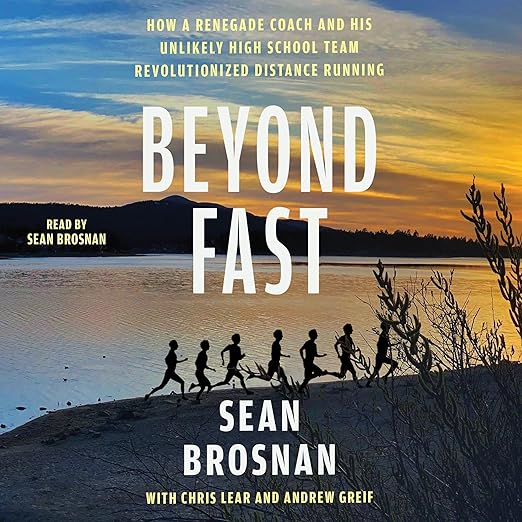
Newbury Park High School's cross country team had not qualified for a California state championship in twenty-five years when Sean Brosnan walked through the door in 2016. That fact alone tells you how steep the climb was. Brosnan's audiobook, narrated by the author himself, puts you on that first practice run with a group of teenagers who had no reason to believe anything historic was about to happen. And yet it did: three consecutive national championships, records demolished, Olympic berths earned. I listened across two back-to-back long runs of my own, and the timing felt exactly right. Brosnan's voice has the cadence of a coach who has spent years explaining not just what to do, but why.
What Sean Brosnan Delivers
Brosnan narrating his own story is not a vanity choice here. His voice carries the specific compression of someone who has spent years coaching teenagers and distilling hard lessons into sentences they will actually remember. He does not dramatize his own heroism. If anything, he is notably honest about the seasons that went sideways, the athletes who were crushed by expectation, and the moments where his methods needed rethinking. That kind of candor is rare in sports memoir, where the temptation to present a clean arc from underdog to glory is almost irresistible. Beyond Fast resists it with something more interesting than modesty: a genuine curiosity about why certain things worked and others did not. The narration benefits from the intimacy of a first-person account, but also from the fact that Brosnan clearly knows how to build a workout and a sentence with equal economy.
The coaching methodology at the center of this audiobook is worth the runtime on its own. Brosnan trained under some of the sharpest minds in American distance running, including Alberto Salazar, Steve Scott, and Jerry Schumacher, and he brought those lessons to a public high school in Ventura County without pretension about the gap between elite athletics and Thursday afternoon practice on a hot asphalt track. One reviewer, Geoffrey J. Wilhelmy, described Brosnan as 'relentless' and noted that for him, 'faster could always be faster.' What the audiobook captures is how that philosophy translates when your athletes are sixteen years old, carrying the weight of school and family alongside their training logs. Brosnan does not treat his runners as raw material. The book returns again and again to the relationships between coach and athlete, and why belief communicated from one person to another is the infrastructure that makes physical training possible at all.
Beyond Fast also succeeds because it is structured honestly around setbacks rather than around the championships. Brosnan devotes real attention to the runners who did not make the roster, to the seasons where injury derailed promising careers, and to the psychological demands of sustaining elite performance across multiple years. This is not a narrative where everything goes right except for one memorable obstacle. It is a narrative where things go wrong regularly and the question is always what happens next. Listeners who have followed high school athletics at any level, or who have been a teenager trying to prove something, will recognize the texture of that uncertainty even if they have never laced up a racing flat in their lives.
Where Sean Brosnan Loses Some Ground
A few structural elements are worth flagging before you hit play. Brosnan wrote this as a participant, which means the perspective occasionally narrows in ways that a more distanced author might not choose. His own coaching decisions are almost always framed sympathetically, and while he acknowledges friction, the athletes' interior lives are rendered from the outside. That is a legitimate constraint of first-person sports memoir, but readers hoping for deep access to the runners themselves may find the framing occasionally limiting. The athletes are vivid and well-drawn, but Brosnan is always the lens through which we see them.
The pacing also compresses the later championship runs somewhat. The early seasons, where the team was finding itself and Brosnan was still calibrating his approach to high school athletes, receive richer treatment than the period when Newbury Park had become a known national force. This is understandable, since the early chapters carry more dramatic uncertainty, but it means the climactic races sometimes feel slightly rushed relative to the buildup they receive. None of this undercuts the book's achievement. It is a precise and honest account of something genuinely extraordinary in American high school athletics, and Brosnan tells it without inflating his own role beyond what the record supports.
One element worth pausing on is how Brosnan handles the Olympic dimension of the story. Several of his runners competed at the international level, which represents a scale of achievement almost never associated with a California public high school's cross country program. Brosnan writes about those moments with the restraint of someone who understands that saying less communicates more. He does not inflate the significance of what his athletes accomplished. He describes it with the plainness of someone who was there and found it almost difficult to believe even as it was happening. That restraint is what keeps the audiobook from becoming a trophy collection and makes it instead a genuine investigation of how one coach and one group of teenagers built something that had never been built before.
Who Should Pick Up Beyond Fast
Runners, coaches, and parents of competitive athletes will find this audiobook immediately useful and absorbing in equal measure. It is equally rewarding for anyone curious about the psychology of high performance, the mechanics of coaching belief into a team, or the particular culture of cross country running in California. Listeners who need a narrative propelled primarily by interpersonal conflict or dramatic personal transformation beyond the athletic may find the scope narrower than they prefer. This is a book about a coach and a team, not a single protagonist's emotional arc, and it earns its subject without apologizing for that specificity.