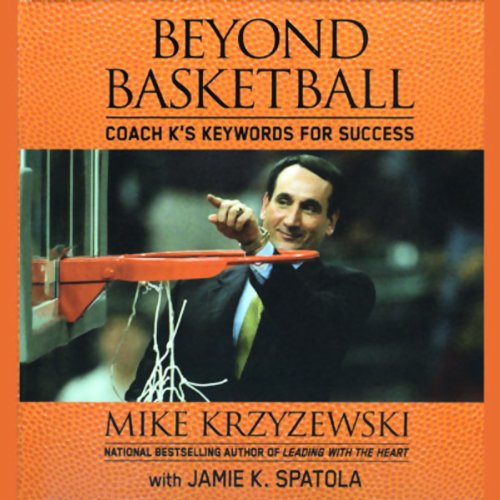
Duke head coach Mike Krzyzewski narrating his own audiobook Beyond Basketball is, in itself, the central editorial decision. Coach K has spent decades in the locker room and on the sideline communicating to athletes under extraordinary pressure, and the 3 hours and 32 minutes of this self-narrated audiobook carry a quality that no hired narrator could replicate: the weight of someone who has actually inhabited every lesson he is offering. When he pauses between words, you understand that the pause means something.
Beyond Basketball collects short essays on the principles Krzyzewski has used to build one of the most sustained winning programs in college basketball history. The book's premise is explicit in its title: the lessons are not about basketball. They are about what basketball demands of the people who pursue it seriously, and how those demands develop capacities that translate directly into leadership, integrity, and meaningful relationship. One reviewer described the collection as an abundance of wisdom within each short essay on various life challenges on and off the court, which is accurate. The essays are short. The wisdom density is high.
What Mike Krzyzewski Delivers
The self-narrator memoir format is not without its risks. Authors reading their own work can be monotonous, can lack the technical range of professional narrators, can flatten their own material through overexposure. Krzyzewski avoids these traps not through technical narration skill but through genuine authority. He is not performing these essays. He is delivering them in the same register he uses to speak to players: directly, with the assumption that the listener is capable of handling unvarnished truth, and with a conviction that feels earned rather than performed.
The format works particularly well for the kind of content this audiobook contains. These are not extended arguments requiring sustained narrative momentum. They are discrete essay units, each built around a specific principle or experience, and the short-form structure means that each listening session, even a brief one, delivers a complete unit of thought. Reviewers have described it as a great tool that one can call upon and glean valuable insights quickly, and the audiobook format amplifies that quality. A drive, a lunch break, a short run: each is enough to absorb one or two essays fully.
What Mike Krzyzewski Gets Right
Krzyzewski's program at Duke has produced a record of sustained excellence that puts him in a rare category: coaches who have maintained competitive relevance across multiple decades while also developing players who speak highly of their experience rather than merely their results. That dual record gives the leadership principles in Beyond Basketball a specific credibility. He is not theorizing about how to motivate people under pressure. He has done it repeatedly, across generations of different athletes, in environments where failure is public and stakes are high.
One reviewer offered an observation worth quoting in full: as a collective unit in society, we see the same picture but sometimes from a different perspective or in different lighting. Words are not like a different lighting; words have meaning. That observation captures something important about what Krzyzewski is doing in this collection. He is arguing that the words we choose to describe our situation and our relationships to other people are not decorative but constitutive: the language shapes the reality. The essay on collecting and owning words, which that reviewer references, is one of the most distinctive pieces in the audiobook, less basketball-specific than most and more broadly philosophical.
Things to Know Before Starting Beyond Basketball
The essays function as a kind of moral vocabulary, a set of terms and frameworks that Krzyzewski returns to across different contexts and applications. Listen for the recurring emphasis on collective identity rather than individual achievement: the word team is doing specific philosophical work in his usage, not just describing a competitive unit but articulating a vision of how people should relate to each other when they share a common purpose. That vocabulary is what the book is really teaching, and recognizing it as a system rather than a collection of separate insights makes the audiobook more coherent.
The connection between athletic development and character development is the through-line across all the essays, and Krzyzewski is careful not to romanticize this. He acknowledges that competitive environments can bring out the worst as well as the best, and that the coach's job is specifically to create conditions where the best is more likely to emerge under pressure. That kind of honest accounting of what sports actually does to people, as opposed to what it is supposed to do, elevates the collection above inspirational boilerplate.
One of the most distinctive qualities of the self-narrator format in this specific audiobook is the absence of distance between the principle being articulated and the person who has lived it. When Krzyzewski discusses the obligation to be honest with the people you lead, even when that honesty is painful, you are hearing that from someone who has had to tell recruits they would not be starting, tell star players their form had deteriorated, tell families that their son would need to find a different program. The weight of those specific, real conversations is present in his delivery without being named. That is what separates a practiced speaker from a polished reader, and the audiobook format captures it in a way that the printed page cannot fully replicate.
Who Should Pick Up Beyond Basketball
Athletes at any level who want to understand how competitive pressure can be channeled into lasting character development will find this audiobook rewarding. Parents of young athletes, coaches working with youth or amateur players, and professionals in high-stakes leadership positions who want a compact and direct framework for motivating and developing people will also find genuine value here. Those seeking extended narrative accounts of specific games or seasons should note that this is an essay collection rather than a memoir of Krzyzewski's career: the basketball is the backdrop, not the subject. At under four hours, it rewards repeated listening: the essays are designed to be returned to rather than read once and shelved.