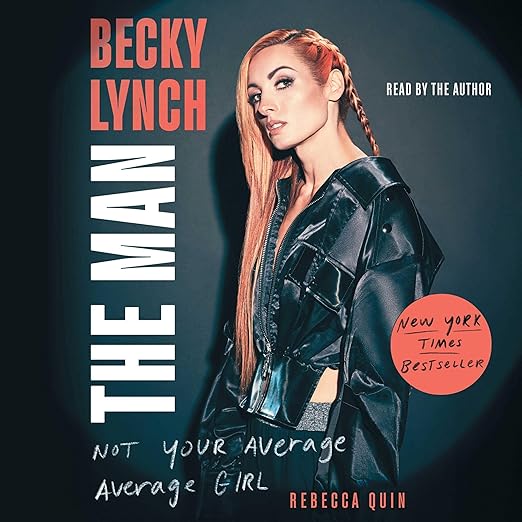
How many titles does one memoir need? The listing calls this Becky Lynch: The Man. The author field says Rebecca Quin. The publisher's description introduces a WWE superstar, a.k.a. The Man, a.k.a. Becky Lynch. And the first reviewer in the column supplies a fourth name entirely, quoting the book as The Man: Not your average average girl, doubled word included. For an audiobook whose declared subject is the distance between a person and the character she plays on television, a page that cannot settle on what to call the thing is almost too apt to be accidental.
What We Made of It
Rebecca Quin reads it herself, and here that is considerably more than a courtesy credit. The description says the book was culled from decades of journal entries. Journals are private writing, and private writing read aloud by the person who wrote it produces something no hired narrator can manufacture: you hear where the writer still winces. Nine hours and fifty-eight minutes of that amounts to a long, close sit with somebody going back through her own notebooks in public.
Dublin is where the copy starts her, in a devoutly Catholic family, inventing new ways to worry her mother. Roughhousing with the neighborhood kids, secret parties while the parents were away, enrolling in a warehouse wrestling school, nearly breaking her neck, almost kneecapping a WWE star before her own career had started at all. As jacket copy that paragraph is unusually well built, and as audio it gains something further, because it is material that improves when the person it happened to is the one saying it.
Why Listen to Becky Lynch: The Man
The four-star review from Cynthia Vespia matters more than any other for anyone choosing between formats, and it never once mentions audio. The book is good, it says, especially for a fan, but some of it reads awkwardly. The entry credits Quin for wanting to write the thing herself and faults the editor for not cleaning up sentence structure and punctuation. Hold onto that, because it describes exactly the problem a self-narrated recording answers: an author reading her own prose supplies the punctuation with her breath, and awkward sentence structure stops being something you can see.
Kate opens a scoring rubric and is cut off inside it. Writing Style: 9, the review announces, and the assessment underneath breaks off before it finishes a word. What survives is the useful half anyway: pulling the curtain back on what happens backstage, on how a wrestling storyline gets developed or fails to, and an open question about whether the book breaks the wall that keeps the character separate from the person performing it. That question is the memoir's actual subject, and a reviewer spotted it.
Stephanie Romano's entry is the only place in this column where anybody says the word audiobook, and the sentence does not survive to the end. Becky's personality comes out of the pages, the review reports, and then: I listened to the audiobook as I was reading the physical book and it jus. There the field stops. Whatever the recording did alongside the print, that listener knew and this page declines to pass it on, which is a small tragedy on a listing where the narrator and the author are the same person.
What Might Not Land
Nine hours and fifty-eight minutes is a substantial sit, and one reviewer accounts for where the length goes: the book is broken into three sections called seasons. That is a structural idea borrowed from the business itself, and it signals that the memoir has a shape somebody designed. Whether it also moves in a straight line from childhood to championship is something the copy declines to say, and worth knowing before you settle in for ten hours.
Patti eiseman's five-star review is the one to read for content, and it doubles as a demonstration of how little proofreading a review column gets. It calls the memoir amazing, describes it as the wrestling industry seen from a woman's point of view, and praises its promotion of empowerment in a male-dominated field. It also doubles a word inside the title it quotes, writes point a view where it means point of view, and has the author succeeding has a professional wrestler. The enthusiasm is perfectly legible. The typing is not.
Taliya's entry, filed from Saudi Arabia in April 2025, carries a headline about the item looking the same as the picture, and a body of two short sentences: the biggest Becky Lynch fan, recommending it to like everyone. Five stars. A remark about a photograph is not a remark about a recording, and it lands in the average carrying exactly the weight of the entries that are. The dates repay a glance as well. Four of these five entries land within four months of the March 2024 release, the earliest of them three days after it, and the fifth arrives more than a year later. This is a book that was read fast by the people who had been waiting for it.
Two blurbs sit at the head of the description doing quite different jobs. Steve Austin contributes infectious and contagious, which is enthusiasm doing the work of description. Publishers Weekly contributes endearing debut memoir, which is a verdict with a small reservation folded into it, since endearing is the compliment you pay a first book. Between the two, the copy tells you roughly what waits: warmth, candor, and a writer at the beginning of writing. Simon and Schuster Audio is the imprint, which puts a professional studio between the journals and the file you download, whatever the sentences were doing on the page.
Who Should Pick Up Becky Lynch: The Man
Wrestling fans have an obvious yes, and so does anyone who wants a sports memoir written by the athlete rather than assembled around her. The description is direct about the ambition: change a culture that aimed antiquated disrespect at the women in the ring, and earn a place among the greatest of them. Four of the five written entries award five stars here, and the fifth awards four.
Anyone from outside wrestling should weigh that four-star review first, since its objection concerns prose and not subject matter, and prose is precisely what this format alters. Listeners hoping for a full production with entrance music and archive audio should recalibrate: what this is, for ten hours, is one woman and her journals.
The Short Version
- Narration: Rebecca Quin reads her own journals, which is the strongest argument this page makes for the recording over the print
- Themes: Wrestling as escape, women inside a male-run industry, the gap between a person and a television character
- Mood: Candid, restless, unpolished in a way that suits the material
- Verdict: Even the reviewer who docked a star for awkward prose was describing the exact problem a self-narrated recording tends to solve.