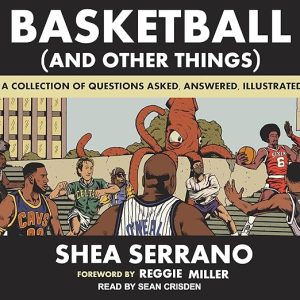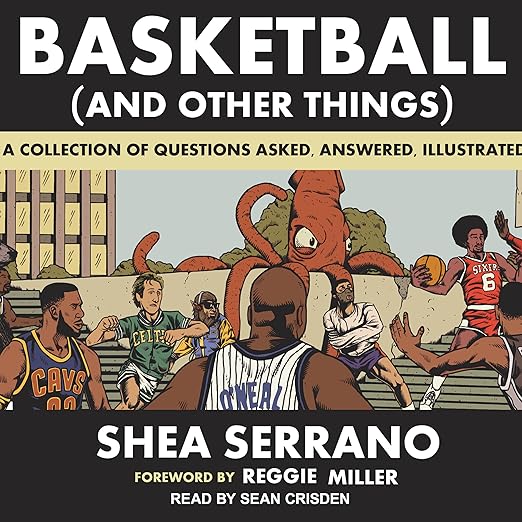
Quick Take
- Narrator: Sean Crisden has no prior track record in our reviews, but he handles Serrano's rapid tonal shifts between mock-serious argument and outright joke with real restraint, never over-signaling a punchline.
- Subjects: Sports fandom as cultural criticism, basketball trivia elevated to genuine argument, comic digression as structure
- Tone: Loose, funny, and argumentative in the best pickup-game sense
- Bottom line: A strong pick for existing Shea Serrano fans and NBA obsessives who want their basketball writing to double as comedy.
Kobe Bryant's dork potential became dinner-table debate material within the first hour of Shea Serrano's Basketball (and Other Things) audiobook, and that argument is a fair preview of what thirty-three chapters of this book actually deliver. Serrano built his follow-up to The Rap Year Book around a single format: pick a basketball question, some obviously important, some secretly important, and chase it as far as it will go, whether that means ranking legacy-defining championships or working out exactly how embarrassing Kobe's own self-given nickname habit really was. The questions sound like bar arguments because they are bar arguments, the kind pickup-game regulars have been having for decades, except Serrano writes them with an essayist's patience and a comedian's sense of when to let a bit run too long on purpose. I listened to a good chunk of this on a long highway drive, and it turned out to be exactly the right setting for material built on tangents.
Our Take on Basketball (and Other Things)
What holds thirty-three loosely connected chapters together is Serrano's own comic voice, which treats an NBA question with the same rigor a philosophy professor might bring to a genuinely hard problem, then undercuts that rigor with a joke two sentences later. The chapter interrogating whether Kobe Bryant was, in fact, a dork works precisely because Serrano refuses to just say yes or no; he builds a case, cites specifics, and lets the absurdity of taking the question seriously become part of the argument. Reviewer J. Dollins compares this book directly to The Rap Year Book, Serrano's earlier collection, and the comparison holds: both books turn pop-culture minutiae into something closer to cultural criticism than trivia, without ever losing the listener who just wants to laugh at a joke about the Staples Center.
The synopsis warns upfront that some chapters go sideways on purpose, one becomes the script of an action movie, another is nothing but lists, and Serrano is right to flag it, because that structural looseness is either the book's biggest strength or its biggest risk depending on what a listener wants from nonfiction. In print, an odd formatting experiment like a screenplay-formatted chapter is easy to skim past; in audio, every chapter gets the same continuous narration regardless of how it was originally laid out on the page, which changes how those experimental bits land. I found the action-movie chapter funnier read aloud than expected, mostly because hearing dialogue delivered straight instead of skimmed on a page makes the joke's commitment more obvious.
Why Basketball (and Other Things) Works as an Audiobook
Sean Crisden narrates, and this is a first appearance in these pages, with no track record to lean on beyond this single book, which makes an honest assessment more useful than a confident one. What the material demands is comic timing that can shift from mock-serious argument to genuine enthusiasm within a single paragraph, since Serrano's prose does exactly that constantly, and Crisden handles the tonal whiplash without ever signaling too hard that a joke is coming. He reads Serrano's rhetorical questions the way a good stand-up reads a setup, letting the pause do the work rather than the inflection. That restraint matters more than it might sound like it should, because a narrator who leans too hard into every punchline can exhaust a listener across eight and a half hours, and Crisden mostly resists that temptation.
The audiobook format also suits a book built from linked but independent chapters better than a traditional narrative would, since listeners can treat individual chapters as standalone segments during a commute without losing a larger plot thread, given that none of the chapters depend on a throughline to begin with. Reviewer Jacob Cole's review, admittedly the most enthusiastic of the three attached here, describes never having written a review before and feeling compelled to make an exception for this book, which says less about the book's objective quality than about the specific kind of devotion Serrano's fans bring to his work, and that devotion translates cleanly to an audio format built for repeat, comfort listening.
What to Watch For in Basketball (and Other Things)
The rating attached to this listing shows 4.8 stars from a single rating, which is not enough of a sample to treat as a real signal one way or the other, so weigh the three written reviews more heavily than the number sitting next to them. All three lean positive, but reviewer McMamba's take is worth reading closely for its specificity: singling out a joke about renaming a minor character's fake ID from McLovin to McMamba as worth the price of admission alone is the kind of granular praise that only comes from someone who has actually sat with the material rather than skimmed it for a star rating.
Listeners expecting a conventional basketball history or a stats-driven analytical book should recalibrate before starting, because that is not what this is; the humor is the point, not a garnish on top of serious sports writing, and a handful of chapters exist purely as comic set pieces with only a loose connection to basketball at all. The list-only chapter mentioned in Serrano's own introduction is a genuine departure from anything resembling narrative prose, and while it works as a change of pace in a printed book a reader can flip through quickly, an audio listener has to sit through its full runtime at whatever pace Crisden reads it, which is worth knowing going in.
Who Should Listen to Basketball (and Other Things)
This audiobook rewards existing fans of Serrano's voice most directly, especially anyone who already loved The Rap Year Book and wants more of the same blend of pop-culture obsession and structural playfulness applied to a new subject. NBA history buffs will get real value from the more analytical chapters, the ones ranking legacies and dissecting specific playoff moments, even if they roll their eyes at the sillier detours. General nonfiction listeners who enjoy Chuck Klosterman's brand of pop-culture argument-making, treating a trivial-sounding question as worthy of genuine intellectual effort, will find a comparable energy here, translated into a specifically basketball-obsessed register.
Listeners who want their sports writing straight, without comic detours or formatting experiments, should look elsewhere, and anyone allergic to a book that openly admits some of its own chapters do not fully work will find that self-aware unevenness more grating than charming. For everyone else, especially anyone with a long commute and a working knowledge of NBA trivia, eight and a half hours goes by fast. It is a book built for laughing out loud alone in a car, which is a specific and real use case worth taking seriously.
Questions Listeners Ask
Do I need to have read The Rap Year Book before listening to the Basketball (and Other Things) audiobook?
No. The two books share Shea Serrano's voice and structural approach but cover completely different subjects, so this audiobook works fine as a standalone entry point even for listeners new to his work.
Does the Basketball (and Other Things) audiobook work for listeners who are not deep NBA fans?
Partly. The chapters built around specific legacy and championship debates reward real NBA knowledge, but several of the funnier, more tangential chapters land regardless of how closely a listener follows the league.
Is the chapter written as a movie script performed differently in the audiobook?
It is narrated straight through like the rest of the book rather than given a dramatized multi-voice treatment, so listeners expecting a shift in production style for that chapter should adjust their expectations accordingly.
How reliable is the 4.8-star rating on this listing?
Not very, since it is built from a single rating rather than a meaningful sample; the three full written reviews attached to the listing give a more useful sense of reception than the star average does.