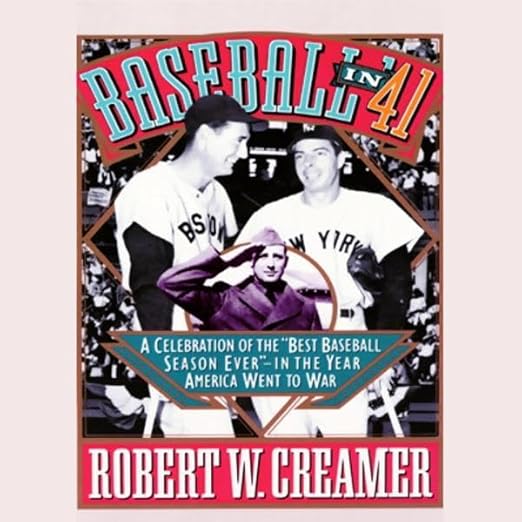
Robert Creamer's Baseball in '41 makes a case that deserves to be heard on its own terms: 1941 was the greatest baseball season ever played, and the reason is not simply the numbers but what the numbers meant inside a specific moment in American life. Tom Parker's narration of this eight-hour-and-forty-six-minute audiobook gives Creamer's argument the proper space to unfold. The book weaves three threads together: Joe DiMaggio's 56-game hitting streak, Ted Williams's .406 batting average, and the Brooklyn Dodgers versus New York Yankees World Series clash. All three are set against the particular atmosphere of a country that knew a war was coming and was not yet ready to say so. That combination of athletic history and cultural memoir is what separates this audiobook from ordinary sports retrospective.
Creamer is not a neutral observer. He was eighteen in 1941, a baseball fan watching these games in real time, and he brings to this account both a journalist's discipline and a participant's memory. The result is a book that operates as cultural history, sports analysis, and personal memoir simultaneously, with each layer informing the others without crowding them out.
What Makes Baseball in '41 Worth Hearing
Parker's narration suits the material's register. This is not a fast-paced statistical analysis or a tabloid sports biography. Creamer writes with the measured pace of someone who lived through the events being described and wants to convey not just what happened but what it felt like to be paying attention to baseball while also paying attention to what was happening in Europe and the Pacific. Parker honors that pace without letting the narration become slow. He moves through the material with the same combination of gravity and genuine affection that Creamer brings to the writing.
The central achievements of the 1941 season deserve the time Creamer spends on them. DiMaggio's 56-game hitting streak remains unbroken more than eighty years later, and Creamer explains not just what happened day by day during the streak but why the number matters and why no one has approached it since. Williams's .406 average, which he refused to protect by sitting out the season's final day when he could have, is treated as a statement about character as much as athleticism. These are not just statistics. Creamer understands them as expressions of what these particular men were, and Parker's narration carries that understanding without sentimentalizing it.
A reviewer noted that the book delivers baseball and social history and memoir in one, which is the most accurate description of what Creamer sets out to do. The social history element is not background noise. The looming war shapes the 1941 season in ways Creamer traces with care, and the book's final movement, as the season ends and America prepares for what is coming, gives the baseball history an elegiac quality that a less historically minded author would not have found.
Things to Know Before Starting Baseball in '41
Listeners who want statistics-first sports history, dense with sabermetric context and comparative analysis across eras, will find Creamer's approach more personal and contextual than that frame demands. The book is not primarily a statistical argument for 1941's greatness. It is a qualitative argument: this season mattered this much because of these specific people doing these specific things at this specific moment, and Creamer experienced it. The memoir dimension is not a digression from the sports history. It is the organizing principle.
The World Series coverage, in which the Yankees and Dodgers played a series remembered partly for Mickey Owen's dropped third strike in Game 4, receives appropriate weight. Creamer was a Dodgers fan, and his account of that Series does not pretend to the objectivity of someone who did not have a stake in the outcome. That admitted partiality is part of what makes the book read as memoir rather than record, and Parker's delivery of those sections carries the appropriate mixture of retrospective humor and genuine remembered pain.
Listeners who arrive with no knowledge of 1941 baseball will need a brief orientation. Creamer assumes a certain baseline familiarity with the era and its players, and those who encounter DiMaggio and Williams primarily as cultural references rather than athletic presences may want some supplementary context. The book was written for an audience that remembered the 1941 season or grew up around people who did. Eight decades later, that audience requires some bridging, and Parker's narration does not provide much of it. That is not a flaw in the narration but an honest description of the book's assumptions.
Who Should Pick Up Baseball in '41
This audiobook is for baseball history enthusiasts who want a book that takes seriously the intersection of sport and American life in the years before World War II. Listeners who appreciate memoir-inflected sports history, who want the texture of a specific era alongside the athletic achievement, and who find DiMaggio's streak and Williams's average genuinely interesting as human accomplishments rather than just statistical records will find Creamer's account deeply satisfying.
Those who want statistics-forward analysis, a primarily contemporary frame for 1941 material, or a book that does not require background knowledge of the era may find the register less useful. For anyone who loves baseball as more than a sport, as a document of American social life across decades, Creamer's account of 1941 is as good a piece of baseball writing as the genre has produced, and Parker brings it home with the narration it deserves.