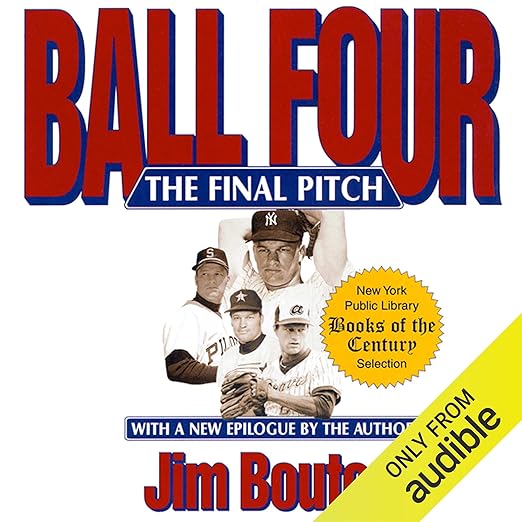
Barry Pearl reread this book after thirty years and filed the result on November 25, 2000, more than eleven years before the audiobook it now sits under was published. It is not the book I remembered, that response says. It's better. Whatever page those words were originally written for, they have arrived here attached to eighteen hours and thirty-nine minutes of Jim Bouton reading his own 1969 diary, and the mismatch deserves naming first, because it sets the pattern for everything else stacked below it.
A Closer Look at Ball Four
Jim Bouton's name fills the writing credit and the reading credit both, and for this particular title that doubling amounts to a structural argument. Ball Four is a diary. Somebody wrote things down in a locker room across a single season, kept writing them down, and then published the lot, and the firestorm that followed was entirely about whether a player had the right to say those things out loud. Having the same person say them out loud a second time, into a microphone, is not a neutral production decision. It is the book performing its own premise.
Bowie Kuhn, the commissioner, tried to make Bouton sign a statement declaring the book untrue. Ballplayers who had not read it denounced it anyway. A few libraries banned it outright. Bouton collected the words Judas, Benedict Arnold and social leper for having violated what the copy calls the sanctity of the clubhouse. Meanwhile David Halberstam, fresh from a Pulitzer for reporting on Vietnam, wrote in Harper's that Bouton had produced a book deep in the American vein, so deep that it was by no means a sports book. That gap, between what the sport said and what the reporters said, is why this keeps getting recorded.
This edition matters, and the copy is unusually precise about which one it is. Ball Four: The Final Pitch is the original book plus all the updates, set explicitly against the 20th Anniversary Edition paperback. So the later material, written well after the season it describes, is layered onto the season itself, and eighteen hours and thirty-nine minutes accounts for the extra weight. The title displayed up top reads only Ball Four, though, which means anyone comparing versions has to go down into the description to find out what they are buying.
What Makes Ball Four Worth Hearing
Jason A. Miller found a copy in a high school library more than twenty-five years before writing in 2015, and remembers it as laugh-out-loud funny. That same response carries the detail worth flagging: it has Bouton reinventing himself as a knuckleball pitcher and hooking on with the lowly expansion Seattle Mariners, while the publisher's own copy places the 1969 season with the Seattle Pilots and the Houston Astros. Two Seattle franchises, one season, both claims sitting on this page without anybody noticing the collision. The publisher wrote one of them and a buyer wrote the other, and nothing here adjudicates between them, so check it before you repeat either version at a bar.
Ezra F Reviews supplies the dissent, such as it is: four stars, and the note that read today it does not seem especially groundbreaking. That is a reasonable thing to say about a book whose reputation rests almost entirely on having gone first, which is a judgment only time could have produced. Omar Gobby, three years later, calls it a twentieth century literary classic, praises the prose as witty, and says it entertains even people with no interest in baseball. Both readings hold. The distance between them is roughly the distance between taking the book as news and taking it as history.
Things to Know Before Starting Ball Four
Content is the first caution, and the two longest responses point at the same thing without setting out to. Ezra F Reviews names the beaver shooting as the element that still registers as shocking. Jason A. Miller's write-up breaks off mid-sentence while describing locker room life and the easy availability of hot young women to professional athletes. This is a 1969 clubhouse recorded by somebody standing inside it, and the attitudes on display belong to that room. The copy calls the result a time capsule of the sixties. Time capsules preserve everything, including the things nobody would choose to pack today, and this one was sealed by a man with no reason to flatter anybody.
Arithmetic here does not hold together either. The counter reports two votes, though five separate write-ups sit beneath it, and the badge shows 4.5. With a pair of whole-star votes behind it, that forces one grader to five and the other to four, one star short of a sweep. Underneath sit five written responses of which only a single one falls below full marks. Whatever those two graders were measuring, the write-ups a shopper actually reads are not it.
Dates here run from November 2000 to July 2025, a quarter century of responses stacked under a recording published in 2012. The oldest predates the audio by more than eleven years. The entry from Japan landed within a year of release and reads, in its entirety, so nice, so cool, so good, this is baseball world. What the spread really tells you is that these notes were gathered from wherever the title has existed, in whatever format, and that not one of them was written by somebody who had this eighteen-hour recording open at the time. The page presents them as though they were.
Who It's For
Baseball listeners are the obvious core, and specifically the ones who care about the sport as a workplace: what goes on in front offices, what a marginal player does once the arm goes, how a knuckleball becomes a survival strategy at the end of a career. Omar Gobby's line about it entertaining non-baseball fans is the more interesting recommendation, and Halberstam's is the strongest endorsement anywhere on this page: deep in the American vein, so deep that it is by no means a sports book at all.
People who want a modern, edited, carefully contextualized account of that era should read something written later, because this is the primary document and it behaves like one: unreconciled, occasionally ugly, and funnier than its scandal reputation suggests. Anyone allergic to 1969 locker-room talk should take Ezra F Reviews at their word about what is waiting in here. Bouton kept the diary in the first place; nobody else has a stronger claim on reading it out.
- Narration: Jim Bouton reads the diary he kept, which turns a production credit into part of the argument.
- Themes: A clubhouse told on, an era preserved whole, a marginal career extended by a knuckleball.
- Mood: Wry and unguarded, funnier than its reputation for scandal suggests.
- Verdict: The primary document read by the man who wrote it, and it is 1969 all the way through.