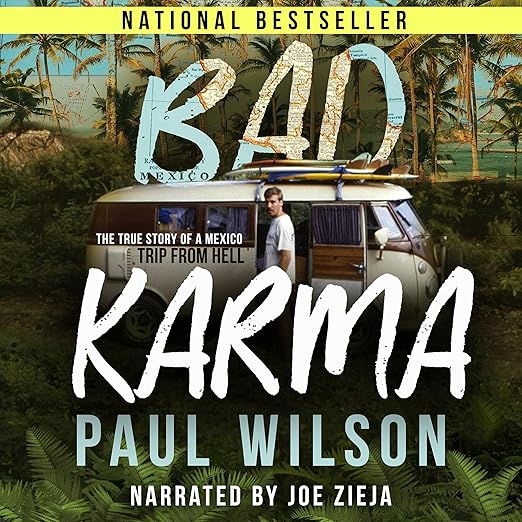
Paul Wilson's Bad Karma opens with a robbery. The author, twenty-one years old and broke in the summer of 1978, needs money to fund a surf trip to mainland Mexico - not Baja, not the tourist-accessible coast, but the interior, deep into what he discovers is cartel country. His solution: rob a supermarket. The story that follows had to wait for the statute of limitations to expire before it could be told, and that detail alone sets the tone for everything this six-hour-and-fourteen-minute audiobook delivers. Joe Zieja narrates Wilson's memoir with the right combination of self-aware wit and forward momentum for a true story this consistently eventful.
How Bad Karma Holds Up
The title earns its meaning through accumulation. Wilson's two travel companions, revealed progressively as the journey unfolds, turn out to be a convicted killer on the run and an unscrupulous opportunist whose ethics are roughly situational. That Wilson did not know this before committing to the trip is both a measure of his twenty-one-year-old judgment and the book's central premise: you can set out for a surf adventure and end up in a situation where survival has replaced surfing as the primary objective. Zieja's narration channels the younger Wilson's optimism and the older Wilson's retrospective clarity simultaneously - a dual-register performance that gives the memoir its tragicomic texture.
Reviewer Philip O. Kelly, who has personal experience driving to southern Mexico, noted that many of the stories are hard to believe but that photographic evidence in the original book supports them. The audiobook cannot reproduce those photographs - a genuine limitation for a memoir whose veracity relies partly on visual documentation - but Zieja's narration of the incidents themselves carries enough specificity to compensate. Wilson's narrative style, described by one reviewer as strong and personal, translates well to audio: it reads as someone telling a story they have told before, refined by repetition into its most efficient and entertaining form, without losing the original shock of the events themselves.
Why Bad Karma Works as an Audiobook
The comparison to Into the Wild and Fear and Loathing in Las Vegas in the book's own promotional copy is ambitious, and the honest assessment is that Bad Karma operates at a different register than either - less tragic than Krakauer's work, less hallucinatorily literary than Thompson's. What it shares with both is the quality of genuine adventure writing: the sense that the author was actually there, that the danger was real, and that the distance between where the story ends and where it could have ended is narrower than comfort allows. Wilson survived. The statute of limitations eventually ran out. The book exists.
Reviewer B. Wallace, who approached the book skeptically given its surf-memoir classification, reported being pulled through quickly by the addictive narrative pacing and found the story far less surf-centric and more universally compelling than the genre label suggests. This is the right calibration for prospective listeners who don't surf and might assume the content is niche. The surfing is context, not subject - the subject is what happens when a young man's plan encounters reality in a place with no safety net. Reviewer Strongman53 praised Wilson's observations about Mexico's people and culture, noting that the book's portrait of family, faith, and honor among ordinary Mexicans stands in deliberate contrast to the cartel-country danger of the trip's geography.
Weak Spots in Bad Karma
The El Chapo detail in the synopsis - Wilson's photographs reportedly include a pre-kingpin El Chapo - is the book's most striking historical footnote and one of several moments where the reader realizes retroactively how close the trip came to something much worse. In 1978, El Chapo was a regional figure rather than the international figure he would become; the photograph's existence is simultaneously a mundane travel snapshot and a document of historical contingency. Zieja delivers this context without over-dramatizing it, which is the correct approach - the fact is strange enough without inflation.
The memoir's moral self-examination is handled honestly. Wilson does not present his younger self as heroic or his decisions as wise; the robbery that opens the trip is framed as the kind of choice that only makes sense in a specific combination of youth, bravado, and insufficient imagination about consequences. The cast of companions - the killer, the cad, and Wilson himself, the youngest and least morally compromised of the three - is sketched with enough specificity to be interesting without tipping into caricature. The Readers Favorite Silver Award the book received in 2020 reflects an assessment of narrative quality that the audiobook format preserves.
The statute of limitations framing is worth dwelling on as a structural device. Wilson did not publish this memoir because he wanted to; he published it because he finally could. That distinction shapes the book's tone in ways that distinguish it from the usual adventure memoir, where the author's retrospective perspective is one of triumph or wisdom. Wilson's retrospect is more legally complicated, and that legal reality anchors the stakes of the story in a way that purely emotional retrospection cannot. The robbery at the story's opening is not a youthful indiscretion that the narrative domesticates into harmlessness - it is the act of a person who made a specific choice and had to live with its implications across the statute of limitations period before telling anyone publicly. Zieja delivers this weight without overplaying it.
The Right Listener for Bad Karma
Listeners who enjoy adventure memoirs with a dark comic undertow will find this audiobook well-suited to their taste. Anyone who has read Into the Wild, Motorcycle Diaries, or the gonzo journalism tradition and wants a story that operates in similar emotional territory with less literary pretension will find Wilson's voice refreshing. The six-hour runtime makes this a manageable single-trip listen for a long drive or a weekend of focused sessions. Listeners who surf will find the cultural context richer; listeners who don't, per the reviewers' unanimous advice, will find the story carries entirely on its own terms. Readers who need strong prose style rather than strong narrative drive should be aware that this is adventure writing in the functional tradition, not literary memoir in the Didion sense.