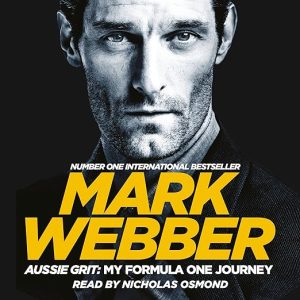
The Short Version
- Performance: Nicholas Osmond takes the whole recording, foreword included, and one reviewer calls the result excellent.
- What it covers: a teammate rivalry that defined a season, the long climb from karting, endurance racing after Formula One.
- Feel: blunt, unguarded, faster than most sporting memoirs.
- Our call: the best account of the 2010 Red Bull season you can get from someone who lived it.
Brandon switched back and forth between the print book and the audiobook, then stopped to hand out what the review calls a shout out to excellent narration. Review columns almost never say anything about the reading, so a buyer landing on this page gets something genuinely uncommon: one person who spent time inside Nicholas Osmond's 11 hours and 27 minutes and thought the performance worth naming in the headline, which reads Great book and narration, audio. Everything else here is about Formula One. That one line is about the product being sold.
A Closer Look at Aussie Grit
Mark Webber sat at the center of one of the most captivating stretches in the history of Formula One. In 2010, driving for Red Bull, he went head to head with his own teammate, Sebastian Vettel, for the world championship, and only one of them could take it. That is the season the book exists to explain, and Webber had never told the inside version of it before this one. Pan Macmillan published the recording in June 2016, six years after that championship season, and the distance shows in the writing. The grievances still have heat in them, but they arrive shaped into an argument, with the spill already edited out, and a shaped argument is what separates a memoir worth eleven hours from a long complaint.
Formula One rivalries between teammates are the sport's oldest and most awkward subject, and the Vettel relationship, on the track and off it, has never sat far beneath the surface. The publisher's copy promises the straight-talking, no-nonsense treatment, and the reviewers back that claim up without much reservation. Webber built a career on being blunt in a paddock where almost nobody is, and a memoir written in that register beats another sanitized sporting autobiography. The book also reaches well past the championship fight, taking in the endurance career that followed and a serious accident, so the Vettel chapters sit inside a longer story without consuming it.
Waldo, at four stars, filed the most calibrated of the five verdicts, the one to read first. The book is a fair and honest account of a driver's Formula One career, thorough year by year, and it generally pulls no punches. The reservation is specific: it runs a little light on the driving how-it's-done side of things. Anyone hoping for technical detail about car setup and racecraft should adjust expectations downward before buying.
Eleven hours and 27 minutes covers a career that starts with karting and runs to a crash that made front pages worldwide. The route through it is chronological and well signposted: the Formula One debut in 2002, scoring Minardi's first points in three years at the Australian Grand Prix, the first win with Red Bull at the 2009 German Grand Prix, the championship year, then endurance racing and the Le Mans 24-hour. In December 2014 came the barricade impact in the final round of the FIA World Endurance Championship in South America, which Webber was lucky to walk away from.
BostonBirder points to the single passage most likely to sell the recording. The description of sitting in the car before a race, right at the start of the book, is amazingly vivid and worth the price on its own. That is exactly the kind of writing that gains from being spoken: a cockpit, a countdown, a driver's interior monologue. The same response credits Webber with being honest about the Vettel relationship and respectful about other drivers, which is not the usual combination.
Nicholas Osmond takes the whole recording, foreword included, and holds the only performance credit anywhere on the record. Australian speech, Formula One jargon and a decade of team politics all have to come from that single reading, and the pace of a race weekend has to survive being narrated. Brandon's verdict is the only direct evidence available, and the verdict is positive, delivered by someone who had the printed text open alongside and could compare the two.
Things to Know Before Starting Aussie Grit
Sir Jackie Stewart supplies a foreword, according to the summary printed on this listing, and appears nowhere in the credits for this recording. One narrator is named, so someone other than Stewart reads those opening pages, and the listing never says who or acknowledges the substitution. It is a small thing that matters to anyone buying partly for that name. Foreword readers get separate billing on plenty of sports memoirs, and here the field simply stops at one entry.
Four point four is what the badge displays, while the tally under it admits to only two votes. No pair of whole-star scores averages out at 4.4, meaning that decimal has to come from somewhere other than the figure printed alongside it. Below both sits a column of five signed opinions, three at full marks and two at four stars. Read the column, treat the badge as furniture, and nothing worth having is lost.
William Hoke's four-star response is the mildest of the set, praising Webber for conveying competitive passion and picking the right bits of the story, and it reads like someone who came away with respect and no strong feelings. BostonBirder's five-star entry, by contrast, stops mid-sentence: I doubt that He, and then nothing at all. Whatever judgment was forming there about other drivers or the sport is lost, and that is a real loss, since the same response was the most detailed one here. Anyone weighing five opinions where one arrives truncated is really weighing four and a fragment.
Who It's For
Motorsport listeners who remember 2010 will get the account they have wanted for over a decade, from the driver on the losing side of it. Bruno Z, a fan before reading and more of one after, recommends it even to people who do not follow racing, on the strength of the personal story alone. Anyone drawn to sporting memoirs about coming second, about being the older driver in a team built around someone else, will find this an unusually unguarded one. Listeners who came through the endurance racing side of the sport get the Le Mans years too, which most Formula One memoirs skip entirely.
Nothing here for you if the appeal was engineering, telemetry or a technical education in how a Formula One car gets driven, since a reviewer already flagged that gap. Everyone else gets a driver being honest about finishing second, at length and with no diplomacy applied anywhere. Brandon heard it and said so, which is one more data point than most listings hand you.
Good to Know
How much Formula One knowledge does Aussie Grit assume?
Less than you might fear. Webber explains the career chronologically from karting onward, so the teams, the seasons and the rivalry all arrive with context attached. One reviewer suggests it works even for people outside the sport. Familiarity with the 2010 championship makes the central section land harder, but it is not required.
Does anyone say how the Aussie Grit audiobook actually sounds?
One person does, and that single line is the most valuable one available. A reviewer who moved between the printed book and the recording singled out the narration for praise and put it in the review headline. That is the only direct assessment of the performance anywhere in the five written responses.
Is the Sir Jackie Stewart foreword part of the audiobook?
The publisher's summary says the book includes it, and the runtime of 11 hours and 27 minutes gives no reason to think it was cut. What the credits do not do is name a second reader, so the foreword is presumably delivered by the same narrator as everything else.
Can a 4.4 rating come from only two votes?
No, and that is the puzzle. Two whole-star scores can only average to a whole number or a half, never to a figure like 4.4, so that decimal has to originate somewhere other than the tally shown next to it. Five signed opinions sit underneath, three of them at full marks and two at four stars.