Key Details
- Narrator: Three readers appear in the publisher's copy and only one name reaches the credit, with the spelling changing between them.
- Subjects: Program culture, role acceptance, championship season, coaching as youth development
- Tone: Warm, orderly, quietly proud
- Bottom line: Excellent as a coaching and program memoir, thinner than advertised as a general leadership manual.
Buy this one for the program, not the boardroom. That is my verdict after weighing what the audiobook actually contains against what its packaging promises, and it is also, near enough, the verdict of the sharpest reviewer on the page. Jay Wright coached Villanova to the 2016 national title on Kris Jenkins's buzzer three-pointer, and this is his account of the season and the twenty years that built it. The recording runs ten hours and two minutes and was released by Random House Audio in February 2017.
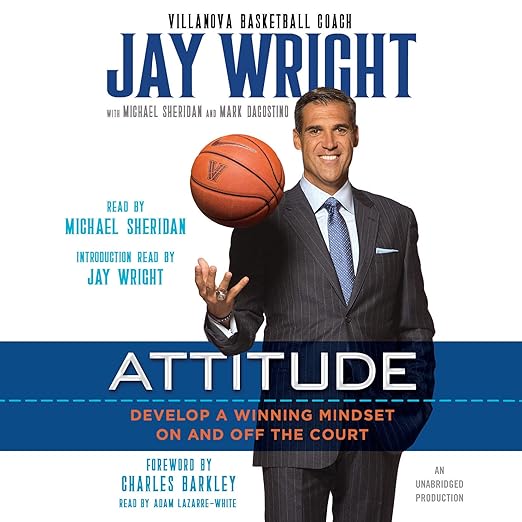
The credit block deserves a moment, because it is muddled. The narrator field names Michael Sheridan. The description says the book is "Read by author Mike Sheridan", applies the word author to him and then to Jay Wright, who reads the introduction, and adds that the foreword is read by Adam Lazarre-White. So three voices appear in the copy and one appears in the credit. That is a data-entry tangle rather than anything sinister, but it has a practical consequence worth carrying into a sample.
What Jay Wright Delivers
A season builds this book and a career furnishes it. The 2015-16 Wildcats give it a narrative spine ending at a result the description gives away in its first paragraph, and around that Wright threads his own climb: the Little League fields of his childhood, a five-year stint as assistant to Rollie Massimino, twenty seasons inside the same program. The recurring device is vocabulary. Each stage of the run gets "a signature term torn from Coach Wright's own motivational playbook", which is a coach's habit transplanted onto a book, and it works better than it sounds because the terms are attached to games you can check.
Around it sits a pitch broader than the content, and the blurbs show the intended reach. A sportswear founder, another program's head coach and one of Wright's own co-captains all appear on the page, which is a deliberate triangle: business, peer coaching, and the players themselves. The description follows suit, promising principles for "the boardroom, the classroom, and the living room". Hold that thought, because one reviewer takes direct aim at it, and the tension between the two readings is the most useful thing on this listing.
What Jay Wright Gets Right
Three hundred and seven ratings behind a 4.6 average is a substantial and settled sample, and the written notices are consistent with it. Patricia A. Lynch, writing as a VU alum, describes being brought back to specific places on campus and gives the book credit for teaching "what makes a great basketball program", adding that "it really is not all about skill". Raymond Moss praises Wright for building the program "with great tradition and strong Augustinian values". Both are responding to institutional detail rather than motivational uplift. Tom Durner's shorter notice points the same way, praising Wright for developing young men rather than for winning games, which is the note this pool keeps hitting.
The season structure is the second reason to press play. Sports memoirs that run chronologically through a life tend to sag in the middle; anchoring the book to a single championship run gives it a clock. Kody's notice catches the effect from the opposing bench, describing how hard it is, as a Carolina fan, to relive a moment that meant fifteen minutes on the floor, and recommending the book anyway to "any basketball fan or youth coach". A book that a beaten rival recommends is doing something right. Another reviewer sends it to "young hoopsters", rising coaches and executives alike, which tells you the enthusiasm here is not confined to one constituency.
Sampling advice follows from that muddled credit block. Whatever plays in the opening minutes may be Jay Wright reading his own introduction or Adam Lazarre-White reading the foreword, neither of whom carries the bulk of a ten-hour recording. Skip ahead into the body before deciding, because the front matter here is not representative of the main text, and a coach's own voice in an introduction sets an expectation the rest of the book does not have to meet.
Where Jay Wright Loses Some Ground
One four-star notice is worth the other four combined for a prospective buyer. It opens by warning that "Contrary to what other reviews might offer, this is a book about basketball", finds it "Somewhat interesting for WIldcat or basketball fans", and lands on "not much to offer in the leadership realm". That is a direct challenge to the boardroom framing, and the description bears that out: the principles it names arrive attached to roles, teams and the people who came before. The transfer to general management is left to the listener.
Coined vocabulary is the other thing to weigh. A book organized around coined terms leans on chapter headings and typography to keep them straight, and audio hands you none of that. Expect to lose track of which phrase belongs to which stage of the run, and expect the terms to blur into one another across a long listen. The 2017 vintage matters too: this is a book written at the peak of a program's arc, with no perspective on anything that came afterwards, and it reads as a victory account because that is what it is.
Who Should Pick Up Attitude
Basketball listeners are the core audience and will be well served, especially anyone who followed the 2016 tournament. Youth and high school coaches are the second group, and probably the ones who will take the most home, since the material lives at the level of practice habits, role acceptance and program culture rather than abstraction. Villanova alumni get a bonus layer of place and memory, which one reviewer describes better than I could. Parents of serious young athletes will also find the developing-young-men thread useful, since a recurring claim in these responses is that the program is judged on the people it produces rather than the banners it hangs.
Corporate readers hunting a transferable leadership framework should adjust expectations, and the four-star reviewer will tell them so before I do. This is a coaching memoir with leadership lessons inside it, not a management book with basketball as decoration. Approach it that way and it is generous, specific and well anchored in a real season. Approach it the other way and you will spend a long recording waiting for the analogy to arrive. The honest summary is that Wright wrote the book he was qualified to write, and the marketing department wrote a wider one on the cover.
Good to Know
Who actually reads the Attitude audiobook?
Michael Sheridan is named for the main text. The description calls him Mike Sheridan and adds that Jay Wright reads the introduction while Adam Lazarre-White reads the foreword. Only one name appears in the credit, so sample past the front matter before judging.
Is this a leadership book or a basketball book?
Mostly basketball. The publisher promises principles for the boardroom, classroom and living room, but a four-star reviewer pushes back hard, calling it a book about basketball that offers little on leadership. The examples do stay close to the court.
Do I need to follow college basketball to enjoy the audiobook?
It helps considerably. The spine is the 2015-16 Villanova season that ended with a title-winning buzzer three-pointer, and much of the pleasure comes from recognizing games, players and rivalries. A general listener will still follow the culture-building material without difficulty.
How long is it and how well does it hold up?
Ten hours and two minutes, released in February 2017. It holds up as a season account and a career memoir, though it carries no perspective on anything after that peak, and the coined motivational terms it is organized around are harder to keep straight by ear.