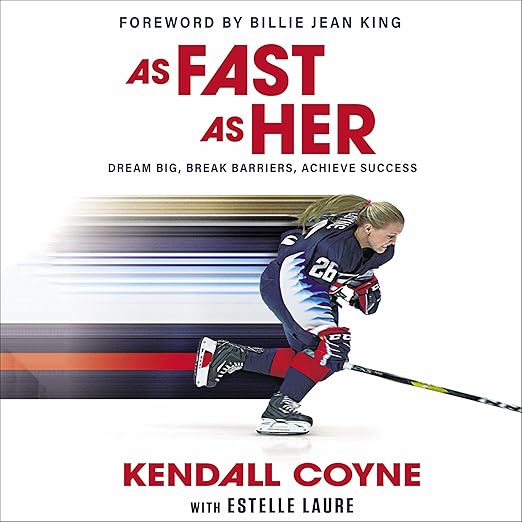
Who exactly is this book for? The description names readers thirteen and up, the publisher line reads Zonderkidz, and the audiobook runs five hours and twenty-eight minutes in the voice of the athlete whose story it is. Kendall Coyne won Olympic gold and earned a place in the Fastest Skater Competition at the 2019 NHL All-Star Weekend, then wrote this to hand younger athletes what she learned getting there. The answer to the question turns out to be less tidy than the age band on the listing suggests.
Kendall Coyne organizes the story around three things people said to her. Not so fast, when she picked up hockey skates instead of figure skates. Just a minute, when she tried out for the boys' team. You're not enough, said often enough that she started to believe it. Building a memoir for young readers out of refusals rather than achievements is a smart structural decision, because a child being told no right now recognizes the shape of that immediately, while a list of medals mostly tells a kid what they are not.
An April 2022 five-star keeps returning to the Golden Coynes, the takeaways threaded through the book, and says the copy is going on a special shelf to be pulled down when motivation runs low. That response has identified the actual product. The narrative is the delivery system and the takeaways are what is being sold, pitched as things to apply at practice rather than things to admire from a distance. Whether that works depends entirely on how concrete they are, and the ones the description previews are concrete.
What Kendall Coyne Gets Right
One response, filed in February 2024, describes reading the whole thing aloud to a five-year-old and a seven-year-old who happily followed along. That sits well below the stated audience and it tells you something real about the writing. Sentences are short, emotional stakes are legible, and the hockey never requires a rules explanation to make sense. A story about being told no and skating anyway does not need a listener who knows what an offside is, which is exactly why it travels down the age range so easily.
Coyne reads the book herself, which is the most consequential fact on this record and the one nobody has addressed. Not one of the five written responses mentions the audio edition; they describe pages, bedtime reading and a shelf. So the question a buyer most wants answered, whether an elite athlete who is not a trained performer can hold five and a half hours of her own prose, is exactly what a 4.8 average cannot answer. Author narration usually trades polish for authority, and on a book whose entire claim is personal testimony, that trade is generally worth making.
Hockey detail is what keeps this from dissolving into general encouragement. The Fastest Skater Competition is a specific event with a specific outcome, and trying out for a boys' team is a specific humiliation that happens in a specific room. Coyne pauses through the story to convert those moments into the practical take-aways the book brands as Golden Coynes, which keeps the order honest: incident first, lesson second, rather than a lesson with an anecdote bolted onto it afterward.
Where Kendall Coyne Loses Some Ground
Readers keep arriving younger than the label expects. A five-star filed on 29 June 2022 points out that the listing says thirteen and up, then explains that a nine-year-old hockey player has been reading it every night and only occasionally asks what a word means, before recommending it from eight or nine upward for confident readers. In audio the vocabulary friction disappears, since nobody has to decode anything on sight. So does the pause that friction creates, because the file simply keeps moving.
Eight pages of full-color photographs sit inside the printed edition, behind the scenes and personal, and no audio edition can carry them. A subtler version of the same problem applies to the affirmations and the take-aways, which are laid out on the page as objects to look at and return to. A listener receives them read aloud in sequence, at narrative pace, with no visual marker for where one stops. Anyone buying this as a motivational tool rather than as a story should know the tools are the part this format handles worst.
Every visible response carries five stars, which is pleasant and not very useful. A 4.8 average across 144 ratings means somebody graded it lower, and none of those people wrote a word, so the page shows the audience the book reached and nothing at all about the audience it missed. For a title that will mostly be bought as a gift by an adult for a child, that is a genuine limitation on what the score can tell you.
Who Should Pick Up As Fast As Her
Young athletes currently being told to slow down are the obvious audience, and the hockey specificity will land hardest with girls who have already noticed which team they were not invited to try out for. Parents and coaches form the second group, since the takeaway structure hands an adult something concrete to talk about after each chapter instead of a vague instruction to be inspired. It also works as a car listen for a family heading to a rink at an unreasonable hour.
Adults wanting a full sports memoir should look at a different shelf, because this is written for young readers and keeps the career at the level of lesson rather than record. Skip it as well if affirmations set your teeth on edge, since they are advertised as a feature rather than an occasional flourish. If the photographs are what you wanted, buy the printed edition, because that insert is the one element this format cannot reproduce at any length.
Quick Take
- Narrator: Kendall Coyne reads her own story, trading professional polish for the authority of the person the barriers were actually put in front of.
- Subjects: Women's hockey, being told no, converting refusals into fuel
- Tone: Direct, encouraging, briskly paced
- Bottom line: A young readers' sports memoir with unusually specific detail, though its takeaways and photographs work better on the page.
What age is the As Fast As Her audiobook really for?
The description names readers thirteen and up, though the material asks much less than that. No hockey knowledge is required, the vocabulary is straightforward once it is read aloud, and the emotional content stays within reach of a grade-schooler. Treat thirteen as the marketing floor rather than the comprehension floor.
Does Kendall Coyne narrate the audiobook herself?
She does. Coyne narrates her own text at five hours and twenty-eight minutes, so the voice telling you about the tryout is the voice that went through it. Expect the delivery of an athlete rather than a studio professional, which suits testimony and matters more on a book pitched as personal advice.
What exactly are the Golden Coynes?
They are the practical take-aways Coyne stops to deliver throughout the story, named as a running feature in the description alongside affirmations and encouragement to find your why. In print they sit apart from the narrative as boxes you can flip back to; in audio they arrive in sequence, so noting them down helps.
Is it worth listening to if you do not follow hockey?
Yes, and one five-star from May 2025 makes the point by joking that reading it failed to make the reviewer any faster on skates. The sport supplies the specifics while the argument is about persistence, so a reader who has never watched a game will still follow every setback in the story.