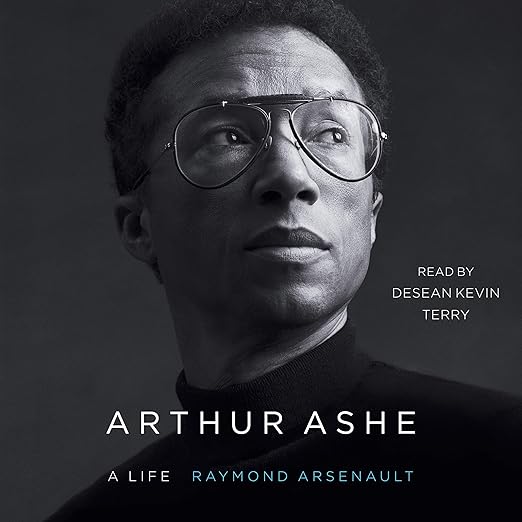
Arthur Ashe's life was built on a series of firsts that he carried with discipline and intention. The first African American to play for the US Davis Cup team. The first Black man to win the US Open and Wimbledon. The first player to turn his international celebrity into a sustained campaign against apartheid in South Africa. Raymond Arsenault's biography, narrated by Desean Terry in this audiobook edition, is a New York Times Notable Book that spends thirty-two hours trying to do justice to a man whose public life was that crowded and whose private life was that complicated. It largely succeeds.
Arsenault was given access to more than one hundred interviews, conducted specifically for this biography, along with an archive of Ashe's correspondence, speeches, and professional records. The result is the kind of biography that accumulates authority through density rather than through a single dramatic revelation. Terry's narration is essential to managing that density across the full runtime; his measured delivery and clear diction keep thirty-two hours from collapsing under their own weight.
The biographical arc of Ashe's athletic career is well-known enough that Arsenault does not linger on the highlights for their own sake. The 1968 US Open, his Wimbledon victory over Jimmy Connors in 1975, the Australian Open title: these are covered with appropriate detail, but the book consistently uses the athletic timeline as a scaffold for the larger story of what Ashe was doing with the platform those victories gave him. His activism against apartheid, his education work through the ABC program which took inner-city youth into elite prep schools, his writing career, his broadcasting work: these are given as much space as his play on the court, and in Arsenault's treatment that balance feels earned rather than politically motivated.
The San Francisco Chronicle called this biography thoroughly captivating, and the New York Times described it as a deep, detailed, thoughtful chronicle. Library Journal gave it a starred review and predicted it would serve as the standard work on Ashe for some time. That consensus from major outlets is worth noting not as empty endorsement but as confirmation that Arsenault's research genuinely closes gaps that previous treatments of Ashe had left open. The material on Ashe's political thinking, particularly his nuanced position on affirmative action and his complex relationships with Black nationalist movements, is new ground in Ashe biography.
Highlights
Terry's narration is the right choice for this material. His voice has the quality of composed authority that matches Ashe's own public persona, and he handles the shifts between athletic reporting, political analysis, and intimate biographical detail without losing the thread of each. The thirty-two-hour runtime is significant; this is not an audiobook for someone looking for a quick life summary. It is suited for listeners who want a complete account and have the patience for comprehensive biography in its fullest form.
The off-court sections of the audiobook are in some ways more arresting than the athletic ones. Ashe's advocacy work during the height of the apartheid crisis, his decision to go public about his HIV diagnosis in 1992 after being forced to do so by press pressure, his final ten months devoted to AIDS activism: these episodes are documented here with the specificity they deserve. The reviewer who describes Ashe as always a class act notes she did not know much about tennis but wanted to understand the man. The audiobook is designed for exactly that listener, because Arsenault never treats the tennis as separate from the activism. They are part of the same argument about what a life in public can be used for.
What to Watch For in Arthur Ashe
Arsenault is careful to situate Ashe within the long history of African American athletes seeking equal opportunity and respect. The comparison to Jackie Robinson, explicit in the subtitle, is examined rather than assumed. Arsenault traces the specific ways in which the tennis world's social dynamics differed from baseball's, how the predominantly white country club culture of tennis created both different obstacles and different forms of accommodation than Robinson faced, and how Ashe navigated them with deliberate strategic intelligence.
The sections on Ashe's heart condition and its long aftermath are among the most humanizing in the book. Beginning in 1979 with his first heart attack, through multiple surgeries and eventually a blood transfusion that left him HIV-positive, Arsenault documents how Ashe managed serious illness while maintaining his public role and expanding his activism. The chronology of that management is documented here in fuller detail than any previous biography has achieved, drawing on family sources and medical records that give the account unusual specificity.
Is This One for You?
This audiobook is essential for anyone with serious interest in twentieth-century American sports history, civil rights history, or the relationship between athletic celebrity and political activism. It rewards the full thirty-two-hour commitment with a portrait that is genuinely comprehensive. Listeners interested in Ashe primarily as a tennis player will be well-served by the athletic material, but they should know they are entering a biography that treats the tennis as one chapter in a much larger story.
Those looking for a shorter, more focused account of Ashe's life should know that shorter alternatives exist. But if the question is whether Arsenault's version is worth the time, the answer from the New York Times, the San Francisco Chronicle, and Library Journal is consistent: this is the standard biography for good reason, and Terry's narration makes the thirty-two-hour investment as manageable as a work of this scale can be.