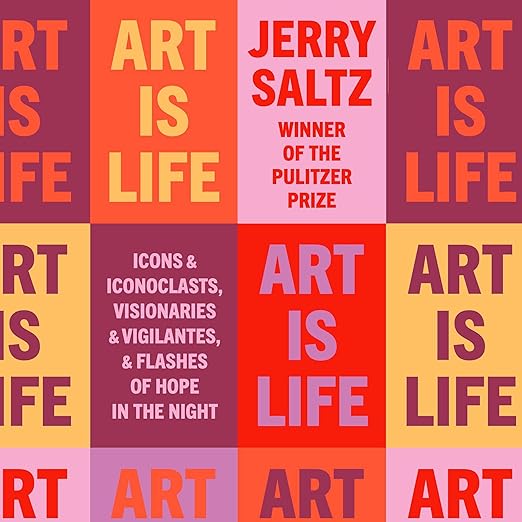
Jerry Saltz narrating Art Is Life is not a conventional audiobook experience. Saltz, the Pulitzer Prize-winning art critic for New York magazine, brings the same combative warmth to the microphone that made his writing so difficult to dismiss: he clearly believes everything he is saying, he is visibly frustrated when artists fail or institutions capitulate, and he is capable of stopping mid-argument to register pure wonder at a painting's surface. The 16-hour-and-1-minute production spans two decades of his criticism, from the post-9/11 cultural reset through the social crises of the present, and it is as much a record of an attentive mind working in real time as it is a survey of contemporary art.
Kara Walker to the Obama Portraits
The book's organizing logic is chronological and thematic: Saltz traces how artists responded to and shaped the cultural moment at each stage of the past two decades. Kara Walker on the persistence of American racial violence, David Wojnarowicz on grief and body politics, Hilma af Klint on what the Western canon systematically excluded, Kehinde Wiley and Amy Sherald on the Obama portraits as a reinvention of national portraiture; each extended piece functions both as art criticism and as a kind of cultural timestamp. You understand what it felt like to be paying close attention at the moment in question, which is something most retrospective criticism cannot achieve.
The Ankara Gallery Assassination of 2016
Saltz also writes about himself with unusual candor, which narrating his own work amplifies considerably. His accounts of a haunted childhood, his self-description as a failed artist who found his purpose in criticism, his epiphanies in front of Botticelli and the cave paintings at Niaux, all of this arrives in his own voice with a directness that grants the autobiographical passages more weight than they would carry read by a professional narrator. One reviewer noted starting to follow Saltz on social media expecting a snobby critic and discovering instead someone with genuine substance beneath the provocation. That quality is even more audible in his narration than in his writing. This is a critic who has thought hard about why art matters and has the biography to prove it was not an idle question.
The piece on the Ankara gallery assassination of 2016, in which a gunman shot the Russian ambassador in front of a crowd of opening-night attendees, is one of the more unusual in the collection. Saltz writes about it with the particular shock of someone who understood what a gallery opening is supposed to be and suddenly had to reckon with what it became. His response is not to aestheticize the violence but to insist on the gallery as a civic space worth defending, which is consistent with the book's larger argument about art's relationship to the political moment. Narrating this himself, Saltz brings a gravity to the piece that no third-party narrator could replicate. It is a reminder that the collection covers art as both cultural production and physical risk, and that the two are not always separable.
Saltz Speeds Up When Excited, Slows When Furious
The self-narration is the primary reason to choose audio over print. Saltz's critical voice in text is already distinctive, provocative, aphoristic, built on declarative sentences that land hard. In audio, these qualities become something different: the rhythm of his argument, the places where he speeds up because he is excited and slows down because he is furious, the way his voice softens when he is writing about work that genuinely moved him. His takes on Jeff Koons and Richard Prince carry a particular edge in his own voice that a professional narrator would likely sand smooth.
The early championing of women artists who had been overlooked is worth noting specifically. Saltz was writing about Kara Walker before her retrospective, and about Hilma af Klint before the Guggenheim show that transformed her reputation. Hearing him read those pieces now, with the historical distance that proves him right, carries a satisfaction that the original publication dates could not offer. The pieces on Thomas Kinkade and Kim Kardashian are equally useful for different reasons: they demonstrate that Saltz takes seriously the question of what art does culturally even when he despises what it is doing. That catholicity is one of the collection's genuine distinctions from more narrowly focused critical work.
Ekphrasis That Assumes You Can See It
Sixteen hours is a significant investment, and listeners who are not already inclined toward contemporary art criticism will find certain sections slow going. The writing assumes some familiarity with the artists being discussed; Saltz contextualizes as he goes, but the emotional payoff of a piece on Marina Abramovic or Jackson Pollock depends on knowing at least roughly why they matter. First-time encounters with this material will work better if the listener has access to images of the work being discussed. The audiobook format cannot compensate for the absence of visual reference, and Saltz's ekphrasis, while vivid, assumes the reader can summon the image independently.
Some pieces also show their original publication context more visibly than others. Essays written in the immediate aftermath of 9/11 or during particular moments of market excess read as period documents as much as timeless criticism, which is partly Saltz's point but which can create an uneven listening experience across a long session. The collection rewards cycling back to individual pieces after completing the whole rather than treating it as a linear-only listen.
For Anyone Who Has Stood in a Gallery Uncertain
Essential for readers who follow Saltz's work and want the extended version of his critical thinking. Strong for anyone with a serious interest in contemporary art who wants a critic's first-person account of the past two decades rather than a museum-catalogue overview. Less effective as an entry point for listeners completely new to contemporary art, though the book rewards intellectual curiosity more than it requires prior knowledge. If you have ever stood in a gallery uncertain what you were supposed to feel, Saltz's voice is an excellent and opinionated corrective. Just be prepared to give it the sustained attention it demands across multiple sessions, because the individual pieces accumulate into something larger than any single essay can carry.
At a Glance
- Narrator: Jerry Saltz narrates his own work, and the effect is essential; his conviction, impatience, and occasional bewilderment at the art world's failures are all present in the voice in ways that print cannot replicate.
- Subjects: Art as cultural barometer, the politics of representation and canon-making, the intersection of personal biography and critical practice
- Tone: Electrifying and opinionated, occasionally tender, never neutral
- Bottom line: Saltz narrating Saltz on 16 hours of contemporary art criticism is one of the more unusual and rewarding listening experiences in the arts and culture audiobook space.