In Brief
- Narrator: Tania Rodrigues brings a measured, clear warmth to Jonathan Drori's globe-spanning prose; she navigates the tonal range from botanical science to cultural mythology without the delivery ever feeling academic or distant.
- Subjects: Trees as cultural and scientific bridges, human dependence on the natural world, botanical history
- Tone: Quietly wondrous, unhurried, rich with specific detail
- Bottom line: A deeply satisfying audiobook for anyone who wants nature writing that is genuinely informative rather than merely atmospheric, with a narrator who trusts the material without overselling it.
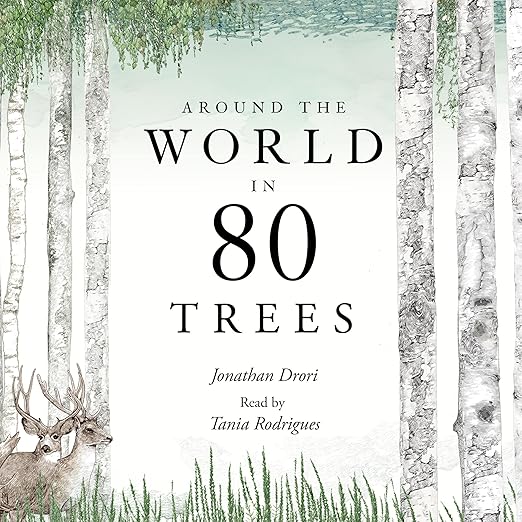
Jonathan Drori's Around the World in 80 Trees arrives with an unusual promise: eighty trees, each representing a stop on a circumnavigation of the globe, each carrying enough science, history, and cultural story to justify the journey. The audiobook, narrated by Tania Rodrigues, runs six hours and nineteen minutes, and the Phileas Fogg structure is more than a marketing conceit. Drori has actually organized these chapters as a traveling collection, moving from Britain to Berlin to California to India's sacred banyan and back, using each tree as a portal into something much larger than botany. A downloadable PDF companion with illustrations is available alongside the audio, extending the experience for visual learners.
From the Romantic to the Regrettable
What separates this from general nature writing is the precision of the connections Drori makes. The lime trees of Berlin's Unter den Linden are not just a beautiful avenue; they are the reason certain Germans have historically experienced inexplicable romantic agitation in June, when the flowers release a compound that intoxicates both bees and people. The streets of Victorian London were paved with Australian eucalyptus wood because of a particular hardness property that seemed promising until it became lethally slippery in wet weather. The California redwoods achieve their extraordinary height through a mechanism involving fog: the trees absorb moisture directly through their needles in a way that the root system alone could not sustain at that scale. These are not trivia items; they are case studies in how trees are woven into the fabric of human life, economy, and imagination in ways we routinely fail to notice.
Drori has described his project as showing how trees play a role in every part of human life, from the romantic to the regrettable, and the word regrettable is doing important work. Several of the eighty entries involve trees whose exploitation, overextraction, or cultural displacement tracks directly to colonial history or environmental degradation. Drori does not lecture, but he does not omit these threads either. The result is a book that earns its description as a love letter to the natural world without sentimentalizing the relationship between humans and trees. Reviewer J Powell noted the particular quality of a book in which you feel the author's love for the subject radiating from the prose, and that is accurate.
Rodrigues Modulates Without Drawing Attention to Gear-Changes
Tania Rodrigues is a strong match for this material. She delivers Drori's prose with a clarity that prevents the science from feeling dense and a warmth that prevents the cultural history from feeling detached. The eighty-chapter structure could, in the wrong hands, become relentless, with each entry beginning to feel interchangeable around the fifteenth or twentieth tree. Rodrigues prevents that by modulating her delivery to the emotional register of each chapter, moving from the contemplative to the mildly comic to the genuinely affecting without drawing attention to the gear-changes. The Sydney Morning Herald called the book an irresistible mix of science, culture, botany, history and vicarious travel, and Rodrigues serves all four of those qualities across the full runtime.
The aspirin-to-maple-syrup range of the book's examples, its refusal to stay in any single disciplinary lane, makes it consistently surprising across the six hours even for listeners who think they know their trees. Drori is a former BBC trustee with an extensive science communication background, and that history shows in how he balances accessibility with accuracy. He does not simplify to the point of distortion; the plant science is real even when it is rendered in digestible form. Fans of Peter Wohlleben's The Hidden Life of Trees will find Drori's approach complementary: where Wohlleben emphasizes the social and communicative lives of trees in forest communities, Drori traces the intersections between individual species and specific human histories.
Two or Three Trees at a Time
The eighty-chapter format means that no single tree gets more than a short essay's worth of treatment. For listeners who want extended deep dives into individual species or ecosystems, this will feel like a survey rather than an immersion. That is a structural feature, not a flaw, but it means this audiobook rewards listening in short sessions, two or three trees at a time, rather than marathon play-throughs. The accumulative effect of eighty well-chosen entries is considerable, but each chapter is also self-contained enough that a listener who puts it down for a week and returns loses no thread.
The publisher's companion PDF is worth downloading before you begin if you have access to it, as Drori's descriptions of tree forms and bark patterns are vivid as verbal images but the visual material deepens the experience for anyone who processes botanical information better with a picture alongside the words. The Culture Trip described the book as reading like a love song to the natural world, brimming with ancient anecdotes contained within the earth, and that lyrical quality is present in the audio experience even when the illustrations are not.
A Companion to Wohlleben's Hidden Life of Trees
Natural history readers, environmental science enthusiasts, and anyone who loved Wohlleben's tree writing and wants a more globe-spanning, culturally inflected companion are the ideal audience. Travel writers and history readers who want their nature writing grounded in specific human consequence will find this rewarding. Listeners who prefer sustained narrative over essay-collection structure may find the eighty-chapter format less immediately gripping, though the cumulative effect is significant. Gift listeners, particularly those with interests in gardening, botany, or cultural geography, will find this audiobook consistently accessible and surprising.
Does the audiobook work without the companion PDF, or is it essential?
The audiobook works fully without the PDF. Tania Rodrigues's narration of Drori's descriptions is vivid enough that the visual material is genuinely supplementary rather than necessary. That said, the PDF adds meaningful context for visual learners and is worth downloading if you have access.
Is Around the World in 80 Trees organized as a continuous narrative or as standalone essays?
Each of the eighty chapters is essentially self-contained, focused on one tree and one set of cultural and scientific stories. They are organized geographically to create the sense of circumnavigation, but a listener who dips in and out between sessions loses nothing of a running narrative thread.
How does this audiobook compare to Peter Wohlleben's The Hidden Life of Trees?
The two books are complementary rather than overlapping. Wohlleben focuses on the social and communicative dynamics of trees in forest ecosystems, while Drori moves across eighty species and global locations to show how individual trees intersect with human culture, history, and science.
Is the scientific content in the audiobook accessible to non-specialists?
Yes. Drori's background in science communication shapes every entry. The botanical and ecological science is accurate and substantive, but it is translated for a general listener without being oversimplified. Reviewers with no specialist background have found it both educational and consistently engaging.