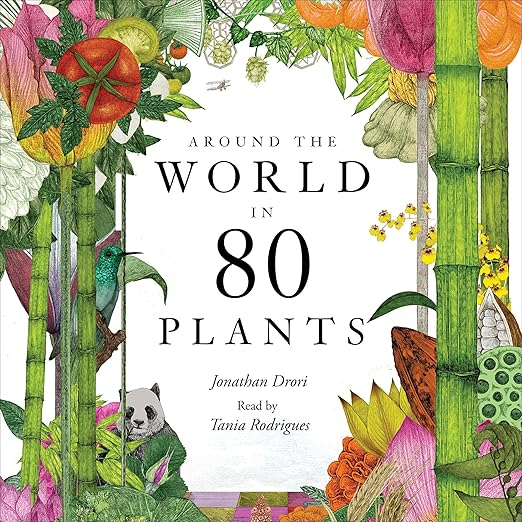
Dandelion chapters and mandrake chapters do not usually share a table of contents, but Jonathan Drori's botanical framing insists on exactly that kind of juxtaposition. Around the World in 80 Plants, the audiobook follow-up to his bestselling Around the World in 80 Trees, takes a familiar Verne-adjacent structure and uses it to do something Drori is exceptionally good at: making the ordinary feel strange and the strange feel inevitable. Within the first chapter, his argument is clear. What we think we know about the plants closest to us is almost entirely incomplete, and the incompleteness is interesting.
Tania Rodrigues narrates, and she is the right choice for this material. Drori's prose moves between the scientific and the folkloric without warning, and Rodrigues tracks those shifts with a voice that feels genuinely engaged rather than professionally neutral. When a chapter about the seemingly familiar tomato pivots into its complex South American origin story, Rodrigues finds the note of mild surprise that the prose requires. Over six hours and forty-five minutes, that responsiveness accumulates into something meaningful.
Spanish Moss Isn't Moss at All
Drori's method is the same one that made the trees book work: take a plant that most listeners will recognize, or think they recognize, and then reveal everything that recognition obscures. The tomato chapter is a good example. The dandelion chapter is another. But the real payoff comes from the plants that are genuinely unfamiliar to a broad audience: the mandrake, with its long and genuinely strange history in European folk medicine; the Spanish moss of Louisiana, which is not moss at all; the eerie plants that enabled whole civilizations to exist in specific geographies.
What the audiobook does particularly well is resist the temptation to organize its 80 chapters into thematic clusters that would impose false tidiness. Drori moves geographically and historically in ways that feel associative rather than systematic, which suits the audio format. Each chapter functions as a discrete unit, complete in itself, which means the listening experience rewards both sustained attention and the kind of interrupted listening that commutes and walks impose. Reviewer Maggie captures this well: "neat little chapters for each plant... you don't need too much time to read and learn something new."
Rodrigues Sounds Like She's Read It Before
The companion PDF bundled with this audiobook edition deserves mention upfront. The book has an illustrated print edition, and the botanical illustrations referenced in the audio are available as a PDF in the Audible library. Listeners who have access to the PDF will find the visual dimension genuinely enriching. Drori references the images in ways that suggest he expects readers to be looking at them, and the illustrations are not merely decorative. That said, the audiobook is fully comprehensible without the PDF, and the verbal descriptions are precise enough to carry the content independently.
Rodrigues's narration has a quality that serves this material well: she sounds like someone who has actually read the text before performing it, rather than someone encountering it cold. Small choices, such as where to place emphasis in a sentence about a plant's particular chemical properties, suggest genuine preparation. This is more common than it used to be in audiobook production, but it remains worth noting when it is present.
A Quiet Call to Arms, Never a Lecture
The book's structure could reasonably be subtitled "stories of 80 plants" rather than a comprehensive survey. Drori is a storyteller first and a botanist second, and some chapters favor the dramatic arc of a plant's cultural history over detailed scientific explanation. Listeners hoping for a botanical textbook will find the genre is closer to popular natural history, with all the pleasures and limitations that implies. The Herald called it "a beautiful celebration of the plants and flowers that surround us and a quiet call to arms for change," and that description is accurate. The ecological urgency is present throughout but never becomes a lecture.
The troubling histories Drori mentions in his synopsis are handled with appropriate weight. Several plant chapters involve colonialism, botanical theft, and the exploitation of indigenous ecological knowledge. Drori does not soften these histories, but he also does not let them overwhelm the wonder that drives the book. Some chapters involve plants with pasts that complicate simple celebration, and the balance Drori maintains between honest history and genuine appreciation for the plants themselves is one of the more difficult things this audiobook gets right. The Herald's description of it as a quiet call to arms is accurate precisely because Drori never raises his voice above a considered, curious register.
Stands Alone, No Trees Volume Required
Listeners who completed Around the World in 80 Trees will want this audiobook without much deliberation. The structure and approach are recognizably similar, and the quality has not declined. Readers coming to Drori for the first time can start here without the prior book; each chapter stands alone, and there is no narrative continuity that requires the trees volume as background.
Natural history enthusiasts, people with a serious interest in botanical folklore, and anyone who finds the intersection of plant science and human culture genuinely fascinating will find this audiobook rewarding at its six-hour-and-forty-five-minute length. Those looking for either hard science or conventional nature writing will find Drori's essayistic approach sits somewhat outside both categories, which is precisely what makes him worth the time across all 80 chapters. Rodrigues's narration sustains energy across that full runtime without losing the attentiveness that the material requires.
Frequently Asked Questions
Do I need to have listened to Around the World in 80 Trees before this audiobook?
No. Each chapter in Around the World in 80 Plants is self-contained, and there is no narrative continuity with the trees volume. Listeners new to Drori can start here without missing essential context.
Is the companion PDF important for the full audiobook experience?
The PDF contains the botanical illustrations that appear in the print edition, and Drori's text occasionally references them. The audiobook is fully comprehensible without the PDF, but listeners who have access to it will find the visual dimension genuinely adds to the experience.
How scientific is this audiobook, and do I need botanical knowledge to follow it?
No prior botanical knowledge is required. Drori is a storyteller as much as a science communicator, and his chapters work as cultural and natural history rather than technical instruction. The science is present but always in service of a story.
Does Tania Rodrigues's narration suit the material in this audiobook?
Yes. Rodrigues handles the range of Drori's prose well, moving between scientific precision and folklore with genuine engagement. She sounds prepared rather than sight-reading, and her vocal choices consistently match the shifts in register that Drori's chapters require.