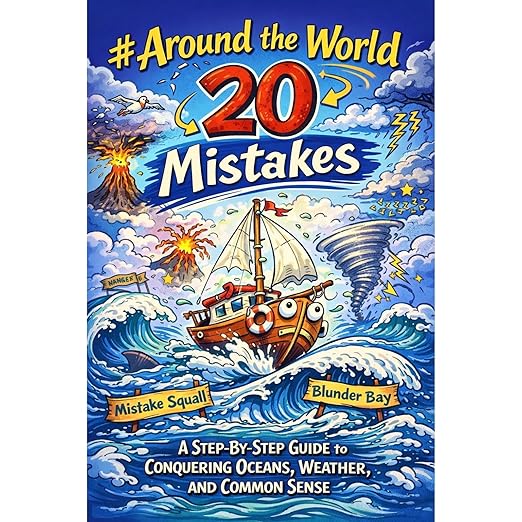
Sasa Fegic promises a step-by-step guide to conquering oceans, weather and common sense. What the record actually supplies is two hours and eight minutes, no written reviews at all, and a narrator credit that reads Virtual Voice. Those three facts put this audiobook in an unusual position: a comedy whose entire value rests on timing, handed to a synthesized reader, with nobody yet on record to say whether the jokes survived the handoff.
What Sasa Fegic Delivers
Cockroaches appear twice in this description and they change size between appearances. Partway down they are the size of dogs. In the bullet list a few paragraphs later they are the size of small cars. Nothing in the copy acknowledges the promotion. That is a small thing and it is also the tell: this blurb was built in passes, each one reaching for the largest available comparison, and nobody read the finished text straight through afterward. Whether that predicts anything about the book itself is a fair question and an open one.
Twenty mistakes is the number in the title and the number the sales text never once reaches. Six bullet points get offered instead: tips for surviving storms and bureaucracy, survival stories involving rum and swearing, a demonstration of why common sense should never be invited aboard, proof that duct tape and blind optimism hold a voyage together, a finale involving Cape Horn and endless wet socks, and proof that you can sail around the world by accident. Six is a decent list. It is not twenty, and the step-by-step structure the subtitle sells never materializes anywhere.
No reviews sit under this title, which is worth stating plainly because it changes the value of everything else here. One person rated it, that vote is a five, and the badge therefore reads 5.0 with a single voter behind it and one blank space where an explanation would go. Published on October 27, 2025 by an independent imprint and filed fourth in a series called Adventures, Mishaps, and Meals at Sea, the record carries no outside opinion whatsoever. What follows is a reading of the sales text, because the sales text is all the evidence available.
What Sasa Fegic Gets Right
Comedy is the product here, and the description makes a respectable case for its own. The jokes are structural, not decorative: sensible ways to travel around the world exist and this is not one of them; the plan is a sequence of catastrophes retrospectively described as a plan; the three pillars of successful ocean voyaging turn out to be duct tape, rum and blind optimism. That is a consistent comic voice with an actual point of view, which is more than most sailing memoirs bring to the dock with them.
Rum, swearing, storms and suspicious customs officers is a promising inventory for two hours and eight minutes, and short is the correct length for this register. A running joke about a boat that hated its owner would thin out badly across twelve hours. The sales text keeps the scope tight instead: bad weather, broken gear, seasickness, officialdom, cockroaches of contested dimensions, and a closing sequence at Cape Horn involving wet socks and the most expensive beer anybody has ever bought. Two hours is roughly a film, which is the right shape for the material.
Nobody who buys this can claim to have been misled about tone. Sail. Drink. Curse. Repeat is the final line of the blurb, and the paragraph above it addresses you directly: sailor, dreamer, or simply somebody who enjoys reading about other people's questionable decisions, the book intends to make you laugh and wince. Copy that names its own audience with that much precision is doing its reader a favor. You will know inside sixty seconds whether this is a voice you want for two hours.
Where Sasa Fegic Loses Some Ground
Virtual Voice sits in the narrator slot, and for this particular book that is the whole question. Synthetic narration has become competent at delivering information and remains poor at withholding it, which is precisely what comedy runs on. The pause before a punch line, the deliberately deadpan reading of a phrase like and then calling it a plan, the small drop in pitch that warns a joke is coming: those are performance decisions, and a machine does not make them. This recording is the writing without an interpreter.
Sail around the world by accident is the boldest claim the copy makes and the one it never supports. Storms, disasters, cockroaches and more bad decisions than a stag weekend in Vegas is the summary offered, but the description never says what the voyage actually was: no dates, no duration, no departure point, no route beyond a single mention of Cape Horn. A memoir that withholds its own itinerary might be making a stylistic choice. A two-hour memoir that withholds it is a considerably smaller book than the subtitle implies.
Not one word names the person in the boat. The story concerns a guy who set out to circumnavigate the globe armed with blind optimism, duct tape and a vessel that hated him; the author line reads Sasa Fegic; the copy insists on real-life proof and on the fact that against all logic it actually happened. But nothing here joins those two things together. Whether this is a memoir or a comic novel about somebody else is not a question the listing answers, and at two hours it probably should.
Who Should Pick Up Around the World in 20 Mistakes
Anybody who enjoys a sailing disaster told at its teller's expense is the audience, and two hours is a low-risk way to test the theory. The register is broad, self-deprecating and profane by its own admission, pitched at people who like watching somebody make a spectacular mess of something difficult. Listeners who have actually rounded Cape Horn or argued with a customs office will get an extra layer, but the copy deliberately widens the door to dreamers and to anyone who enjoys other people's questionable decisions.
Buyers who need proof the performance works should hold off. This is a comedy read by a synthetic voice with zero written feedback attached, which is about the least verifiable combination a listing can offer. Anyone allergic to the shouty comic register should also pass, since it never drops below full volume for a single sentence. What can be said is that the writing is funny where you can read it and the runtime is short. Everything else about this record is a promise nobody has checked yet.
- Themes: Comic seamanship, catastrophe as method, duct tape and blind optimism
- Mood: Loud, profane and self-deprecating
- Verdict: The comedy works in print, though nothing on this record confirms it survives a synthetic reading.
Common Questions
What does the Virtual Voice credit mean for this audiobook?
It means the reading is machine-generated, with no person performing it. For most nonfiction that costs very little. For comedy it costs the timing: pauses, emphasis and the small drop before a punch line are performance decisions, and a synthesized reader does not make them. Sample it before committing to two hours of jokes.
Does the audiobook actually list twenty mistakes?
The blurb does not, and no chapter breakdown appears anywhere either. Six bullet points get offered instead, covering storms, bureaucracy, rum, duct tape, Cape Horn and wet socks. Whether the recording numbers its disasters one through twenty is a question two hours and eight minutes will settle faster than this listing can.
Can you start here if you have not heard the earlier books in the series?
Almost certainly. The series is called Adventures, Mishaps, and Meals at Sea and this is filed as the fourth entry, but nothing in the blurb refers back to a previous volume, names a recurring character, or assumes any prior knowledge. It reads as a self-contained account of one voyage told for laughs.
Why does this audiobook show a 5.0 rating with no reviews under it?
Because a single person voted and nobody left a word behind. One five-star click is the only composition available to a 5.0 built from one vote, so the badge is accurate and almost useless. With no written responses attached, the page cannot tell you whether the humor lands or how the machine reading holds up.