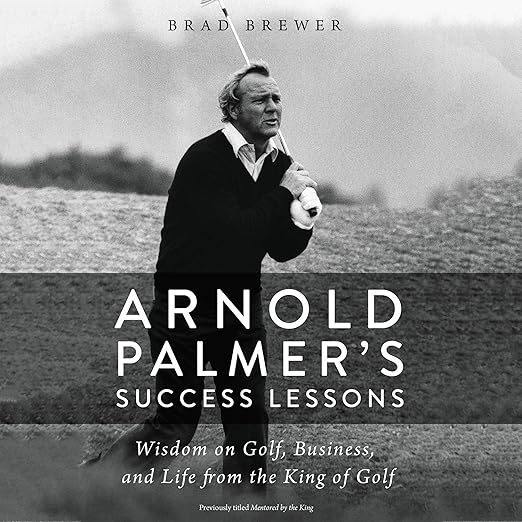
- Narration: Fred Sanders brings a respectful warmth to the material that suits the memoir-adjacent tone, he sounds like someone who genuinely admires the subject, which the book requires.
- Themes: Mentorship across decades, character as competitive advantage, the separation between public achievement and private virtue
- Mood: Warm and reflective, with the quiet authority of a lesson offered rather than a lecture delivered
- Verdict: A tribute that earns its warmth because Brewer writes about what he witnessed across thirty years, not what he read in a profile, a genuinely personal account of a genuinely singular man.
I came to Arnold Palmer's Success Lessons on a quiet Sunday evening, after a week that had been long in the way that makes you want to hear about someone who did things well. Brad Brewer's tribute to his mentor is exactly that kind of book. It does not promise to revolutionize your game or your business. It promises to tell you about a man who changed lives simply by living well, and it keeps that promise across five hours and five minutes of Fred Sanders reading it to you in a voice that sounds like someone who has also spent time thinking about what matters.
The premise is simple. Brewer was Arnold Palmer's protege for more than thirty years, a world-class golf instructor himself, he credits Palmer not just with teaching him golf but with teaching him how to move through the world. This book is his account of those lessons, organized in short chapters that each trace a specific principle back to something Palmer said, did, or modeled.
What We Made of It
What distinguishes this from the generic inspirational-figure-tribute genre is the specificity of Brewer's access. He is not writing from biographical research or filtered anecdotes. He is writing about moments he witnessed: Palmer in his hometown, Palmer as a business partner, Palmer as an employer, Palmer navigating the particular complexity of being one of the most recognized people in the world while remaining genuinely interested in other people. That proximity gives the book an authority that more distant biographies cannot replicate.
The chapters move through principles that Palmer embodied: playing for love of the game rather than the score, understanding what your starting point reveals about your destination, capitalizing on past success without being imprisoned by it, the attitude of a true champion. In lesser hands, these could be fortune-cookie wisdom. Brewer grounds each one in specific memory, which keeps them from floating into abstraction.
The Best Parts of Arnold Palmer's Success Lessons
Fred Sanders is a good match for this material. His narration carries the warmth appropriate to a tribute without becoming reverential to the point of cloying. There are moments where the material is explicitly emotional, the sections covering Palmer's final years, his return to Latrobe, and Sanders handles them with restraint rather than performance. That restraint is the right call. Palmer was apparently not a man who made a show of himself, and a narrator who understood that quality serves the book well.
The short chapter structure makes this a comfortable listen for busy weeks. Each chapter is essentially self-contained, a lesson, an illustration from Palmer's life, a reflection on its application. You can absorb it in brief sessions without losing the thread, which is an underrated practical virtue in a five-hour audiobook. The reviews, while few in number, are uniformly enthusiastic, with particular appreciation for the way Brewer captures timeless fundamentals without making them feel like cliches.
What Might Not Land
This is not a golf instruction book, and readers approaching it primarily for on-course technical lessons will be disappointed. The game is the metaphorical container for the life lessons, not the content itself. The principles are applicable to leadership, relationships, and how one chooses to live, they are not about swing mechanics or course management strategy.
The book's reach is also somewhat narrow in the sense that it depends heavily on the reader's baseline respect for or interest in Arnold Palmer himself. Brewer's portrait is admiring, necessarily so, given the relationship, and readers who are skeptical of Palmer's legend or unfamiliar with his significance to golf's public history may find less to hold onto. For anyone who understands why the King mattered, this is a rewarding account of what was behind the charisma.
The Right Listener for Arnold Palmer's Success Lessons
Golf fans who admire Arnold Palmer will find this deeply satisfying. Leadership readers interested in mentorship, long-term relationship, and character as a competitive advantage will also find genuine value. Those who want technical golf instruction or a comprehensive biographical accounting of Palmer's career should look elsewhere, this is personal, intimate, and deliberately partial in its focus on what Brewer observed at close range across three decades.
Common Questions
Is this a biography of Arnold Palmer or a memoir by Brad Brewer?
It is closer to a memoir by Brewer organized around the lessons he received from Palmer. It covers Palmer's life, childhood, career highlights, final years, but always through the lens of Brewer's relationship with him rather than as a comprehensive biographical account.
Does the audiobook contain meaningful golf instruction or is it purely a life-lessons book?
Purely life lessons. The golf metaphors and anecdotes are present throughout, but the principles Brewer extracts from Palmer's example apply to leadership, character, and how one approaches work and relationships, not to technique, swing mechanics, or on-course strategy.
How does Fred Sanders handle the more emotional passages about Palmer's later years?
With appropriate restraint. Sanders does not dramatize the material or push for sentiment, he delivers it with the kind of quiet respect that the subject seems to have embodied. That measured quality makes the emotional sections land rather than feeling manipulative.
Is this book relevant to non-golfers or primarily for fans of the sport?
The principles themselves are universal, caring for others, cherishing time, playing with integrity rather than just for outcomes. Non-golfers willing to read through the golf-specific framing will find the underlying message applicable. That said, the emotional resonance of the book depends partly on understanding why Palmer mattered to the game and to American sports culture broadly.