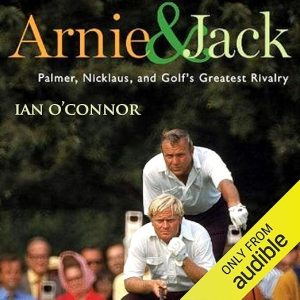
Ian O'Connor understood, when he set out to write Arnie & Jack, that the Palmer-Nicklaus story had never been told as a dual portrait. Individual biographies of both men existed in abundance. But the relationship between them, the specific chemistry of admiration, rivalry, and mutual envy that shaped modern professional golf across fifty years, had never been excavated with the kind of exclusive access and dogged reporting that O'Connor brought to this project. The audiobook, narrated by Alpha Trivette and clocking in at 12 hours and 28 minutes, is the product of over 200 new interviews, including direct access to both Palmer and Nicklaus.
The asymmetry at the heart of the book is its central drama. Nicklaus won 18 major championships to Palmer's 7. By every formal measure of on-course achievement, the Golden Bear's record was definitively superior. Yet Palmer outearned Nicklaus in endorsements for three decades and was named the top-grossing athlete in sports until Michael Jordan finally displaced him. Nicklaus had the trophies. Palmer had the love. And O'Connor's reporting reveals, with intimate and sometimes painful specificity, that each man spent significant psychological energy wanting what the other possessed.
How Arnie & Jack Holds Up
O'Connor is an award-winning sports columnist, and the craft shows in how he organizes this sprawling, fifty-year story into a series of scene-level mini-dramas. The 1962 US Open, where Palmer and Nicklaus first met properly on a course, is rendered with enough period texture and competitive detail to feel cinematic. The early involvement of both men with IMG, the sports marketing agency that shaped the commercialization of golf, is traced carefully and shows how much of what we think of as modern professional sports economics has roots in that specific partnership and the tensions within it. The later golf course design rivalries, where the two men's competitive instincts persisted long after their playing prime, add a final chapter to the story that most observers missed entirely.
One reviewer noted the book occasionally overdoes the contrast, returning repeatedly to the Palmer-as-charismatic-cowboy versus Nicklaus-as-calculating-scientist framework to a degree that can feel mechanical. That observation is fair. O'Connor's organizing contrast is effective but relentless, and readers who find themselves wanting more textural complexity in either portrait will occasionally feel the binary structure constraining. But it is worth noting that the best sports writing always contains this risk: the organizing frame that makes a story coherent can also flatten what does not fit neatly within it. O'Connor earns his frame more often than he overextends it.
The Best Parts of Arnie & Jack
Alpha Trivette brings exactly the right register to this material. Sports biography narration requires a narrator who can handle descriptive athletic passages, interview quotations from multiple voices, and analytical commentary with equal fluency, without making the transitions between those modes feel jarring. Trivette manages this well across more than twelve hours. The interview-sourced sections, where O'Connor quotes Palmer and Nicklaus directly, are particularly effective on audio because Trivette gives each man a subtle but consistent vocal distinction that helps listeners track whose perspective is being represented at any given moment.
The audio format also handles the chronological structure better than a quick summary suggests. O'Connor moves between time periods with confidence, and Trivette's narration maintains momentum through those transitions. The book is organized around thematic episodes rather than strict chronology, which can be disorienting in print but works naturally in audio because the narrative voice carries the connective tissue. Listeners who came to Palmer-Nicklaus history through watching the Masters over the years will find the audio format reactivates those visual memories in interesting ways: hearing about a specific tournament, a specific green, a specific crowd reaction brings the television images back with unexpected vividness.
Before You Commit to Arnie & Jack
Golf knowledge helps but is not required. O'Connor explains the significance of major championships, the structure of the PGA Tour, and the specific tournaments that mattered most to the rivalry with enough context that non-golfers can follow the competitive narrative. Where the book assumes familiarity is in the emotional register: why a gallery cheer matters, what it means for a player to control or lose a crowd, the specific psychology of a playing partner who is also your primary competition. These are dynamics that golf fans will feel instantly, while non-golf readers will need to build that emotional vocabulary from the text alone.
The book's final section, covering the decades after both men's competitive prime and particularly the warmth that developed between them in their final years, is among the most moving parts of the text. O'Connor does not sentimentalize it, but he does not underplay it either. The fifty-year story that began at the 1962 US Open ended with something neither man quite expected from a rivalry that fierce: genuine mutual respect, and in some accounts, genuine affection. Hearing that evolution narrated by Trivette in the closing chapters is the emotional payoff of a long and detailed book.
Should You Listen to Arnie & Jack?
This audiobook is for golf fans who want the definitive account of the most consequential rivalry in the sport's modern history, and for sports biography readers interested in how competitive relationships shape careers, personal identities, and the commercial structure of professional sports. O'Connor's access, his 200-plus interviews and direct time with both principals, produces a level of detail and intimacy that most dual sports biographies cannot match. Trivette's narration is strong enough that the twelve-plus-hour runtime passes quickly.
Non-golf readers can follow the narrative but may find some of the tournament-specific sections slower going. Readers who want a quick introduction to either Palmer or Nicklaus individually might be better served by a single-subject biography first. But for listeners who want the full story, including the boardroom rivalries, the marketing battles, the course design wars, and the complicated late-career friendship, Arnie & Jack delivers it with the reporting depth the subject deserves. The 4.5 rating across 260 reviews reflects a substantial listening audience that found this one of the better sports biographies in recent memory.
Frequently Asked Questions
Do you need to know golf well to enjoy this audiobook?
Golf familiarity helps with the emotional stakes, but O'Connor provides enough context about major championships and tour structure for non-golf readers to follow the competitive narrative. Where the book assumes knowledge is less in rules and more in feeling: why crowd reaction matters to these particular players, and why specific tournaments carried the weight they did.
Is this audiobook primarily about golf or about the broader business and cultural impact of Palmer and Nicklaus?
Both, but with genuine depth on the business side. O'Connor traces the origins of modern sports marketing through Palmer and Nicklaus's early involvement with IMG, their endorsement strategies, and their later golf course design rivalries. The book argues that their competitive dynamic did not just shape golf but helped create the commercial architecture of modern professional sports.
How does Alpha Trivette's narration hold up across twelve hours of sports biography in this audiobook?
Reviewers and the consistent 4.5 rating suggest Trivette handles the long-form narration well. He moves between descriptive athletic passages, analytical commentary, and interview quotations with fluency, and gives Palmer and Nicklaus distinct enough vocal registers that listeners can track whose perspective is being represented. Sports biography is a demanding narration genre and Trivette meets its requirements.