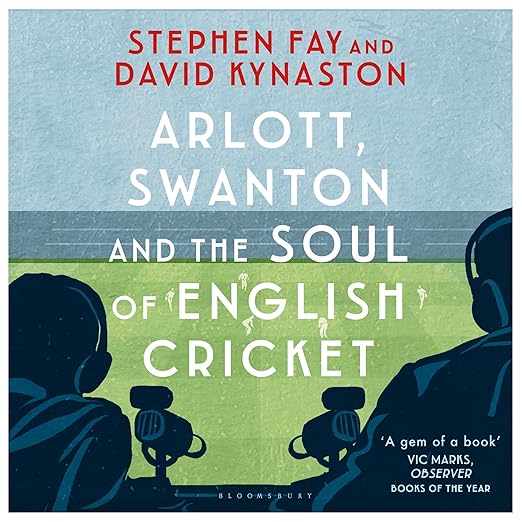
- Read by: Mark Meadows brings measured authority to Fay and Kynaston's prose, handling the class distinctions between Swanton's crispness and Arlott's Hampshire warmth with audible care.
- At its heart: Post-war British identity, class and broadcasting, cricket as cultural mirror
- Vibe: Richly textured, elegiac, and socially alive
- Short version: A serious, well-crafted dual biography that earns its place alongside the finest cricket writing of the past two decades.
Stephen Fay and David Kynaston's collaboration arrives on audio as exactly the kind of audiobook that rewards unhurried listening. I put it on during a long stretch of travel and found myself rationing the chapters, reluctant to arrive. The subject is ostensibly two men, two voices, two temperaments. But the deeper subject is England itself, refracted through the peculiar lens of cricket broadcasting in the decades after the Second World War.
John Arlott and E.W. 'Jim' Swanton were not friends. They were barely colleagues in any warm sense. Yet for a generation of listeners, their voices on BBC radio defined what cricket meant, and what England sounded like to itself. This audiobook takes that premise seriously and never lets it become mere anecdote.
Fay and Kynaston are both accomplished historians, and their near-seamless collaboration, as the Times Literary Supplement noted, keeps the book 'shrewd, worldly, balanced and fresh.' The achievement is a dual biography that never privileges one subject over the other, even as it makes clear how different the two men were in origin, manner, and politics. Swanton's voice was upper-class, imperial, certain of its own authority. Arlott's Hampshire burr carried the weight of a different England entirely, working-class, angular, liberal in the old sense. That these two men could both become beloved institutions of the same sport, heard by the same millions, says something about cricket's peculiar role in the national imagination.
The book covers the years from the immediate post-war period through 1980, and Kynaston and Fay are careful to embed the cricket in its social context. The dismantling of the amateur-professional distinction within the sport mirrors the broader shifts in British society, and the authors draw those parallels without straining them. One reviewer who attended first-class matches beginning in 1961 noted that the historical research rang true to lived experience, which is the kind of endorsement a social history most needs.
The two men's contrasting politics are also drawn with care. Swanton's conservatism was as much temperamental as ideological; Arlott's liberalism was forged by the class he came from and the causes he championed outside cricket, including his opposition to apartheid-era South African cricket tours. The book handles these dimensions without reducing either man to a political category.
Why It Works in Audio
Mark Meadows is the right narrator for this material. He never overplays the contrast between the two voices the book constantly circles, though he finds the registers that distinguish Swanton's crispness from Arlott's more ruminative delivery in the quoted passages. At nearly twelve hours, the audiobook has room to breathe, and Meadows uses that space well, maintaining a pace that feels like a long innings rather than a Twenty20 sprint.
The audio format suits this kind of social history. The writing is dense with names, matches, and dates, but Meadows grounds the narrative consistently enough that a listener new to cricket history can follow the arc. A reviewer gave the book to her father, an Arlott devotee, who described it as 'a good social commentary on the game of cricket,' which undersells it slightly but captures the spirit. The Daily Mail called it 'one of the best cricket books I've read in years,' and on audio that judgment holds.
What the audiobook captures particularly well is the texture of an era. Long-forgotten matches are made, in the Daily Mail's phrase, to 'live and breathe as though they were played yesterday.' That quality of historical resurrection is hard to achieve in any format, and harder still to carry across in audio without the visual anchor of photographs or scorecards. Fay and Kynaston achieve it through writing, and Meadows delivers it through voice.
Weak Spots in Arlott, Swanton and the Soul of English Cricket
One reviewer suggested the book might be 'predicated on a false premise,' by which he meant the two men's careers and characters may not be as directly opposed as the dual-biography structure implies. That is a fair caveat. Arlott and Swanton did share airspace and occasionally shared opinion, and a book that insists on them as polar opposites risks flattening the documentary record. Kynaston and Fay are aware of this tension, and mostly navigate it well, but listeners invested in nuance may occasionally feel the structure pulling at the material.
The book is also primarily a history of English cricket from the inside, which means its perspective is English and male throughout. Women appear at the margins; non-English players appear in the context of touring sides. If you come to this expecting a broader reckoning with cricket's colonial history, you will not find it here. What you will find is a meticulous, generous account of a very specific cultural moment, with all the pleasures and limitations that focus entails.
The Telegraph Cricket Book of the Year Award for 2019 signals the audience the book was written for, and that audience will not be disappointed. For those outside the cricket world approaching the book primarily as social history, some patience with the match-by-match detail is the price of entry, but it is a price worth paying.
Recommended For
Cricket enthusiasts who remember the post-war era will find this essential listening, but the audience need not be limited to them. Anyone interested in how broadcasting shapes national culture, how class inflects public life, or how a sport becomes a mirror for its society will find Fay and Kynaston's collaboration rewarding. It works as social history with cricket as its vehicle, not just as cricket writing with social history as its backdrop.
Listeners with no prior interest in cricket may find the match references challenging, but the human drama and cultural argument carry the book even in those passages. It is not, however, a light listen. This is a serious work, carefully made, and it asks for a reader's full attention. Give it that, and it returns something close to the Mail on Sunday's verdict: unputdownable.
Does the Arlott, Swanton and the Soul of English Cricket audiobook work for listeners who don't follow cricket closely?
Yes, with some patience. The match histories and player names require concentration, but the book's argument about class, broadcasting, and national identity is accessible to anyone interested in British cultural history. Meadows's narration keeps the pace intelligible even during dense cricketing passages.
Is this audiobook more about cricket or about social history?
Both, genuinely. Kynaston and Fay use the careers of Arlott and Swanton as a lens for understanding how England changed between 1945 and 1980. The cricket is the medium, not just the subject, and the social history runs through every chapter.
Does the audiobook cover the famous differences between Arlott and Swanton's political views?
Yes. Swanton's conservatism and Arlott's liberalism, including his outspoken opposition to apartheid-era South African cricket tours, are treated as central to understanding both men. The book handles these dimensions with care rather than reducing either figure to a political type.
How does Mark Meadows handle the quoted material and the different styles of the two subjects?
Meadows is a controlled, authoritative narrator. He doesn't attempt full character voices, but he modulates tone when moving between the two men's styles, giving enough distinction to follow whose words belong to whom without theatricality.