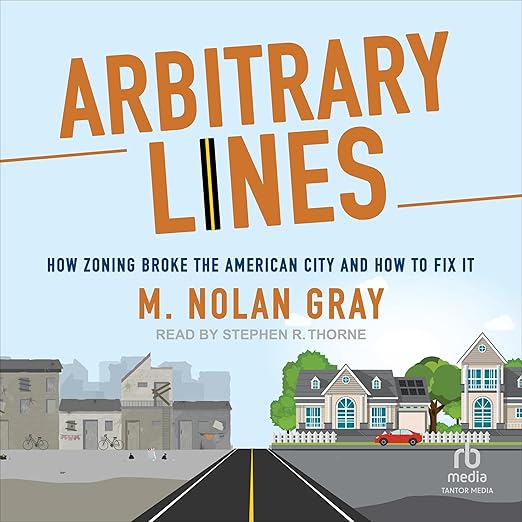
Zoning is one of those policy instruments that operates at the center of American life while remaining almost completely invisible to the people it shapes. The arbitrary lines Gray refers to in this audiobook's title are the ones drawn on maps across every American city, determining where housing may be built, how densely, at what cost, and for whom. M. Nolan Gray makes the case over seven hours that these lines, which most people never examine and many assume are technical necessities, are actually political choices with enormous consequences for affordability, equity, and the environmental performance of cities. Stephen R. Thorne's narration navigates that argument with a clarity that matches Gray's prose.
Thorne's Clarity Serves a History of Segregation
Gray brings firsthand professional credibility to this material. Reviewer Megan Hansen specifically flagged his experience as a city planner in New York City as one of the book's assets, giving the critique of zoning a grounded quality that distinguishes it from abstract policy theorizing. The book is organized to move a general reader through the subject methodically: first, how zoning actually works and why it was adopted, a history that is more contingent and politically motivated than most civic mythology suggests; second, the major contemporary critiques of zoning across economic, equity, and environmental lines; and third, what reform looks like in practice and what a post-zoning planning framework might involve. That arc is well judged and makes the book accessible to listeners with no background in urban planning. The historical section is particularly strong, revealing how zoning was adopted in the early twentieth century not as a neutral technical tool but as a mechanism for enforcing racial and class segregation that has proven far more durable than the overtly discriminatory laws it often supplemented. That history reframes what might otherwise seem like a dry regulatory debate into something with real moral stakes attached to it.
Minneapolis, Fayetteville, and Hartford Are Already Reforming
The case studies Gray marshals are one of the audiobook's genuine pleasures. He draws on cities as different as Minneapolis, Fayetteville, and Hartford to show that zoning reform is already underway in diverse political contexts, not just in predictably progressive coastal cities. He also points to American cities that have managed land-use planning without traditional zoning at all, which defuses the common objection that zoning abolition would create chaos rather than housing. Reviewer Shane Fields, who identified himself as an urban planner and planning graduate student in California, offered a careful qualified endorsement: he found the critique of zoning largely fair and the first half of the book an excellent explanation of the planning profession in accessible terms, even while disagreeing with some of Gray's prescriptions. That kind of engaged critical reading is exactly what a serious policy book earns. At seven hours, the audiobook is long enough to develop its argument fully without overstaying its welcome.
The Weakest Case Is What Replaces Zoning
Gray is explicitly a reformer, and Arbitrary Lines reads as advocacy as much as analysis. That is not a disqualification, but listeners expecting a balanced pro-and-con survey of zoning will need to adjust their expectations. The book argues a position clearly and makes a strong case for it. Where it is most open to challenge is in its treatment of what would replace zoning's land-use functions if the system were abolished or radically reformed. Gray addresses this, but the affirmative vision for post-zoning planning is less fully developed than the critique of the existing system. The book is also primarily focused on American cities, and its arguments about segregation, parking minimums, and apartment bans are most directly applicable to the US context, though listeners from other countries will recognize similar patterns in their own planning systems and find the analytical framework portable even when the specific examples are not.
For Anyone Confused by the Affordability Crisis
This audiobook is essential for anyone who has found themselves confused or frustrated by the housing affordability crisis in American cities and wants to understand its structural causes rather than its symptoms. It is also valuable for voters, local government participants, and engaged citizens who want to evaluate zoning reform proposals in their own communities with some actual analytical framework behind them. Readers who have encountered the YIMBY movement or housing policy debates online and want a sustained, documented argument rather than fragmented social media discourse will find exactly that here. Urban planners and policy professionals will find less that is new but may still appreciate the clarity with which Gray synthesizes the critique. For anyone coming to this subject fresh, Arbitrary Lines is the most direct and well-organized introduction to the politics and consequences of zoning available in audio form today. The book has already proven influential in policy circles, and readers who engage with it seriously will find themselves better equipped to evaluate the housing and land-use debates that are playing out at city council and state legislature levels across the country right now. The book has already proven influential in policy circles, and readers who engage with it seriously will find themselves better equipped to evaluate the housing and land-use debates that are playing out at city council and state legislature levels across the country right now. For anyone who wants to understand what is actually driving the housing crisis, this audiobook provides the clearest and most accessible analysis available. The book is a necessary read for anyone who wants to understand the housing affordability crisis as a policy problem with a history rather than simply a market phenomenon with no particular cause.
In Brief
- Narration: Stephen R. Thorne presents M. Nolan Gray's policy argument with measured authority, keeping the material engaging through what could easily be dry regulatory territory.
- Themes: Zoning reform, housing affordability, urban planning and equity
- Mood: Analytical and reform-minded, with a controlled but clear sense of urgency
- Verdict: A well-argued case that zoning is both more consequential and more reversible than most people realize, essential listening for anyone who wants to understand why housing is so expensive in American cities.
Does the Arbitrary Lines audiobook require any background knowledge in urban planning or policy?
No. Gray explicitly structures the book to bring a general reader through the subject from foundational concepts to reform proposals. Reviewer feedback from both planners and non-specialists suggests the material is accessible at multiple levels of prior knowledge.
Is Arbitrary Lines audiobook more of a neutral policy overview or does it advocate a clear position on zoning?
It advocates clearly for zoning reform. Gray is a reformer making a case, not a neutral surveyor of competing views. The argument is well supported and fairly presented, but listeners expecting balanced coverage of arguments for and against zoning should know the book has a point of view.
Does Stephen R. Thorne's narration make the technical policy content more accessible in this audiobook?
Thorne reads with measured authority that keeps the material moving without flattening it. For a subject that involves regulatory history, planning jargon, and statistical claims, a narrator who maintains a consistent analytical tone is important, and Thorne delivers that.
Does the Arbitrary Lines audiobook cover specific cities or is it more theoretical?
Both. Gray grounds the argument in specific case studies including Minneapolis, Fayetteville, Hartford, and cities that operate without traditional zoning. The specific examples are one of the book's strengths, making the abstract policy argument concrete and verifiable.