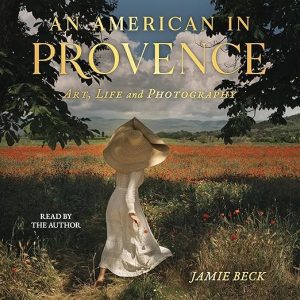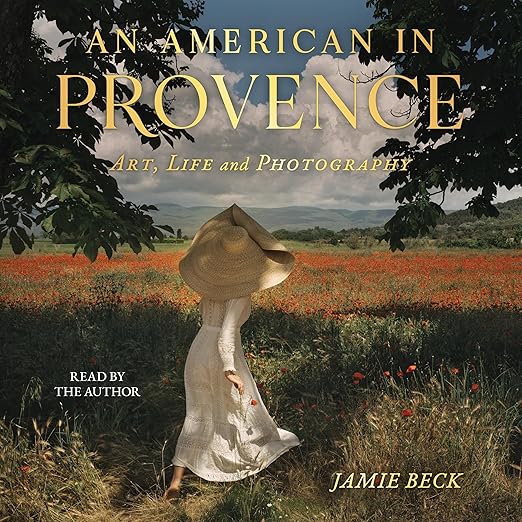
Provence arrives first through Jamie Beck's photographs: sun-bleached stone farmhouses, lavender rows, a table set outdoors with wine and bread. That is the difficulty and the opportunity of turning An American in Provence into an audiobook, since the printed edition is built as much around Beck's own portrait, scenic, and still-life photography as around her prose. What survives the transition to audio is the memoir underneath the images: a fashion photographer who left a fast-paced New York City career, meaning to slow down in the French countryside for one year, and stayed five, chronicling her transformation as a photographer, a mother to her daughter Eloise, and a woman rebuilding her sense of self an ocean away from everything familiar. Beck narrates her own audiobook, and that choice turns out to matter more than the missing visuals do.
Beck Chooses to Risk a Successful Career
Self-narration is the right call for a book this personal. Beck is not a trained voice actor, and it shows in the small ways that ultimately work in the book's favor: pauses that land where her own thinking pauses, not where a script direction would put them, and a warmth in the passages about Eloise's birth that a hired narrator, however skilled, would have to manufacture rather than simply access. One review here describes the essays as open, real, humble, breathtaking, inspiring and visceral, with a kind of disarming honesty that only comes from an artist, and that disarming quality depends on hearing Beck's actual voice describe her own career, body, and spiritual transformation rather than a performance of it secondhand.
Structurally, this book asks a lot of itself: part art book, part travelogue, part memoir, part cookbook, four distinct modes stitched into one narrative. In print that hybrid format works because the reader can flip between a recipe, a photo spread, and a paragraph of reflection at will. In audio, everything arrives in a fixed sequence, and the transitions between Beck describing a lavender field and Beck walking through a recipe for spring chicken with herbes de Provence can feel abrupt without a visual cue to signal the shift. It mostly works because her narration voice stays consistent across all four modes; the throughline is her personality, not the format.
It helps to know what Beck actually left behind. Before Provence, she and her husband built a career as sought-after fashion and lifestyle photographers, shooting ad campaigns and editorial work on a nonstop New York City schedule, the kind of career most working photographers spend a lifetime chasing. Walking away from that momentum voluntarily, not because the work dried up but because it was consuming her, gives the book's central decision real weight; this is not a story about someone escaping failure, it is a story about someone choosing to risk a successful career for an uncertain one.
The Memoir Is What Audio Does Best
Be clear-eyed about what audio cannot deliver here. The book's title alone signals photography as a co-equal element, and a portrait or scenic photograph loses everything in translation to sound; a narrator describing a photo of her daughter in a lavender field is not the same experience as seeing it. The recipes face a milder version of the same problem: braised beef stew and lemon meringue tart translate fine as spoken instructions, but a home cook actually wanting to follow along while cooking will need the print or ebook edition open on the counter regardless of how good the narration is. Go in expecting the memoir portion to be what audio does best here, not the visual or culinary portions.
The reviews attached to this listing back that reading. One listener describes traveling through the Luberon region of Provence herself and recognizing so many of the exact villages Beck photographs and describes, a specific, personal kind of corroboration that only comes from someone who has actually stood in the places being described. Another reviewer calls it a mini vacation every time she picks it up, a phrase that works just as well, maybe better, for something you can listen to during a commute or a walk rather than something that requires sitting with a physical book open. Enough material sits inside this eight-hour-and-four-minute runtime to support that kind of repeat, dip-in listening across many separate sessions.
The audiobook's chapter breaks are worth using deliberately rather than listening straight through in one sitting, given how essayistic the structure already is. Because each chapter tends to circle a single theme rather than advance a strict timeline, replaying a favorite section, the passages on Eloise's birth, or on the specific fear of starting over creatively in a new language and culture, works well on its own even out of sequence, closer to how a reader would revisit a favorite essay in the print edition rather than rereading a whole chapter.
It Began as an Instagram Documentary Project
The five-years-condensed-into-one-book scope means pacing is uneven by design. Some sections move quickly through a full year of adjustment to rural French life, while others slow down to sit inside a single afternoon or a single photograph's backstory for much longer. Listeners expecting a tightly chronological travel memoir, one year, clearly marked, moving in a straight line, should recalibrate: this reads more like a scrapbook narrated in roughly the order Beck assembled it, occasionally circling back to a theme, slowing down, artistic risk, motherhood, from a new angle rather than advancing a single timeline forward. That structure suits the material's photographic, moment-by-moment origins, but it is worth knowing before pressing play expecting strict memoir chronology.
Worth flagging plainly: this began as an Instagram documentary project, Beck's own account chronicling her life as an American in Provence in real time, before becoming a book, and that social-media-diary origin shapes the tone throughout. Passages read like expanded captions as often as they read like traditional memoir prose, intimate and immediate rather than polished into a single sustained narrative arc. Readers who already follow her photography online will recognize specific images and moments described here; readers coming to this cold, with no prior familiarity with her work, may want to sample a chapter first to confirm the register suits them before committing to the full runtime.
Choose Print Instead for the Photography Itself
Recommended warmly for Francophiles, photography enthusiasts curious about the creative and business realities behind a career reinvention, and anyone drawn to slow-living, escape-the-city memoirs. Beck's own narration is the strongest argument for choosing audio specifically: hearing an artist describe her own transformation, in her own unpolished voice, adds a layer of intimacy her prose alone would not fully carry. Listeners who enjoy memoirs built around a specific place, the way a location itself becomes a character, will find plenty to like in how thoroughly Provence saturates every chapter.
Skip the audio edition specifically, though not necessarily the book itself, if the photography and cookbook elements are your primary reason for buying; those readers should choose print or ebook instead, where the visual material can actually do its job. Listeners wanting a strict, chronological travel narrative rather than an essayistic scrapbook should also look elsewhere. For everyone else drawn to a genuine, specific story of reinvention in the French countryside, narrated by the person who lived it, this is an easy recommendation.
Key Details
- Voice: Jamie Beck narrates her own memoir with unpolished, genuine warmth that a hired narrator could not fully replicate.
- Big ideas: artistic reinvention, slow living in the French countryside, motherhood and identity transformation.
- Atmosphere: Sun-warmed, reflective, intimate.
- Worth it?: Worth it for the memoir and Beck's own voice, but photography and cookbook lovers should buy the print edition instead.
Does the audiobook edition of An American in Provence include Jamie Beck's photography?
No. The audiobook carries only the spoken memoir, travelogue, and recipe text; the portrait, scenic, and still-life photography that anchors the print edition cannot transfer to audio. Photography-focused buyers should choose the print or ebook version instead.
Does Jamie Beck narrate her own audiobook, and does that matter?
Yes, Beck reads the entire book herself, and her unpolished, personal delivery adds real intimacy to passages about her daughter's birth and her own career transformation that a hired narrator would likely struggle to match.
Can I follow the cookbook recipes in An American in Provence using just the audiobook?
It is possible but not ideal. Recipes like the braised beef stew and lemon meringue tart translate as spoken instructions, but cooks who want to follow along hands-on while preparing them will want the print or ebook edition open alongside the audio.
Is An American in Provence more memoir or more travel guide?
It reads primarily as memoir and travelogue rather than a practical travel guide, built around Beck's personal reinvention story rather than itineraries or logistics for visiting Provence yourself.