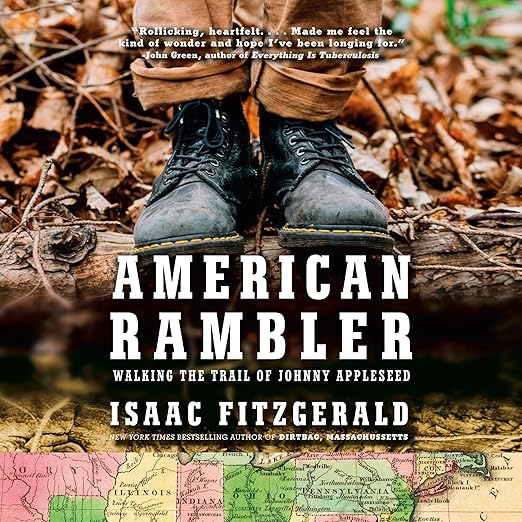
Every fact worth having about this audiobook comes from one paragraph of publisher copy, and that paragraph is unusually concrete. Isaac Fitzgerald walked from Massachusetts to Indiana across a year, following the path of Johnny Appleseed, and the announcement says the result is a reckoning of loss and grief, ritual and faith, grimy gas-station bathrooms and scenic apple picking. That last pairing is the most informative thing anywhere on the record. A publicist willing to put gas-station bathrooms next to apple picking is telling you this is not a pastoral, and that nine hours of it will include the parts of a long walk nobody photographs.
Is American Rambler Worth Your Time?
Neither the author field nor the narrator field surprises on its own; together they do something worth noticing. Isaac Fitzgerald wrote the book and Isaac Fitzgerald reads it, which for a first-person walking memoir is the arrangement that makes the most sense and is nowhere near guaranteed. The copy quotes a line from inside the text: it's a difficult thing, to separate legend from story from memory from fact. In a self-narrated recording that sentence arrives in the voice of the person doing the separating, with whatever hesitation or weight he actually meant it to carry. A hired reader would deliver it as a proposition. Read by its author, it becomes an admission.
Once you look past the walking, the underlying shape here is a father book. The publisher's paragraph is explicit about where the fascination started: family ties to the legend, his father's larger-than-life stories, and a shared restlessness to leave home and discover what lies beyond. Johnny Appleseed is the route, not the subject. Loss and grief are named before ritual and faith in the publisher's own list, and the sentence about separating legend from story from memory from fact reads like a thesis for a man crossing country his father narrated to him first. Nine hours gives that enough room without turning it into an endurance test. The announcement does one more thing worth registering: its middle paragraph is nothing but that quoted sentence, set apart on its own like an epigraph. Publishers rarely hand a whole paragraph to thirteen words unless they are convinced those thirteen words are the pitch, which suggests the separating of legend from fact is the argument and the walk is the vehicle.
The Best Parts of American Rambler
Some of the most useful information here has been filed in the wrong slot. The genre reads sports and outdoors and the tag reads Walking, while nothing in the description suggests an athletic undertaking of any kind. What the publisher actually describes is a blend of memoir, history and travelogue, an ode to the American heartland and an antidote to the breakneck pace of modern life, which belongs on a completely different shelf. Anyone arriving from the outdoor category will get a book about grief and inheritance with a long walk running through it. Anyone who wanted that book has been looking in the wrong aisle for it.
Listeners get something from a walking memoir in audio that the printed page cannot supply. Nine hours is about the length of a long day outdoors, and a book built out of miles tends to sit well against actual miles; the rhythm of a reading and the rhythm of your own feet do not fight one another. Random House Audio has produced it straightforwardly, one voice, author-read, no cast and no apparatus, which suits material that moves in a line from one state to the next. The structure is episodic by nature. You can leave it at one town and rejoin it at the next without any sense of having missed a turn.
Before You Commit to American Rambler
None of the usual signals exist yet. This record went live on May 12, 2026 and has attracted no grade whatever: the rating field is empty, the vote count is empty, and nobody has written a line. Every judgment currently available about pacing, delivery or the shape of the last third belongs to the publisher, and publishers are not neutral witnesses. The copy calls the journey epic and the reckoning profound, two adjectives that do no work at all. Strip them out and what remains is still substantial: a route, a distance, a year, a named legend, and a first-person voice belonging to the person who did the walking.
When the copy opens with New York Times bestselling author, it is asking you to buy on reputation before description, which is worth registering and never worth resenting. Two other things deserve weighing. The duration reads nine hours with no minutes attached, round enough to read as an approximation rather than a measurement, so allow some slack either side of it. And the walk is described as year-long while the recording runs nine hours, which means heavy compression: a year of days rendered as a single working day of listening. Anyone hoping for the granular daily texture of a trail diary should adjust downward before starting. The price field, for what it is worth, reads $0.00, which is a catalog artifact and no statement about value and should not be taken for a promotion.
Should You Listen to American Rambler?
The natural audience is people who read grief memoirs and people who read about American roads, two groups that overlap more than either tends to admit. If you want a book that uses a landscape to think about a father, nine hours in Fitzgerald's own voice is a strong offer. Walkers get the practical texture promised in that opening paragraph, the gas stations along with the orchards. Anyone drawn to American folklore gets Johnny Appleseed approached as something to be sorted out of legend and into fact, which the quoted line names as the project, with the backdrop somewhere behind it. Reading groups will find plenty to work with too, since a memoir that sets out to separate legend from fact hands a discussion its opening question free of charge.
A few listeners should hold off. If ratings drive your buying, this record has none to offer and will not for a while, so waiting costs nothing at all. Should the sports classification be what drew you in, the description promises something else entirely and will lose you at the first mention of ritual and faith. And if a year compressed into nine hours sounds thin, it may prove to be. Everything else points the right way: one voice, one route, one inheritance being walked off. Start it on a day you are going somewhere on foot.
- Read by: Isaac Fitzgerald reads his own book, which puts the line about separating legend from fact in the voice that owns it
- At its heart: A father's stories, grief walked off across a year, Johnny Appleseed used as a route more than as a subject
- Vibe: Unhurried and road-worn, gas stations as much as orchards
- Short version: Strong material and a self-read voice, with nothing independent yet to check either against.
Common Questions
What does Isaac Fitzgerald reading his own audiobook change?
Quite a lot, for a memoir. The publisher quotes a line about how difficult it is to separate legend from story from memory from fact, and in a self-narrated recording that sentence carries the hesitation of whoever wrote it. A hired reader would simply state the idea. Fitzgerald has to stand behind it across nine hours.
Why is a walking memoir filed under sports and outdoors?
Because the tag reads Walking and the classification appears to have followed it there. The publisher describes memoir, history and travelogue braided together, aimed at readers who want the American heartland and a slower tempo than the one they live at. Nothing in that is athletic. Expect inheritance and grief, not training, distance or gear.
Should I wait for listener feedback before buying this audiobook?
If ratings guide your decisions, yes. The record went live on May 12, 2026 with an empty rating field, an empty vote count and not one written response, so nothing independent exists to weigh. Every current claim about pacing and delivery comes from the publisher. Waiting costs nothing, and the record will fill in eventually.