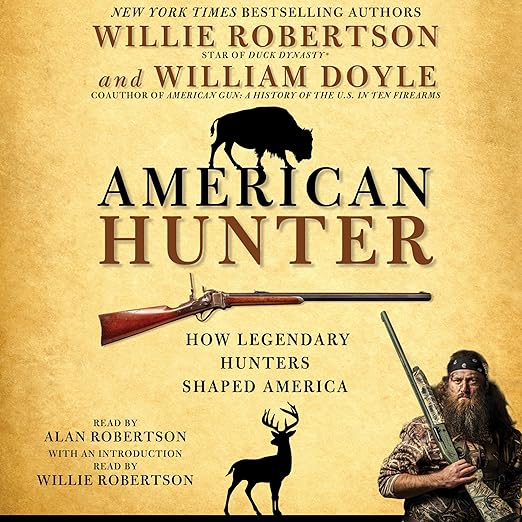
Teddy Roosevelt once declared that the virility and clear-sighted common sense of the American people owed itself to a nation of hunters. Willie Robertson and coauthor William Doyle open American Hunter, the audiobook narrated by Alan Robertson, by taking that claim seriously rather than treating it as a slogan. This is a sweeping tour through the history of hunting in North America, from Plains Indian culture to Daniel Boone, Davy Crockett, Buffalo Bill, and eventually the Duck Dynasty generation, narrated by a voice that carries the weight of genuine family legacy. Hearing Alan Robertson read his brother's words gives the listen an intimacy that a hired narrator simply could not replicate.
A Closer Look at American Hunter
Robertson and Doyle make an effective pairing. Doyle, best known as the coauthor of American Gun, brings historical structure to material that could easily turn self-congratulatory in less disciplined hands. The result is a book that moves chronologically and thematically, opening with Plains Indian hunting culture and tracing a lineage through Daniel Boone, Davy Crockett, Kit Carson, Buffalo Bill, and Teddy Roosevelt before landing in the twentieth century with Hemingway, Lyndon Johnson, and eventually the Robertson family itself. That arc gives the book genuine scope rather than the compressed spotlight of a single-subject biography.
Alan Robertson's narration is the right choice for this material. He is not a professional audiobook narrator, and that shows in the most useful possible way. He reads with the cadence of someone telling stories around an actual fire, not performing them. Some listeners expecting a polished production will notice the difference; listeners who came for the substance and the authenticity will appreciate it. At five hours and eight minutes, the listen moves efficiently, and the Roosevelt sections in particular carry real energy, drawing on TR's own words about hunting as a crucible for national character. The parallel structure between individual biography and the history of specific hunting traditions gives the book depth that a simple celebrity-hunter memoir would not achieve.
What Willie Robertson Gets Right
One of the book's most effective choices is treating the evolution of hunting traditions as parallel threads in American cultural history rather than as background context. Robertson and Doyle trace fox, rabbit, deer, squirrel, duck, goose, and big-game hunting as distinct traditions with their own social meanings, equipment histories, and regional characters. The sections on hunting weapons double as a catalog of American ingenuity and industrial development, connecting the story of the rifle to the story of the frontier in ways that feel earned rather than tangential. For listeners interested in the history of American material culture, those sections carry value beyond their sporting context.
Reviewer Douglas Egenolf noted the book's movement from dark history into the light of conservation, and that arc is one of its more mature qualities. Robertson and Doyle do not shy away from the periods when unregulated hunting devastated species populations; they treat the conservation movement as a natural extension of the hunter's relationship with the land, which is a more nuanced position than critics might expect from this pair of authors. That willingness to sit with complexity makes American Hunter a more honest piece of American history than its premise might initially suggest. For listeners who came up in households where hunting was a seasonal rhythm rather than a political statement, this audiobook will land with particular resonance.
The Robertson family's own story, woven into the final sections, functions less as celebrity memoir and more as a case study in how hunting culture is transmitted across generations, and why that transmission matters to families who see it as fundamental to identity. Reviewer Sean Ryno specifically highlighted the personal stories tied to the overarching theme of each chapter as a favorite element, and that structural choice, weaving autobiography into history rather than separating them, is where the book finds its most distinctive voice.
Things to Know Before Starting American Hunter
Listeners approaching from outside hunting culture should know that the book is written from inside it, without apology. That is not a flaw; it is a perspective, and it is consistently stated. The narrative does not engage seriously with debates about trophy hunting, animal welfare ethics, or the environmental politics of hunting lobbies. If those are the questions you bring to the listen, you will find them largely absent. The book's argument is about heritage, skill, and conservation, and it stays there.
The scope is also somewhat uneven. The sections covering Plains Indian hunters and early colonial-era figures are necessarily compressed compared to the twentieth-century material, where Robertson and Doyle have more primary sources and personal connection. Some reviewers have noted that depth fluctuates by chapter, with the Roosevelt and Robertson sections hitting hardest while some earlier chapters read more like encyclopedia entries than narrative history. In audio, that unevenness is smoothed somewhat by Alan Robertson's storytelling instincts, but it is worth noting for listeners expecting consistent narrative texture throughout.
Who Willie Robertson Is Writing For
American Hunter is built for listeners who already love hunting culture and want to understand its lineage, and it delivers exactly that. History readers with an appetite for portraits of outsized American personalities will find enough here to stay engaged even without a personal connection to the outdoors. Fans of Willie Robertson who came through Duck Dynasty will hear his voice in this book's values and rhythms, even when Alan is the one delivering them. Listeners who approach hunting from outside the tradition or who are looking for a more critical engagement with the subject will likely find the book's perspective too settled to be revelatory. For its intended audience, though, this is a reliable and well-structured listen.
Before You Listen
Do you need to be a hunter to enjoy this audiobook?
Not necessarily. The historical sweep covering figures like Teddy Roosevelt, Daniel Boone, and Davy Crockett gives non-hunters enough to engage with, though the book's emotional center is firmly inside hunting culture.
Why is Alan Robertson narrating instead of Willie Robertson himself?
The audiobook uses Alan Robertson, Willie's brother and a Duck Dynasty castmember, as narrator. His delivery has the storytelling quality of someone who lived this culture, which suits the material well even if it lacks the finish of a professional audiobook narrator.
Does the audiobook cover environmental ethics or just celebrate hunting?
Reviewer feedback highlights that the book addresses the conservation movement and darker periods of American hunting history. It is written from inside hunting culture, however, and does not engage with animal welfare debates or trophy hunting controversies.