In Brief
- Narration: LJ Gasner handles nearly fourteen hours of dense archival biography with consistent pacing, locating the narrative thread without flattening the complexity.
- Themes: Forgotten athletic greatness, institutional friction and legacy, the cost of competitive obsession.
- Mood: Measured and historically immersive, like reading a long-form magazine investigation aloud.
- Verdict: A rigorous, archivally grounded biography of a genuine football legend that earns its length and its argument.
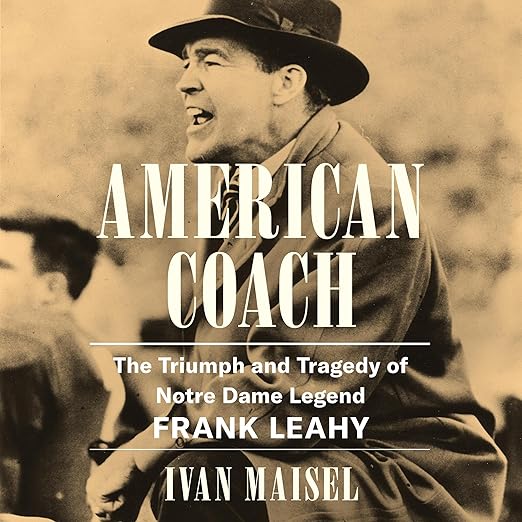
Ivan Maisel has spent decades covering college football, and it shows in every sentence of this audiobook. American Coach reconstructs the career of Frank Leahy with the kind of archival depth and sourcing discipline that separates serious sports biography from hagiography. Narrated by LJ Gasner over nearly fourteen hours, this is not a book for casual football fans looking for highlight reel nostalgia. It is an examination of a man who won at the highest level, repeatedly, and still managed to be almost entirely forgotten, a paradox that Maisel treats with the seriousness it deserves.
How American Coach Holds Up
The central puzzle Maisel sets out to solve is why Frank Leahy, with a career winning percentage of .864 (second only to Knute Rockne), six undefeated seasons, and four national championships across eleven seasons at Notre Dame, has virtually disappeared from the public memory of college football. The answer Maisel constructs is not a simple one. Leahy's compulsive need to win made him enemies. His tactical innovations, brought to a program that was deeply reluctant to change anything Rockne had established, generated institutional friction. His health collapsed under the pressure he placed on himself. And when he left after the 1953 season, the Notre Dame administration did not exactly light candles at his altar.
Maisel had rare and complete access to the University of Notre Dame's historical archives and the cooperation of Leahy's family, and that access shows. The sourcing in this biography goes beyond the usual sportswriter's toolkit of game accounts and interviews with former players. Maisel reconstructs Leahy's relationships with presidents and movie stars, his appearance on the cover of Time magazine, and the specific institutional politics of a Catholic university that wanted football success but sometimes did not want Frank Leahy's methods of achieving it.
Why American Coach Works as an Audiobook
LJ Gasner's narration suits the material well. The book is dense with names, dates, game accounts, and institutional detail, and Gasner never lets the delivery become a recitation. He finds the narrative through-lines and lets them carry the listener across the stretches of archival reconstruction that might otherwise feel dry. At thirteen hours and forty-five minutes, the book has genuine mass, and Gasner's pacing choices matter over that length. He handles the sections about Leahy's deteriorating health and his conflicts with the Notre Dame priests with the appropriate gravity, not sentimentality.
Reviewer David Meekison praised the 'very detailed analysis' of Leahy's life and specifically the insight into 'what made the man tick.' Reviewer trips03, who admitted to not being a Notre Dame fan, still called it 'an outstanding work, both historically and football related.' That non-partisan response is significant: Maisel has written a book about Notre Dame football that is not really about Notre Dame loyalty. It is about competitive obsession, institutional power, and the strange way that excellence can undo itself.
The comparison points Maisel deploys are illuminating. Nick Saban and Bear Bryant are the only coaches to have won more national titles than Leahy. Bobby Bowden, Woody Hayes, Eddie Robinson: all their records pale against Leahy's achievement. And yet Leahy gets a fraction of the cultural airtime. Understanding why that is the case, which Maisel genuinely does illuminate, turns out to be as interesting as the football itself.
Weak Spots in American Coach
Listeners without some pre-existing interest in college football history will need to bring patience to the more granular game-by-game sections. Maisel is thorough, and occasionally the thoroughness tips into accumulation rather than argument. The book also does not shy away from Leahy's more difficult qualities, his obsessiveness, his clashes with opposing coaches, his alienation of some of the players who might have advocated for his legacy. This is not a reverential portrait, and some listeners expecting a straightforward celebration will find the complications more prominent than expected.
The historical period Maisel reconstructs, roughly 1941 through 1953, is one of the most interesting in college football history and one of the least well-documented in popular form. The game was both more brutal and more strategically primitive than its modern version, with rule sets and player personnel practices that are nearly unrecognizable today. Maisel is good at making this context concrete rather than merely descriptive: you understand what it meant to run Notre Dame's offense in 1947 in terms of specific tactical constraints and physical demands on players, not just in terms of results.
Leahy's relationship with Rockne, his college coach and enduring reference point, adds a layer of psychological complexity that Maisel handles well. Leahy both revered Rockne and felt the weight of following his ghost at Notre Dame for more than a decade. The university's institutional attachment to Rockne's legacy created specific constraints on what Leahy could change and how he could present those changes, even when the innovations were clearly necessary. Understanding that dynamic helps explain some of Leahy's more aggressive behavior toward the administration, behavior that ultimately cost him the institutional support he needed to secure his legacy.
The Right Listener for American Coach
College football historians and serious fans of the sport will find this audiobook exactly as satisfying as the reviews suggest: richly sourced, compellingly argued, and worth the full fourteen-hour investment. Notre Dame faithful in particular will encounter material from the university's archives that has not been widely circulated. Listeners drawn to sports biography as a vehicle for examining how institutions shape and constrain individual excellence will also find plenty here. Those looking for a lighter, more anecdotal sports memoir should look elsewhere, but serious readers of the genre will not be disappointed.