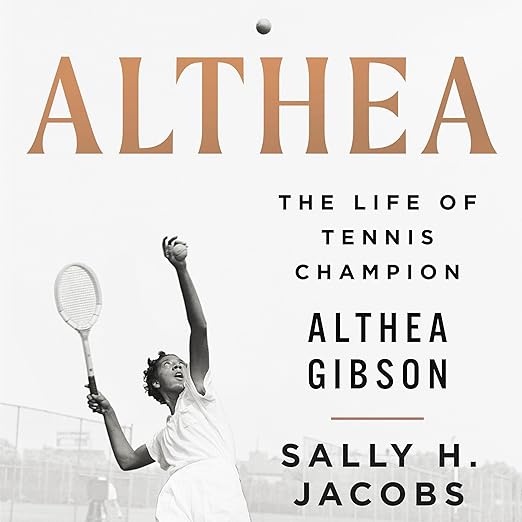
Althea Gibson walked onto Wimbledon's grass courts in 1951 as someone the all-white tennis establishment had accepted only because pressure left them no other option, and she proceeded to become the best female tennis player in the world. Sally H. Jacobs's biography, this audiobook narrated by Chanté McCormick, is the most thorough reckoning with Gibson's life and career that has yet appeared in print, and its arrival could not be better timed: a generation of tennis fans who came of age watching the Williams sisters may have only the vaguest sense of who opened the door they walked through.
The statistics of Gibson's achievement are staggering when assembled in sequence. She won Wimbledon and the US National Championships in both 1957 and 1958. She was ranked the world's number one female tennis player in both those years. She shook hands with Queen Elizabeth II and was driven up Broadway through a ticker-tape snowstorm. She was the first Black woman to appear on the cover of Sports Illustrated and the second to appear on the cover of Time. Seven years after retiring from tennis, she broke the color barrier again by becoming the first Black woman to join the Ladies Professional Golf Association. In 1950, three years after Jackie Robinson integrated Major League Baseball, the US Lawn Tennis Association had opened its door only barely, and Gibson had to fight for every inch of that crack.
The Review
What Jacobs does that previous Gibson coverage has not is account for the full complexity of her subject. Gibson was not simply a symbol; she was a specific person, born in South Carolina and raised in Harlem, street-savvy and physically gifted and emotionally complicated in ways that the mythology of the pioneer tends to flatten. Jacobs, a prize-winning former Boston Globe reporter, brings the same rigor to this biography that she brought to investigative journalism, and the result is a portrait that refuses to reduce Gibson to her achievements or to the institutional barriers she overcame.
Billie Jean King's endorsement, included in the book's framing, calls Gibson her "personal shero" and describes the biography as "captivating" and "brilliantly" revealing of an overlooked legend. King's voice here is not generic celebrity endorsement; she is someone who entered the professional game in the years immediately following Gibson's dominance, which means she has direct knowledge of what Gibson's presence in the sport made possible. That contextual weight gives the endorsement genuine credibility.
AudioFile singled out Chanté McCormick's performance for specific praise, writing that she "rises to the challenge of narrating Jacobs's comprehensive biography of Althea Gibson with grace, energy, and a rich voice." That assessment is confirmed across the audiobook's nineteen-plus hours. Jacobs's biography is dense with reported detail: newspaper archives, interview transcripts, court records, and the kind of documentary reconstruction that requires a narrator to manage transitions between intimate character scenes and historical summary without losing momentum. McCormick handles this range with consistency and intelligence.
The full scope of Gibson's life, including the financial insecurity and personal struggles that followed her tennis career, gets serious treatment in the audiobook. Reviewer Barry Sparks noted that Gibson was "born too early to reap the benefits of her skills and hard work," and Jacobs does not flinch from the injustice of that timing. Gibson's post-tennis years, in which she struggled financially despite her historic achievements, are covered with the same rigor as her athletic peak.
Things to Know Before Starting Althea
At nineteen hours and three minutes, this audiobook is a comprehensive commitment. Jacobs is thorough in a way that serves the subject: Gibson's life has enough complexity and historical significance to sustain the length. But listeners who want a narrative biography focused primarily on the tennis career and the integration story should know that Jacobs extends well beyond those chapters into Gibson's later life, her golf career, her financial circumstances, and her complicated relationship with legacy and recognition.
The Kirkus long-listing for Best Books of the Year in 2023 reflects the critical consensus that this biography fills a genuine gap in American sports history writing. Reviewer John O'Donoghue described Jacobs as "a first-rate wordsmith" who gives Gibson the exhaustively researched story she has deserved, and that characterization holds across the full audiobook. The timing of the release, with Coco Gauff ascending as Gibson's most visible contemporary heir, adds additional resonance to the historical argument Jacobs makes about Gibson's underrecognized significance.
The timing of the biography's publication and its Kirkus long-listing is worth noting as context. The book arrived in 2023, a period when conversations about the historical erasure of Black women athletes had become more prominent in sports journalism and in broader cultural discussion. Jacobs's contribution to that conversation is specific and evidentiary: she is not making a general argument about overlooked athletes but reconstructing, document by document, the specific ways in which Gibson's achievements were undervalued and her post-career struggles were insufficiently supported by the institutions whose doors she had forced open. That specificity is what gives the biography its authority and its sting.
Who It's For
Listeners who want to understand the full story of American sports integration beyond Jackie Robinson's narrative will find Gibson's biography essential and revelatory. Tennis fans who know the Williams sisters' history but have only a surface familiarity with the generation that preceded them will find this audiobook both corrective and illuminating. Biography listeners who value rigorous reporting and emotional honesty over hagiography will find Jacobs's approach exactly right. The nineteen-hour runtime suits listeners who want depth; those looking for a shorter overview should know they are getting the definitive treatment here, not a summary.