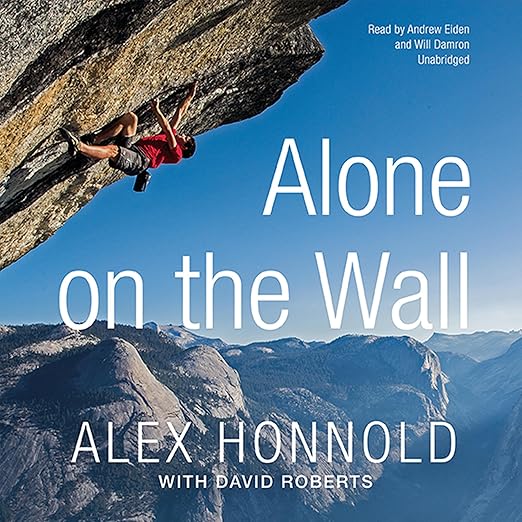
Alex Honnold's name carries a specific weight in the climbing world that this audiobook assumes you already sense, even if you've never tied into a rope: he is the person who climbs the world's most dangerous walls without one. Free soloing has exactly one acceptable outcome each time a climber attempts it, and Honnold has built an entire career, plus a genuine claim to being the most famous adventure athlete alive, inside that binary. This audiobook, narrated by Andrew Eiden, walks through seven of his most significant climbs, and it does so with a matter-of-factness that took me a little while to adjust to.
That flatness is the point, not a flaw. Honnold has talked openly elsewhere about being unusually unbothered by fear in ways researchers have actually studied, and Alone on the Wall lets that temperament shape the whole book's voice. Veteran climbing writer David Roberts contributes portions of each chapter in his own voice, providing outside context and historical framing around Honnold's climbs, and while only Eiden is credited as narrator here, the book's structure still alternates between Honnold's interior account and Roberts's more traditional journalistic scene-setting.
The Verdict, Briefly
What works best across these seven climbs is how little Honnold dramatizes his own fear, which forces the tension to come from somewhere else: the listener's growing understanding of exactly what a single mistake would mean. Eiden's narration leans into this by keeping an even, almost conversational pace even during the most exposed sequences, which sounds counterintuitive for a book about free solo climbing but actually intensifies the stakes. When the prose slows down to describe rock texture, wind, or the exact placement of a foot on granite the width of a coin, that steadiness makes the danger land harder than a more breathless delivery would.
Roberts's sections function almost like a counterweight, and Eiden handles the shift in voice within the text capably even without a formal cast change, giving Roberts's portions a slightly more removed, reportorial tone that contrasts with Honnold's first-person immediacy. One review mentioned watching Free Solo before listening, and I'd agree the documentary and this audiobook complement each other well: the film shows what the climbs looked like, and Honnold's own account here fills in what they felt like from the inside, including the parts he still can't fully explain even to himself.
Readers who enjoy Jon Krakauer's mountaineering writing, Into Thin Air especially, will recognize the genre Roberts is working in throughout his sections: adventure writing that treats the physical stakes seriously without romanticizing the risk into something abstract. The difference here is that Honnold survives every chapter by definition, since he's narrating his own account, which removes the mortal suspense a Krakauer book can generate but replaces it with a different kind of tension: not whether he'll die, but how he continues choosing not to.
Why Alone on the Wall Works as an Audiobook
The appeal isn't just vicarious thrill, though the recounting of his free solo of Half Dome's Regular Northwest Face, among the seven climbs covered, supplies plenty of that on its own. It's Honnold's genuine attempt to answer the two questions he says he's asked constantly: whether he's afraid of dying, and why he does this at all. He takes both questions seriously rather than deflecting with bravado, and that honesty is what elevates this above a standard extreme-sports memoir into something closer to a study of an unusual mind.
Eiden's steady delivery also serves the book's quieter passages well, particularly the details about Honnold living full time out of his van and the discipline of his climbing journal, which one reviewer called a virtual bible for students of the sport. Those domestic, unglamorous details ground the extraordinary feats in something recognizably human, and the narration never oversells them for sentiment they don't need.
Roberts brings decades of his own mountaineering writing experience to his sections, including work for outlets like Outside magazine, and that professional distance is useful counterprogramming to Honnold's more internal, sometimes clinical self-analysis. Where Honnold tends to underplay danger, Roberts's framing occasionally supplies the outside perspective that properly contextualizes just how far outside normal risk tolerance these climbs actually sit.
Points to Consider
Listeners expecting a conventional sports memoir arc, struggle followed by triumph followed by lesson learned, should recalibrate. This audiobook is structured around seven discrete achievements rather than a single narrative through-line, which makes it easy to dip into but occasionally episodic in feel when listened to straight through in one sitting.
The technical climbing vocabulary is dense in places, and while Honnold and Roberts both work to make the terminology accessible, listeners with zero climbing background may want to slow down or replay certain passages describing specific routes and holds. It's not gatekeeping so much as the natural cost of writing precisely about a highly technical sport.
One more scope note worth flagging: this book was published before Honnold's now-most-famous achievement, his free solo of El Capitan captured in the Free Solo documentary. That climb happened in 2017, after Alone on the Wall's original release, so listeners expecting the book to cover it directly will be looking in the wrong place. The seven climbs actually covered here, including the Half Dome solo, are earlier chapters in his career, no less impressive, but a different set of achievements than the one most casual audiences now associate with his name.
Should You Listen to Alone on the Wall?
This is for anyone drawn to extreme athletes whose motivations resist easy explanation, and especially for listeners who've already seen Free Solo and want Honnold's own account of the psychology behind it, not just the visuals. Climbers will get the most granular value from the route-specific detail, but you don't need to have ever touched rock to find Honnold's temperament genuinely strange and compelling.
Skip it if you want a linear memoir with rising narrative stakes rather than a chapter-by-chapter tour of achievements, or if extended technical climbing description isn't something you'll enjoy sitting with. For everyone else, Eiden's calm narration matches Honnold's own famous calm well enough that the pairing feels almost inevitable.
Questions Listeners Ask
Does this audiobook explain the neuroscience behind Honnold's lack of fear?
It touches on his unusually low fear response as part of his own reflection, though the focus stays on his climbs and choices rather than a deep scientific study of his psychology.
Do I need climbing experience to follow this audiobook?
No, though the technical vocabulary around specific routes and holds is dense enough that climbers will extract more granular detail than non-climbers.
How does the audiobook handle David Roberts's co-writing credit?
Roberts's journalistic sections are woven into the same narration by Andrew Eiden, alternating with Honnold's first-person chapters rather than using a separately credited narrator.
Is this audiobook better experienced before or after watching Free Solo?
Either order works, but listening after seeing the documentary adds interior context to climbs you've already watched unfold on screen.