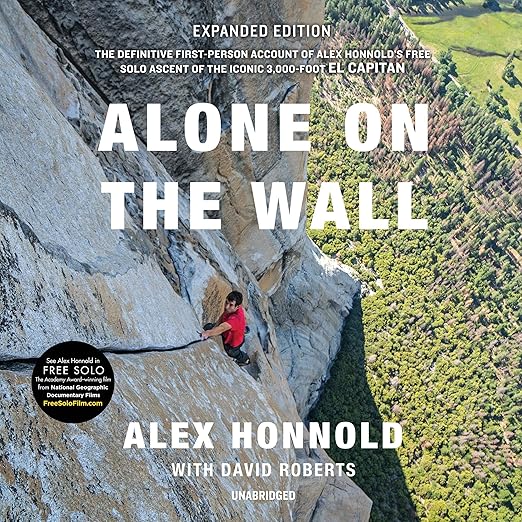
I watched the documentary Free Solo before I listened to this book, which I suspect is the case for most people who come to Honnold's memoir. The film does something the book cannot quite replicate, it shows you the exposure, the sheer vertical drop, the small chalk-dusted holds on 3,000 feet of granite. What the book does that the film cannot is take you inside the preparation. The years of repetition. The route memorization. The practice of not reacting to fear.
Alone on the Wall covers Honnold's full career up through the 2017 El Capitan free solo, with the expanded edition adding two new chapters specifically about that climb. National Geographic called it the greatest feat of pure rock climbing in the sport's history. Honnold describes it with characteristic understatement and precision.
Our Take on Alone on the Wall (Expanded Edition)
This is not a straightforward action memoir. Honnold is not given to dramatic narrative; he is given to analysis. He wants to understand what he does and why it is possible, and the result is a book that spends as much time on the mental architecture of free soloing as on the physical execution. That is genuinely unusual in sports autobiography, and it is what distinguishes this from other extreme sports memoirs.
The book covers the Half Dome free solo that first brought him widespread attention, the 60 Minutes appearance that turned him into a public figure he was not entirely comfortable being, the Fitzroy Traverse in Patagonia, the Triple in Yosemite, and the El Capitan solo that made all of those look like preparation. One reviewer who had followed Honnold's career since before the book's first publication found it covered all the major moments they already knew and added depth to each.
Why Listen to Alone on the Wall (Expanded Edition)
Andrew Eiden's narration is deliberately low-key, which fits the material. Honnold's voice, as captured in interviews and the documentary, has a similar quality: thoughtful, unadorned, occasionally self-deprecating. Eiden does not manufacture excitement that Honnold himself declines to manufacture. One reviewer noted that the book shifts naturally between first and third person perspectives across different sections, which Eiden handles cleanly without making the transitions feel abrupt.
At eight hours and forty-six minutes, it is a manageable listen even for people who are not habitual audiobook consumers. The expanded edition's additional chapters on El Capitan give the book a culminating structure that the original lacked, the climb that everything else was, in some sense, preparation for.
What to Watch For in Alone on the Wall (Expanded Edition)
The technical content is real. Honnold describes routes, hold sequences, and climbing mechanics with the precision of someone who has memorized them for his survival. One reviewer noted it is a climber's book, the technical passages are written from inside the discipline rather than explained outward. Listeners without climbing experience will still follow the narrative, but some of the nuance will land differently.
There is also an emotional flatness to some of the writing that is clearly intentional, Honnold's relationship to fear and risk is not like most people's, and he does not pretend otherwise. If you want someone to tell you they were terrified, he will not give you that. What he will give you is a precise account of how he trained his nervous system not to react the way yours would.
Who Should Listen to Alone on the Wall (Expanded Edition)
For anyone who has seen Free Solo and wants more context, more of the career that preceded El Capitan, more of the psychological preparation the film sketched, this delivers exactly that. Climbers will get technical depth. Non-climbers drawn to the psychology of extreme performance will find Honnold's self-analysis genuinely interesting. If you want high-drama storytelling, this is the wrong register. If you want to understand what kind of mind produces this kind of achievement, there is nothing else quite like it.
Frequently Asked Questions
Should I watch Free Solo before or after listening to this audiobook?
Either order works. The documentary provides visual context for the climbs that the book cannot replicate. The book provides psychological depth and career context that the film compresses. They complement each other well.
What does the expanded edition add compared to the original 2015 publication?
Two new chapters specifically covering the 2017 El Capitan free solo, including Honnold's account of the preparation and the climb itself in his own words. This is the main reason to choose the expanded edition.
How does Honnold discuss the psychological component of free soloing, does he address fear directly?
Extensively. This is arguably the book's central subject. Honnold's approach to managing fear, his process of training himself not to react to exposure, and his analysis of what separates manageable risk from recklessness are all covered in specific detail.