
In Brief
- Narration: Donald Corren handles the book's wide tonal range, gossip, film analysis, and cultural history, with the same composure that has made him a strong fit for demanding multi-strand nonfiction elsewhere.
- Themes: Hollywood's Golden Age on and off screen, the making of a classic film, celebrity rivalry and reinvention
- Mood: Dishy and detailed, closer to a definitive cultural history than a quick trivia primer
- Verdict: Essential listening for classic film buffs, though casual fans may find its thoroughness more than they bargained for.
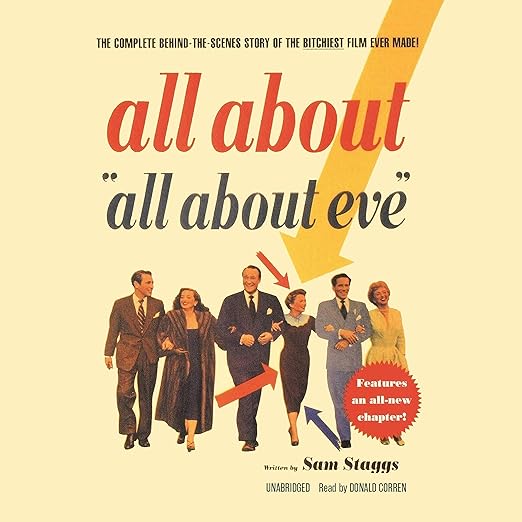
Bette Davis and Celeste Holm never liked each other, and Sam Staggs does not paper over it. This audiobook opens with exactly the kind of on-set friction its subject is famous for, the "bitchery," to use one reviewer's own word, that apparently defined the set of one of Hollywood's most quotable films. All About "All About Eve" runs thirteen hours and thirty-four minutes, and across that runtime Staggs treats the making of All About Eve less like a making-of featurette and more like a dense, fully reported cultural history in its own right.
A Hot-Blooded On-Set Romance Turned Real Marriage
Staggs works outward from the film itself, Bette Davis, Anne Baxter, George Sanders, and Celeste Holm all finding what the synopsis calls their best roles, into everything surrounding it: who the fictional Margo Channing was really based on, the career boost the film gave a young Marilyn Monroe, and how the project became a capstone on director Joseph L. Mankiewicz's career. That structure, film first, then its ripple effects outward into the industry and the culture, is what separates a genuinely comprehensive cultural history from a simple production diary.
The reporting goes well beyond the screen. The synopsis specifically flags the 'hot-blooded romance on-set between Bette Davis and costar Gary Merrill,' a relationship that led to their real-life marriage not long after filming wrapped, giving the book a genuine off-screen love story running parallel to the film's own plot about ambition and reinvention in the theater world. That parallel, a movie about performers reshaping their identities, made by people who were doing exactly that in their own lives, gives the book real thematic coherence rather than just a pile of trivia.
Back-to-Back Academy Awards for Directing
Mankiewicz's own career context matters here too: he won the Academy Award for both writing and directing in consecutive years, for A Letter to Three Wives and then All About Eve, an achievement that still stands as one of the most remarkable directing runs in Hollywood history. Staggs treats the film as the peak of that specific streak, which gives the book's Mankiewicz sections a real sense of a director working at the absolute height of his powers rather than just another studio assignment.
The synopsis's own claim that the film 'found their best roles' for its entire cast is worth testing against what Staggs actually documents: Davis had already built a major career before this film, but Eve is widely regarded as the performance she is most remembered for, which makes 'best roles' less hyperbole than a genuinely defensible critical claim the book backs up with specific casting and production detail rather than asserting it as received wisdom.
Corren Goes From Arctic Memoir to Hollywood
Donald Corren has an established track record handling unusually wide tonal range with composure, moving between Arctic expedition memoir, theoretical physics, and historical analysis in prior work without simplifying any of it, and that same steadiness is well suited to a book that shifts constantly between gossip, film criticism, and cultural history. Corren's demonstrated comfort with intellectually demanding, genre-refusing nonfiction is a direct match for Staggs's sprawling approach here.
When Celeste Holm Said 'Good Morning!'
Reviewer Sharyn Ann Tadolini calls it a 'must read' that 'covers EVERY aspect of the movie,' from who the real Eve was based on to 'the relationships onscreen & off screen.' Reviewer Steven Daedalus backs that thoroughness with a specific, vivid example: when Celeste Holm greeted Bette Davis with a cheery 'Good morning!' on their first meeting, Davis reportedly shot back, 'Oh, s****, good manners', the kind of granular, sourced anecdote that confirms the book digs into real behind-the-scenes friction rather than sanitizing it.
The film's own legacy adds weight to why a book this thorough is warranted: All About Eve held the record for the most Academy Award nominations of any single film for decades, a fact that underlines just how completely the industry recognized what Mankiewicz, Davis, and the rest of the cast had accomplished. A film with that kind of institutional recognition earns the kind of exhaustive cultural-history treatment Staggs provides.
Reviewer Sharyn Ann Tadolini's 'must read' verdict comes with a specific behavioral detail worth noting: she says 'once you start reading, you can't put it down,' framing a dense, thirteen-and-a-half-hour cultural history in the same propulsive terms usually reserved for thrillers, a meaningful signal that Staggs's reporting reads as genuinely engaging rather than dutifully comprehensive.
A Dense History That Rewards Watching First
Thirteen hours and thirty-four minutes is a substantial commitment, and this is not a breezy trivia-night primer; Staggs's thoroughness means listeners get genuine depth on the production, casting, and cultural afterlife of a single film rather than a broad survey of classic Hollywood. That density rewards existing interest in the subject more than casual curiosity.
Some familiarity with All About Eve itself will deepen the listening experience considerably, since Staggs references specific scenes, lines, and performances throughout; listeners who haven't seen the film may want to watch it first to get full value from the level of detail Staggs provides about individual moments and decisions.
Cult Status Across Seven Decades
One of the three attached reviews is worth setting aside as a data point: a review praising a specific used copy's physical condition rather than the book's actual content, which doesn't add analytical value but is worth knowing about when browsing the full review set, since it doesn't reflect a judgment on the writing or narration at all.
The synopsis specifically promises coverage of 'the audience who loved it when it came out and adore it to this day,' a reception-history angle that goes beyond standard behind-the-scenes reporting into how the film built and sustained its cult status across seven decades. That's a different kind of chapter than cast gossip or production logistics, closer to cultural anthropology of fandom, tracking why specific lines from the script became part of the broader cultural lexicon long after the film itself left theaters. It's worth knowing going in that Staggs's ambitions extend that far beyond the set itself, into the much longer afterlife the film has had among audiences who never saw it in its original 1950 release.
Not a Quick Trivia-Night Refresher
Classic Hollywood buffs and film history listeners are the clear audience, especially anyone who already holds All About Eve in high regard and wants the full, sourced story behind its most famous lines and performances. Listeners interested in Golden Age Hollywood culture more broadly, career reinvention, on-set rivalry, the machinery of a major studio production, will find plenty here even beyond the specific film.
Listeners who enjoy directors' and actors' career-retrospective nonfiction generally, not just single-film histories, will appreciate how thoroughly Staggs situates All About Eve within Mankiewicz's, Davis's, and Monroe's broader careers rather than treating the film as an isolated achievement.
Casual fans hoping for a quick trivia refresher rather than a comprehensive, exhaustively reported cultural history should adjust expectations, since Staggs's thoroughness is the entire reason this book exists, not an incidental feature of a shorter, breezier account.
A Few Questions About All About "All About Eve"
Does the All About "All About Eve" audiobook cover Marilyn Monroe's role in the film?
Yes. Staggs specifically covers the career boost the film gave Monroe alongside its impact on Bette Davis, Anne Baxter, George Sanders, and Celeste Holm.
How long is the All About "All About Eve" audiobook?
It runs thirteen hours and thirty-four minutes, reflecting Staggs's thorough, fully reported approach rather than a quick overview.
Do I need to have seen the film All About Eve before listening to this audiobook?
Some familiarity helps you appreciate the specific scenes and quotes discussed, but Staggs provides enough context that newcomers to the film can still follow along.
Does this audiobook include real on-set gossip, or is it strictly analytical?
Both. Reviewer Steven Daedalus recounts specific catty exchanges between cast members, confirming the book digs into genuine behind-the-scenes friction, not just formal film analysis.







