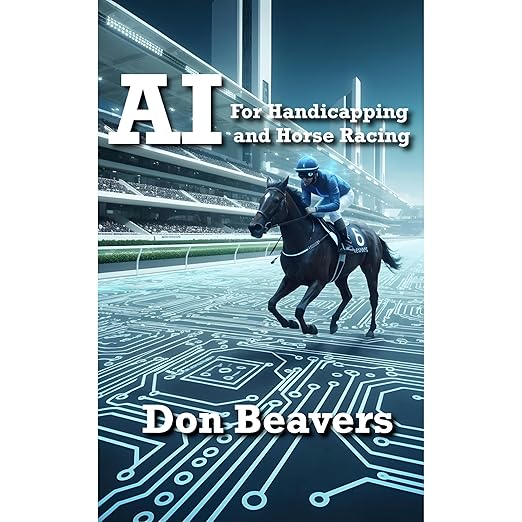
The Short Version
- Themes: Prompt engineering for form analysis, data curation before modeling, hunting value against public favorites
- Mood: Confident, technical, and impatient with beginners
- Verdict: A sharp framework for handicappers who already have a process, in a format that fights its own subject.
Don Beavers spends this audiobook teaching handicappers how to write prompts. The recording itself is read by a machine. The narrator credit says Virtual Voice, which is either fitting for a book about delegating analytical work to software or awkward for a book you are meant to follow along with, depending on your tolerance for the joke. One hour and forty-eight minutes covers six areas the description calls masterable, from data curation to structuring exotic tickets, which signals the register immediately.
Our Take on AI for Handicapping and Horse Racing
What that runtime has to deliver is, by the description's own account, a complete framework: turning dense past performance files into clean text a model can read, writing layered prompts that address pace scenarios, form cycles, trainer intent, class dynamics, and workout patterns, running predictive race simulations, auditing false favorites, and building a repeatable daily workflow. Six competencies in under two hours works out to roughly eighteen minutes apiece. Anyone who has written a prompt worth reusing knows eighteen minutes is a lecture, not a workshop.
Two things make prompt instruction awkward in audio, and both of them apply here. A prompt is text you copy, adapt, and paste rather than a sentence you memorize from a recording, and this listing mentions no companion document, no appendix, and no downloadable template. The second problem follows from the book's own argument: since vague questions produce vague answers, the prompts it teaches are long and layered by design. Hearing a long, layered prompt read aloud is a very different thing from having it.
For once the numbers on a page can be pinned down exactly. Seven votes produce the displayed 4.4, and those seven total precisely 31 points out of a possible 35, four short of a clean sweep. The four visible grades are five, four, five, and five, which accounts for nineteen of those points and leaves twelve spread across the three votes nobody can read. Small and warm rather than authoritative, but it does mean no hidden one-star is sitting in the pool.
Why Listen to AI for Handicapping and Horse Racing
If the premise sounds like hype, the description is more careful than this category usually manages. It rejects the idea of an AI oracle that spits out picks and positions the software as an analytical co-pilot instead: a research assistant sifting thousands of data points, a pattern-matcher catching form cycles the eye might miss, a simulator running the race before the gates open. The listener stays the strategist, the one who asks the right questions. That framing is both more modest and more usable than most gambling technology promises.
Where the reviews agree is on who this suits, and the description agrees with them. It states outright that this is not for novices, and two independent responses confirm it from experience. A four-star response calls the strategy sharp, clear, and focused, then adds that it is not exactly beginner-friendly and that you will probably need prior knowledge to apply it well. Another warns that anyone with zero knowledge of AI may struggle, because the prompts are advanced. The book knows its audience and its audience knows it back.
Most instructional titles this short are standalone products. This one arrives as the sixth entry in the Horse Racing and Handicapping series, which changes how the brevity reads. The description assumes you already hold the trusted angles you know and offers to supercharge them, meaning the handicapping itself lives in the earlier books while this volume covers only the software layer sitting on top. Understood that way, one hour and forty-eight minutes is a supplement rather than a course, and a supplement is entitled to be brief.
What to Watch For in AI for Handicapping and Horse Racing
One caveat outranks all the others, and it concerns time rather than quality. The description names ChatGPT, Claude, and Gemini as the tools you will be directing, and this listing is dated July 28, 2025. Guides built on the behavior of specific commercial models age faster than guides built on principles, because the products shift underneath them: interfaces change, limits move, and a prompt tuned to one release can behave differently on the next. The strategic framework should outlast that. The keystroke-level instruction may not.
The reading is machine-generated, and that lands differently in technical instruction than it would in a novel. Prompts, race conditions, and wager structures are precisely the material where emphasis carries meaning and where the ear has to catch the boundary between an instruction and an example of one. No audio sample appears on the listing, so how clearly the voice marks those boundaries across the full runtime stays unknown until after purchase. For a title this short the exposure is limited, but it is exposure a buyer takes blind.
A five-star response on this page deserves reading before anyone trusts the average. It opens by calling the book a microcosm of a much bigger truth, travels through staffing solutions and guest experience personalization, addresses a named individual directly in an aside, and closes on the versatility of artificial intelligence generally. What it never does is describe the handicapping content. It is an enthusiastic reaction to the idea of the book, and it weighs exactly as much in that 4.4 as the two responses that engage with what is inside it.
Who Should Listen to AI for Handicapping and Horse Racing
That leaves a clear picture of who gains from this. Experienced handicappers who already read form, already have a process, and want to attach a research assistant to it will find a framework that respects their expertise rather than replacing it. Anyone hoping the software will do the picking should leave it alone, since the description explicitly refuses that promise. And anyone who has never handicapped a race will be lost twice over, once in the racing vocabulary and once in the prompting, and neither gap is one this runtime sets out to close.
This is a supplement to an existing practice, not the practice itself, and it is paced accordingly. The framework is sound, the insistence on clean data as the first discipline is the right opening lesson, and the refusal to promise winners is a mark of seriousness in a field full of the opposite. What no listener can extract from audio alone is the prompts themselves in a form they can actually use. Bring your own method for capturing them, or plan to listen with a notebook open.
Do I need experience with AI tools before starting this audiobook?
Yes, and the description says so before any reviewer does. It declares the book is not for novices and assumes an existing handicapping process. Two reviewers back that up, one noting it is not beginner-friendly, another warning that listeners with no exposure to these tools will struggle with the advanced prompts.
Does the audiobook give you the prompts in a form you can reuse?
Nothing on the listing indicates a companion PDF, appendix, or template file. Since the method depends on long, layered prompts you paste into a model, hearing them read aloud leaves you transcribing. Plan to take notes as you listen, or treat the audio as an outline of the approach rather than a toolkit.
Where does this fit in the Horse Racing and Handicapping series?
It is listed as the sixth entry, and the description positions it as an add-on to angles you already use. The racing craft is assumed rather than taught, which explains the short runtime. Listeners new to the series should start earlier in it before adding the technology layer on top.
Is one hour and forty-eight minutes enough for a complete framework?
It covers six declared skill areas, which averages out to under twenty minutes each. That is enough for a clear conceptual map and not enough for worked practice. Treated as a briefing for handicappers who will experiment on their own afterward, the length is defensible rather than generous.