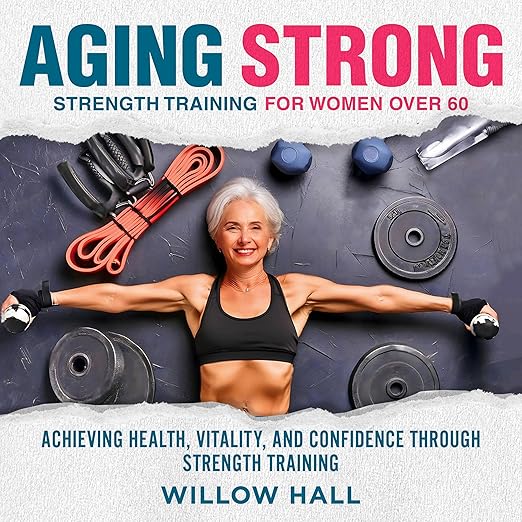
Bone density statistics tend to sound abstract until you land in a physiotherapist's office at sixty-three with a compression fracture nobody saw coming. That was not my situation, but it was close enough to several listeners I know that when I started the audiobook version of Aging Strong Strength Training for Women Over 60 by Willow Hall, narrated by Gwyneth Serra, I paid attention in a way I rarely do with fitness titles. The concern is real: after sixty, muscle and bone loss accelerate, and most mainstream fitness advice simply does not address the mechanics or the psychology of training in that phase of life. Hall steps directly into that gap.
What Willow Hall Delivers
Willow Hall structures this as a practical guide rather than an inspirational manifesto, and that choice pays off. The book opens by confronting the physiology head-on: why strength training matters more, not less, as estrogen declines, and why bone mineral density responds to resistance load in ways that walking alone cannot replicate. Hall keeps the science accessible without dumbing it down. One reviewer, Robin Kesner, noted that learning about hip fracture risk in women over sixty-five was the motivation that pushed her to act, and the audiobook delivers that same wake-up call without being alarmist about it. The tone sits somewhere between concerned friend and knowledgeable trainer.
Hall's approach emphasizes progressive overload adapted for aging joints, which means she is not simply lifting standard gym programming and adding a disclaimer. She builds in recovery emphasis, joint-friendly form cues, and explicit guidance on working around common age-related limitations like reduced shoulder mobility or knee sensitivity. Reviewer EAFox, who picked this up post-injury on a doctor's recommendation to build core strength, found Hall's style 'informative and motivating and well researched.' The research pedigree matters here, because the market for women's fitness books over fifty is flooded with underpowered advice.
What Willow Hall Gets Right
Gwyneth Serra's narration suits the material well. Her delivery is measured and encouraging without tipping into the relentless cheerleader register that can feel condescending in this genre. Serra reads as if she actually understands what Hall is describing, which makes a difference when the content involves technical form breakdowns. The pacing allows listeners to absorb instructions rather than race through them, which is particularly useful for anyone planning to follow along during workouts. The audiobook format works for this title because much of the guidance is principle-based rather than requiring visual demonstration, and Serra's clarity makes the verbal descriptions of movement patterns easier to follow than written text often is.
The book clocks in at just over four hours, which several reviewers flag as short but well-paced. What Hall chooses not to include is as telling as what she does. She skips detailed nutrition programming, does not wade into hormone replacement debates, and avoids the motivational padding that inflates many fitness titles to double their necessary length. The result is dense with usable content. Reviewer from Amazon noted the content 'is easy to read and can be applicable to anyone,' though the clear target audience remains women navigating the specific physical shifts of the post-sixty decade.
Where Willow Hall Loses Some Ground
A few caveats worth flagging. Hall's exercise descriptions are verbal-only, and while Serra reads them clearly, some listeners may find themselves wanting visual reference for form checks on compound movements like deadlifts or goblet squats. If you are brand new to strength training and have no prior experience with movement patterns, you may want to pair this with a single session with a trainer or a video reference to supplement what you hear. The audiobook does not include companion materials in the standard release, so those notes cannot be checked mid-listen the way you might flip back through a print book.
The book also does not differentiate significantly between women at sixty and women at seventy-eight. The physiological challenges at either end of that range differ enough that some listeners in their mid-seventies or older may find the programming slightly optimistic for where they are starting. Hall addresses modifications, but the primary framing assumes a baseline of mobility that not everyone in the target audience will have. This is a real limitation, not a fatal one, but it is worth knowing before you start.
One of the underappreciated strengths of this format is that Gwyneth Serra's narration allows Hall's form cues to function almost like verbal coaching. A reader processing the same content on the page would have to stop, re-read, and mentally rehearse each instruction. The audio version builds that cycle into its natural rhythm: Serra describes the movement, pauses for pacing, and moves on. For listeners who already have a basic understanding of exercises like squats or rows, that rhythm supports retention in ways that passive reading often does not. Hall understands that she is building habits, not just delivering information, and the audiobook format serves that pedagogical intent well.
Who Should Pick Up Aging Strong Strength Training for Women Over 60
Pick this audiobook up if you are a woman over sixty who wants a science-grounded entry point to strength training, or if you are a daughter, partner, or friend shopping for something genuinely useful rather than aspirational. It suits anyone who has been told by a doctor to work on bone density or core strength and wants a structured path forward rather than generic encouragement. Skip it if you are already training seriously and looking for advanced periodization, or if you need visual demonstration rather than verbal instruction to learn new movement patterns. At just over four hours, it asks very little of your time while delivering a high concentration of practical, well-researched guidance.