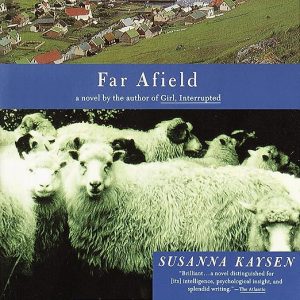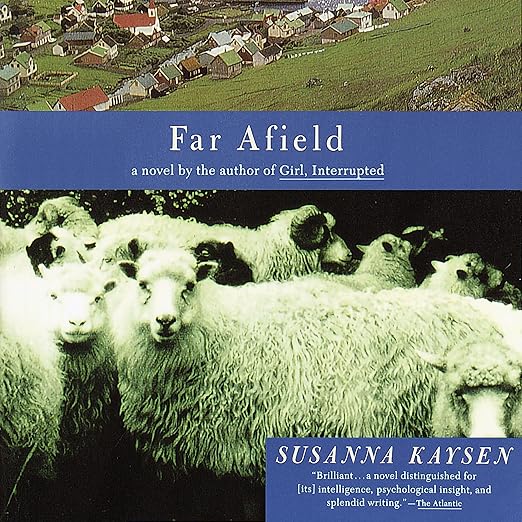
Susanna Kaysen's fiction debut arrived years before Girl, Interrupted made her name synonymous with a very different kind of writing, and in this audiobook of Afield, also published as Far Afield in its original edition, the novel's particular combination of anthropological wit and atmospheric immersion gets a reading that does it real justice. Vas Eli narrates with a measured, slightly detached intelligence that slots perfectly into the perspective of Jonathan Brand, a Harvard graduate student in anthropology who has chosen the remote Faroe Islands in the North Atlantic as his fieldwork site and quickly discovers how little his academic training prepared him.
The craft of Kaysen's setup is worth noting immediately: she sends an academically trained observer to one of the most deliberately unreachable places in Europe, a cluster of islands between Norway and Iceland where even the cuisine resists easy categorization, and then she watches what happens when all that Harvard vocabulary proves nearly useless. Jonathan Brand cannot understand, let alone study, the culture he encounters. His struggles with local food, his complicated affair with a Danish woman the islanders seem to have already decided he should marry, his oscillation between repulsion and deep attraction to Faroese life: these are the materials Kaysen shapes into something wry, insightful, and more emotionally complex than the premise initially suggests.
The Review
What makes this novel reward close listening is the gap between what Jonathan thinks he knows and what the audiobook actually shows. He arrives with the vocabulary of scholarship and leaves with something harder to articulate. Kaysen does not resolve that tension with a neat conversion narrative: Jonathan does not simply fall in love with the Faroe Islands and abandon his academic pretensions. The process is messier and more interesting than that. One reviewer described the novel as a book where characters are well developed and the plot starts a little slow before grabbing you and pulling you in, and that arc accurately captures what the audiobook delivers.
Eli's narration is calibrated for exactly this kind of slow burn. He does not push the humor or undersell the melancholy; he lets Kaysen's prose do both simultaneously, which is the correct approach for a novel that earns its laughs through observation rather than incident. The Faroe Islands material, the landscape, the seasonal rhythms, the social codes that Jonathan keeps misreading, is rendered with enough specificity that listeners who have no prior knowledge of the islands will develop a vivid, accurate sense of place. At least one reviewer has made multiple visits to the islands specifically because of this book, which is a meaningful indicator of how effectively the novel builds its setting.
The eleven-hour-and-forty-four-minute runtime is paced to match the novel's sensibility: deliberately, without false urgency. This is a book that rewards patience. Listeners who expect plot momentum in the conventional thriller sense will find it frustrating. Listeners who appreciate novels where the real action is happening at the level of perception, where the protagonist's slow realization that he understands almost nothing is the central event, will find it absorbing in a way that proves difficult to set down even without conventional narrative hooks.
Kaysen's gifts here, which reviewers also praise in her later work, are imagination, satire, and compassion in roughly equal measure. The satire lands because the compassion is real: she is making fun of Jonathan's academic assumptions, but she is not contemptuous of him, and she is genuinely in love with the Faroe Islands in a way that comes through in every descriptive passage. The affair subplot is handled with considerably more complexity than a brief synopsis suggests. The Danish woman Jonathan becomes involved with is not a romantic prop; she has her own displacements and ambitions that complicate the story's cultural dynamics in ways that deepen the novel's central questions about belonging and the limits of understanding across cultural difference.
Before You Commit to Afield
Listeners who pay close attention to the structural choices Kaysen makes will notice how she deploys Jonathan's academic framework as a source of irony without making it the whole joke. The anthropological vocabulary he carries into the islands does occasionally illuminate something true about Faroese life; his mistakes are not uniform, and neither is his learning. That calibration, where the satire is pointed but not total, is what prevents the novel from becoming a straightforward comedy of incompetence.
Kaysen's background as the author of Girl, Interrupted means some listeners will arrive with expectations shaped by that book's confessional intensity. This novel is cooler in register, more committed to irony, and much less interested in psychological interiority in the memoir sense. Those differences are features rather than disappointments once you settle into the novel's actual ambitions. Eli's narration honors that cooler register throughout the eleven-hour runtime without ever making the novel feel emotionally unavailable.
Who It's For
Listeners drawn to literary fiction with a strong sense of place and satirical intelligence will find this audiobook thoroughly engaging. It particularly rewards those with an interest in anthropology, Nordic geography, or the comedy of cultural misreading. Fans of Kaysen who came to her through Girl, Interrupted should be prepared for a different mode, but will find the quality of observation consistent. Listeners who need plot-driven momentum or prefer naturalistic dialogue without ironic framing may find the pace a challenge. For everyone else, this is one of those quiet audiobooks that earns a permanent place in the memory long after the runtime ends.
Good to Know
Is this audiobook based on the novel Far Afield by Susanna Kaysen?
Yes. The novel was originally published as Far Afield and this audiobook edition is based on that same text. Kaysen, best known for Girl, Interrupted, wrote it as her fiction debut before the memoir that made her famous.
Does prior knowledge of the Faroe Islands help with this audiobook, or is the world-building self-contained?
No prior knowledge is needed. Kaysen builds the Faroese setting through Jonathan Brand's outsider perception, so listeners discover the islands alongside him. The descriptions are vivid enough that multiple readers have reported the audiobook made them want to visit.
How does Vas Eli's narration handle the novel's satirical tone?
Eli keeps the performance dry and observational, which is exactly right for Kaysen's style. He does not push the comedy or underline the pathos; the subtlety of the narration mirrors the subtlety of the prose and gives the satire room to work on its own terms.
Is this audiobook appropriate for listeners who have not read other Susanna Kaysen works?
Completely. The novel stands fully on its own. Familiarity with Girl, Interrupted might even create minor expectation mismatches since the tones are quite different, so coming in fresh is arguably the better approach.