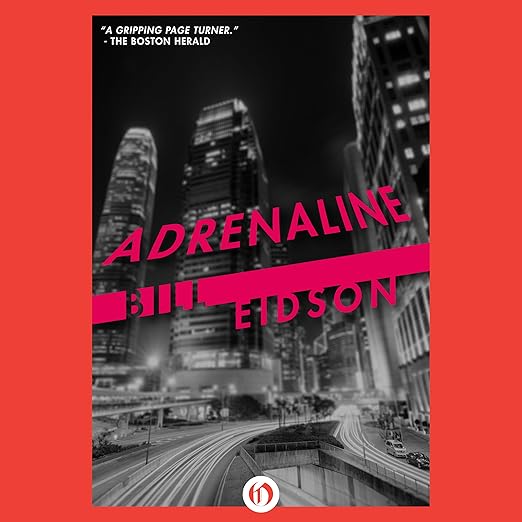
Bill Eidson's thriller Adrenaline, narrated by Tim Friedlander, opens in the recognizable terrain of corporate America before pivoting into something considerably darker. The audiobook tracks two men whose careers began in parallel: Steve Dern, who makes it to CEO, and Geoff Mann, who loses the race and ends up on the street. From that single bifurcation, Eidson constructs a tightly wound psychological study in what happens when someone discovers that the most intense rush of all is not a BASE jump or a free climb, but the act of taking a human life.
The setup is deceptively clean. A lost promotion, a man with nothing left to lose, a taste for extreme sports that mutates into something far more dangerous. Eidson uses the language of addiction throughout, and it is precise and deliberate. Geoff does not simply become a killer. He finds that killing delivers the neurochemical hit that nothing else does, and Eidson treats this as a serious premise rather than pulp shorthand. The result is a thriller that is more interested in how someone becomes capable of this than in the mechanics of the crime itself.
The Verdict, Briefly
The structural engine of the novel is the game Geoff constructs with Steve as his opponent and Lisa, Steve's wife, as the prize. What makes this more than a standard cat-and-mouse thriller is the asymmetry Eidson builds into the confrontation. Steve is not a thriller hero by disposition. He is a corporate executive who made it to the top of a conventional hierarchy and is now being asked to operate in a completely different system, one where the rules are Geoff's and the stakes are total. To save Lisa, Steve must find a way to make Geoff feel fear. To scare a man who has discovered he enjoys killing is not a tactical problem. It is a psychological one.
Friedlander's narration suits the material. He does not play up the menace artificially; instead, he lets Eidson's prose do the escalating. The 9 hours and 13 minutes move at the pace of the title, which is to say that once the thriller's central dynamic locks into place, the listening experience becomes difficult to interrupt. Reviewers have described not putting it down across a single sitting, which is the specific kind of endorsement this type of thriller earns or does not.
The Best Parts of Adrenaline
Eidson is interested in corporate culture as a generator of psychological damage in ways that feel durable. The premise that losing a promotion could set off a chain of events leading to murder is not treated as a moral riddle but as a case study in how certain personalities metabolize humiliation. The extreme sports thread in the first act is not mere atmosphere. It establishes the way Geoff processes risk, that he has always organized his interior life around the pursuit of intensity, and that what changed was not his character but his access to a more extreme form of it.
The Lisa thread adds a register that the male rivalry structure alone could not sustain. Her situation is not passive. Eidson gives her interiority and agency, and the question of whether Steve's plan to frighten Geoff can actually work before something irreversible happens to her gives the final act its genuine tension. The no-holds-barred quality that the synopsis promises is delivered without gratuitousness. Eidson shows just enough to make the stakes credible and lets the psychological portrait carry the weight.
Eidson also understands that the most disturbing thrillers are the ones where the villain's logic is internally coherent. Geoff is not irrational. He has applied the same framework he used to evaluate extreme sports to a new domain, and within that framework his actions follow. That coherence is more unsettling than straightforward psychopathy because it requires the reader to follow the reasoning rather than simply recoil from it. Friedlander's narration of Geoff's self-explanations never lets the performance tip into theatrical villainy. He plays it straight, which is the correct choice and the more difficult one. The audiobook's final act depends on a confrontation that requires Steve to understand Geoff well enough to predict his responses, and the groundwork Eidson laid across the preceding hours makes that confrontation feel earned rather than contrived.
Points to Consider
Watch the early extreme-sports passages carefully. Eidson is establishing a vocabulary that he returns to in the book's most intense scenes. The way Geoff describes the sensation of a free fall or a dangerous dive is the same framework he uses to describe what he feels when he crosses ethical and then legal lines. The continuity is deliberate, and catching it early gives the later revelations more force.
Friedlander's choices in those passages are worth attention. He delivers Geoff's self-justifications with a flatness that registers as more chilling than an obviously malevolent performance would. When a character explains his own psychology with complete calm and clinical precision, the horror comes not from the delivery but from the content, and Friedlander understands that. It is a performance choice that rewards a listener who is paying attention rather than simply being pulled forward by plot.
Who Should Pick Up Adrenaline
Thriller listeners who want psychological depth alongside propulsive plotting will find this audiobook satisfying. If you are drawn to stories that examine how ordinary lives can break toward extreme outcomes, and that do so with structural rigor rather than sensationalism, Eidson's work earns serious attention.
Listeners who prefer their thrillers anchored in procedural detail or law enforcement perspectives may find the absence of institutional framework slightly disorienting. This is a story about two men and a woman caught in a private war, and the resolution depends on psychology rather than procedure. If that particular balance does not appeal, the novel's strengths may not compensate.
Before You Press Play
- Read by: Tim Friedlander keeps pace with Bill Eidson's propulsive plotting, handling the psychological spiral at the core of the thriller with controlled intensity.
- At its heart: Corporate rivalry turned deadly, the psychology of thrill-seeking, a husband's race to save his wife
- Vibe: Tight, escalating, and genuinely unsettling in its central premise
- Short version: Eidson's thriller earns its title by making a disturbing psychological portrait feel both plausible and relentless.