- Performance: Lauren Garvin paces the dense fitness science and behavioral coaching material with clarity and appropriate variation, making twelve hours of certification prep more engaging than the subject matter alone might warrant.
- What it covers: ACE certification exam preparation, exercise science and anatomy, behavioral coaching and program design
- Feel: Motivating and methodical
- Our call: A well-structured audio study guide from the Davidson's series that converts commute and workout time into genuine ACE-CPT exam preparation.
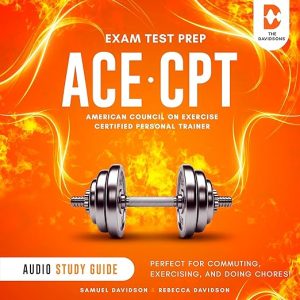
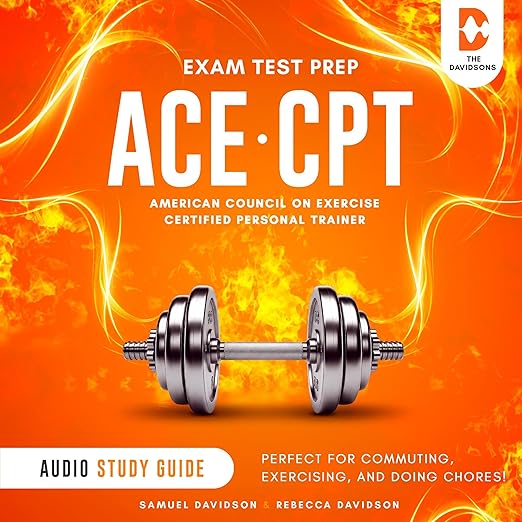
ACE certification opens real doors in the fitness industry, and Samuel Davidson's ACE-CPT American Council on Exercise Certified Personal Trainer Study Guide, narrated by Lauren Garvin, is designed to prepare candidates for the full scope of that examination through audio. The audiobook runs twelve hours and twenty minutes and is part of the Davidsons Audiobooks: Exam Test Prep series, which has an established framework for turning listening time into structured certification preparation. This is an audiobook that knows exactly what it is trying to accomplish and builds every production decision around that specific purpose.
The ACE-CPT exam covers considerably more territory than the fitness knowledge candidates typically begin with. Functional movement, resistance training, cardiorespiratory endurance, advanced programming, anatomy and physiology, applied kinesiology, behavioral coaching, client communication, program design for diverse populations including youth, seniors, pregnant clients, and those with chronic conditions, and the legal and ethical dimensions of professional practice are all tested domains. Davidson's approach is organized by the ACE Fitness Training Model, which gives the preparation a structure that mirrors the exam itself rather than imposing an external pedagogical framework that candidates then have to translate back to the test context.
Garvin's Pacing Varies Without Tipping Into Performance
Garvin's narration is the technical production choice that most affects how well this audiobook works as a study tool. Davidson's series positioning emphasizes harnessing the rhythms of the spoken word to boost cognitive retention, which is marketing language for a real phenomenon: well-paced verbal presentation of technical information improves retention compared to monotone delivery, and Garvin implements this through varying pace between concept introduction and detail-heavy application sections. She maintains a clear and motivating tone throughout twelve hours without tipping into the performative enthusiasm that would undercut the clinical content and signal to the listener that the material is being sold rather than taught.
The anatomy, physiology, and applied kinesiology sections are where the audio format faces its greatest challenge. These are traditionally visual subjects, and the relationships between muscle groups, movement patterns, and injury mechanisms are easier to understand with diagrams than with verbal description alone. Garvin and Davidson address this through precision of language: the descriptions are careful enough to build workable mental models rather than requiring visual confirmation at every point. Candidates who supplement the audio with visual anatomy references will retain more from these sections, but the audio coverage is substantively useful on its own for most of the content.
Driving, Lifting, Running, and Studying All at Once
The case for this audiobook is the format flexibility it provides for people already working in fitness or living active schedules. Davidson's design explicitly addresses candidates who are driving, lifting, running, or occupied with daily routines, and the audio format means certification preparation is possible during the time that busy fitness professionals struggle to protect for study. At twelve hours, it is a realistic commitment across a preparation period of several weeks at one hour per day, a sustainable pace for most working candidates that does not require carving out separate study blocks from an already full schedule.
The practice questions with in-depth explanations integrated throughout the audio content are the most direct exam preparation feature the program offers. Rather than requiring a separate test bank session after completing the main content, Davidson integrates the Q&A into the learning sequence in ways that create the retrieval practice that exam performance research consistently supports. Hearing the reasoning behind correct and incorrect answers immediately after encountering the question builds critical thinking about the material rather than simple recognition of the right answer when you see it again on the exam.
Client Communication Content Fits the Audio Format Well
The behavioral coaching and client communication sections, which cover strategies for helping clients build healthy habits and stay motivated through realistic obstacles, are content areas where the audio format works particularly well because the material is fundamentally about human communication rather than technical specification. Candidates who are strong in exercise science but less confident in the coaching dimensions of personal training will find these sections especially valuable for building the full competency profile the exam tests.
The legal, ethical, and scope-of-practice content is important and often underestimated in exam preparation by candidates who are focused on the science. Davidson covers ACE's Code of Ethics and the professional guidelines for building a sustainable fitness career with appropriate emphasis. This content is tested on the exam and also has real professional consequences for new trainers, since violations of scope of practice are a genuine risk that starts on day one of certification. Garvin's delivery of this material is clear and authoritative without becoming legalistic.
Skip It If You Need NASM or ISSA Prep
This audiobook is built for fitness professionals and career changers preparing for the ACE-CPT examination who want to convert audio-available time into structured exam preparation without sacrificing coverage quality. It is also a strong resource for certified trainers seeking a continuing education refresher on the full ACE framework. Skip it if you need visual anatomy references as a primary learning tool rather than a supplement, or if you are preparing for a different certification body's exam, since this guide is specifically aligned with ACE's current content blueprint and not transferable to NASM, ISSA, or other certifications. For candidates who can commit twelve hours of listening across their preparation period, this is a productive and well-designed use of that time.
Questions Listeners Ask
Does this ACE-CPT audiobook cover all the domains tested on the current certification exam?
Yes, the guide covers the full ACE Fitness Training Model including functional movement, resistance training, anatomy and physiology, behavioral coaching, program design for diverse populations, and legal and ethical guidelines. It is organized by the ACE exam structure rather than a generic fitness education framework, which helps candidates understand how the material maps to the actual test.
How does this audiobook handle practice questions, and are they useful for actual exam simulation?
Practice questions with in-depth explanations are integrated throughout the audio rather than collected at the end, creating distributed retrieval practice across the twelve hours. The explanations cover why answers are correct or incorrect, which builds critical thinking about the material rather than simple pattern recognition of the right answer.
Is this audiobook part of a series, and does the Davidson's series approach affect how ACE-CPT material is covered?
Yes, it is part of the Davidsons Audiobooks: Exam Test Prep series, which has a consistent methodology for audio-based certification preparation. The series emphasizes retention through pacing and audio-integrated practice rather than simply reading a textbook aloud, which is a meaningful distinction for candidates committing twelve hours to the format.
Can this ACE-CPT study guide audiobook be used alongside other preparation methods, or is it designed as a standalone resource?
The guide is designed as comprehensive standalone preparation, but candidates with specific weak areas will benefit from targeted supplementary work. The anatomy and physiology sections benefit from visual reference material alongside the audio, and candidates who are primarily visual learners may want access to diagrams while listening to those specific sections.