Fifteen years separate the start of this review column from the recording it now sits beneath. Three of the four written responses were filed in 2007, 2010 and 2012, long before this October 2022 audiobook existed, and only the newest of them could possibly have heard it. That does not make them worthless, since Brad Snyder's book has been argued over for a long time and the arguing is worth reading. It does mean the 119 ratings above them are a verdict on a text rather than on sixteen hours and nineteen minutes of audio, and a buyer should approach the star average knowing which product it was earned by.
A Closer Look at A Well-Paid Slave
Almost none of this sounds believable now. After the 1969 season the St. Louis Cardinals traded their star center fielder to Philadelphia, and under the rules of the time a traded player had two options: report to the new club or retire. No free agents. No no-trade clauses. Curt Flood, unwilling to leave St. Louis and moving in the current of the civil rights movement, sued Major League Baseball for his freedom. The case went to the Supreme Court and he lost it. Three years later free agency arrived anyway, built on ground his defeat had cleared. The cost was his career, and the copy places his influence alongside Jackie Robinson and Muhammad Ali.
A 2012 five-star reads the structure correctly: this is two books at once, a biography of Flood and an account of his collision with baseball's antitrust exemption, and it gives roughly equal weight to both. That response supplies the early material the description skips, an Oakland childhood spent mostly trying to survive, high school all-star teams shared with Vada Pinson and Frank Robinson, and a network of family and coaches who kept him out of trouble. Knowing what the man came from is what makes the later refusal land. A player with nothing to fall back on walked away from everything on principle.
What Makes A Well-Paid Slave Worth Hearing
A 2010 five-star shows what the book does to a reader, which is worth more than a summary. That entry turns into a broadside at modern professional athletes and their luxury cars, arguing that every one of them owes their leverage to a man they have never bothered to learn about. The tone is furious and the point stands. Flood's name has faded while the free agency he made possible turned into the most lucrative labor market in sports, and a book still capable of producing that much anger years after it appeared is doing something durable.
Sixteen hours is a serious commitment and this material justifies it, because the legal argument needs the length. Nnamdi Asomugha is the voice credited on this Audible Studios production, and the pairing of a sports subject with a full-scale courtroom narrative is exactly the kind of book audio suits: you can carry the chronology in your head while the details of the reserve clause accumulate. The story also has an unusual advantage in that its ending is public knowledge, so nothing is spoiled and the tension comes entirely from watching a man decide to lose on purpose.
Things to Know Before Starting A Well-Paid Slave
The most serious reservation belongs to a 2007 four-star that engages the book on its own terms. It credits Snyder with a widely researched and richly detailed account of Flood's fight against the reserve system and of the years after the courts ruled against him, then challenges the central thesis: that Flood acted as a civil rights activist modeling himself on Jackie Robinson. The verdict is that the case is reasonable without being wholly satisfying. Anyone who wants the sports history without the political frame should know that the frame is the book's organizing argument, not a coat of paint on it.
Thin is the word for this column, given how many ratings sit above it. Four accounts stand under 119 grades, and to their credit not one of them is shorter than a paragraph, which is rarer than it should be. The other thing to weigh is register. Following the order the description sets out, the book turns at the lawsuit, moving from a life to a case, and a listener who came for the center fielder has to be willing to follow him into federal court and stay there. A large share of the purchase goes on procedure, argument and aftermath rather than on games.
Who Brad Snyder Is Writing For
Filed from Canada in February 2024, the newest entry lands on the reaction the book is engineered to produce: that every player in the game should know more about what Flood gave up to fight a system that was plainly unfair, even though it cost him personally. That is the audience. Baseball listeners who want more than a pennant race, legal history readers who like watching a doomed case build, and anyone interested in the point where the civil rights movement met professional sport will all get their money's worth across the full runtime.
Casual sports fans looking for a breezy diamond story should pass. This is a courtroom book with baseball in it, and long stretches concern arguments, filings and the machinery of an antitrust exemption rather than games. Listeners who need a triumphant arc should also be warned that Flood loses, publicly and expensively, and that the victory belongs to the players who came after him. Union members, labor historians and anybody who has ever wondered how athletes won the right to choose an employer are the ones who will finish it changed.
- Read by: Nnamdi Asomugha holds the reader credit on an Audible Studios production, pairing a sports subject with an extended courtroom narrative.
- At its heart: The reserve clause, civil rights, sacrifice and consequence, the birth of free agency.
- Vibe: Sober, indignant and legally detailed.
- Short version: Essential sports history, provided you accept that the courtroom outweighs the ballpark.
Before You Listen
Do the reviews on this audiobook page describe the recording?
Three of the four cannot have. Their dates land a decade or more before the October 2022 release, which means they grade Brad Snyder's text rather than any recording of it. Only the February 2024 entry postdates the recording, which leaves the 119 ratings pooled across two very different products.
How much baseball is actually in this audiobook?
Less than the category suggests. Shelving puts it in sports under a baseball tag, but the spine of the story is a lawsuit that reached the Supreme Court. Expect a career and a childhood in the early hours, then an extended legal narrative about the reserve clause and its collapse.
Did Curt Flood win his case?
No, and the book does not pretend otherwise. The Supreme Court ruled against him and the fight cost him his career. Free agency arrived roughly three years later in the atmosphere his challenge created, which is the paradox the whole account is built to explain rather than a twist it withholds.
Why does the description end with a cover photo credit?
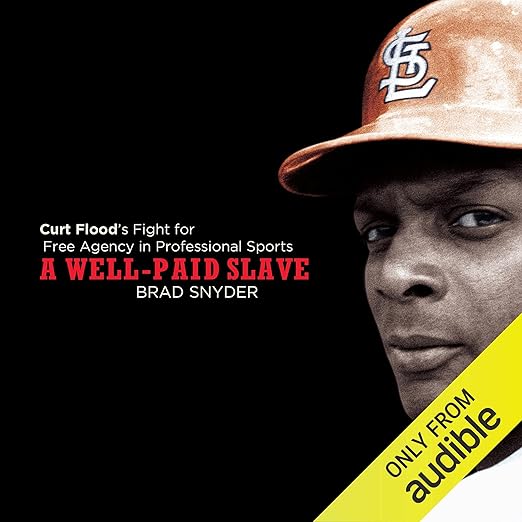
Because it was written for a printed jacket. The copy closes by crediting a picture agency for the cover image, a line that makes sense on a dust jacket and none at all on a listing where the artwork appears as a thumbnail. It is one more sign the page began life selling a book.