At a Glance
- Voice: Jeff Cummings brings sober, restrained gravity that keeps the material's moral complexity intact.
- Big ideas: Maya Lin versus Frederick Hart, art and politics colliding, memory and how a divided country honors its dead.
- Atmosphere: Tense and reflective, more political history than art criticism.
- Worth it?: A genuinely illuminating account of the Vietnam Memorial's bitter creation, essential for anyone with a personal connection to the war.
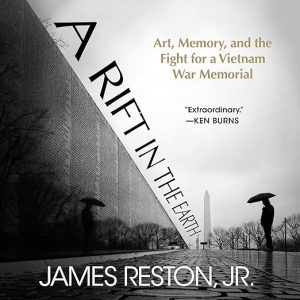
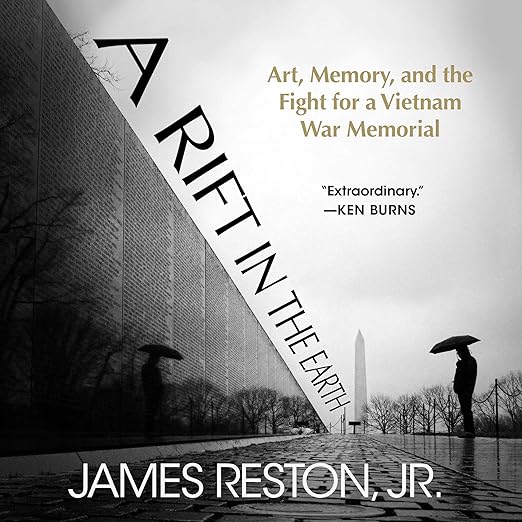
A young architecture student from Yale, still years from any real professional reputation, submitted a design so spare it was mistaken by some early critics for an absence of design entirely, and then spent the next five years defending it. This audiobook covers the 1979-to-1984 fight over what became the Vietnam Veterans Memorial, centered on Maya Lin, whose winning design triggered fierce backlash from powerful figures who wanted something more traditionally heroic, and sculptor Frederick Hart, whose more figurative statue eventually joined the site as a compromise. James Reston Jr., a Vietnam-era veteran who lost a close friend in the war, approaches this less as neutral art history and more as an insider's reckoning with how the country chose, after considerable ugliness, to remember its dead, and narrator Jeff Cummings reads it with the sober, unhurried gravity the material demands.
Reston Frames This as an Art War
Reston frames this explicitly as an art war, and the book's real strength is refusing to let either side, Lin's abstract minimalism or the traditionalists who found it unbearably bleak, off the hook for the ugliness that followed. Reviewer J. K. Campbell, a Vietnam-era Army draftee himself, thanks 'Reston and Ken Burns for illuminating a dark corner of our country's past,' a reminder that this controversy, decades later, still carries real weight for people who lived through the era it's revisiting.
Becky W. remembers the fight firsthand too, describing 'the bitter back and forth of politicians who couldn't comprehend her design, and art critics who had their own old boy's network and favorites,' which captures the specific, personal pettiness Reston documents rather than treating the controversy as an abstract debate about aesthetics. Bill in Florida sums up the improbability of the whole outcome plainly: 'with all the in fighting it is a wonder that it was ever built,' crediting Lin's 'drive to get the Memorial built without changing her design' as the thing that ultimately saved it from committee-driven compromise.
Reston's own history isn't incidental to how the book reads, either; his sympathy clearly extends to everyone genuinely trying to honor the dead, even as he documents how badly that shared goal fractured into competing visions of what honoring them should actually look like. That personal stake also explains the book's tone throughout: this isn't a detached academic case study of a public art controversy, but an account written by someone who understands exactly what was actually being fought over underneath the arguments about aesthetics and committee procedure.
Lin's Rift, Hart's Sea of Sacrifice
The dual-figure structure, Lin and Hart, is what elevates this above a straightforward controversy recap. Reston includes both artists' own words on their work: Lin describes her memorial as 'a rift in the earth, a long polished black stone wall, emerging from and receding into the earth,' and Hart describes his contribution as 'a kind of ocean, a sea of sacrifice,' adding, in his own words, 'I place these figures upon the shore of that sea.'
Cummings Keeps Both Sides Morally Complicated
Hearing both framings back to back, in a narrator's voice rather than on a page, makes the aesthetic disagreement feel less like a simple culture-war binary and more like two serious artists genuinely wrestling with how memory and grief should look in physical form. Jeff Cummings's sober, restrained delivery suits this balance well; a narrator pushing too hard toward outrage on either side would flatten a story that Reston, by all accounts, works hard to keep morally complicated. J. K. Campbell's evident gratitude as a veteran of that same era speaks to how much of this specific history isn't widely known and rarely taught, despite the memorial itself being one of the most visited sites in Washington.
The book also captures something specific about how public art gets made, or nearly doesn't, in a democracy: a jury selected Lin's design through a blind competition specifically to keep politics out of the decision, and the ensuing five years of controversy show exactly what happens when that insulation from politics turns out to be temporary rather than permanent. The blind-competition detail complicates any easy narrative about the fight, too; the process that chose Lin's design was specifically built to be fair and apolitical, which makes the backlash that followed less a failure of that process and more a demonstration of how much political pressure can still override it after the fact.
The Ken Burns Credit Isn't Confirmed Elsewhere
J. K. Campbell's review credits both Reston and Ken Burns, which is worth flagging as the reviewer's own framing rather than something confirmed elsewhere in the listing; nothing in the synopsis or the other reviews mentions a Ken Burns connection, so treat that detail as one listener's personal context rather than an established production fact worth repeating as settled.
The book's focus stays tightly on the 1979-to-1984 controversy specifically, not on Maya Lin's broader career before or after this project, so anyone hoping for a full career retrospective of her later architectural and artistic work will find the scope narrower than expected. At six hours and fifty-two minutes, the runtime is efficient rather than exhaustive, which means some of the political maneuvering, the committee fights Bill in Florida references, moves at a brisk clip that occasionally trades depth for momentum. Given how politically charged the original controversy was, involving patriotism, racism, and disagreements about how to honor an unpopular war's dead, anyone expecting a tidy, uncontroversial art-history account should recalibrate; Reston doesn't sand down the uglier parts of the fight.
More Politics Than Aesthetic Theory
Vietnam veterans and anyone with a personal connection to the war, the audience J. K. Campbell's review speaks to most directly, will likely find this account of how the country argued over honoring its dead resonates on a different level than it will for listeners without that connection. Readers of design and public-art history, particularly anyone interested in how Minimalism collided with public expectations for war memorials, will also find the Lin-versus-Hart framing genuinely illuminating rather than one-sided.
Pure art-history purists hoping for a focused monograph on Minimalist sculpture will find more politics, patriotism, and committee infighting here than aesthetic theory, since Reston's real subject is the fight itself rather than formal analysis of the design. Anyone looking for a tidy, feel-good story about a monument uniting a divided country should also know upfront that the art war framing is earned; the process Reston documents was genuinely bitter, and the book doesn't smooth that over for a cleaner narrative.
Before You Listen
Does this audiobook cover Maya Lin's entire career, or just the Vietnam Memorial controversy?
Just the controversy, specifically the 1979-to-1984 fight; listeners hoping for a full career retrospective of her later work will find the scope intentionally narrower than that.
Do I need prior knowledge of the Vietnam War to follow this audiobook?
Not extensive knowledge, though general familiarity helps; Reston's real focus is the memorial controversy itself rather than the war's military history.
Does Jeff Cummings's narration handle both Maya Lin's and Frederick Hart's perspectives fairly?
Yes, his sober, restrained delivery avoids favoring either artist emotionally, which suits a book that includes both of their own words about their competing visions.