
The Short Version
- Performance: Simon Vance takes the full ten and a half hours solo, with no cast and no author cameo in the credits.
- What it covers: Illegitimacy and abandonment, addiction and sobriety, the blues as inheritance, the death of a child
- Feel: Plain-spoken, unsparing, quietly devastating in the last third
- Our call: One of the few star memoirs willing to tell on itself, worth the ten and a half hours if you can take the weight.
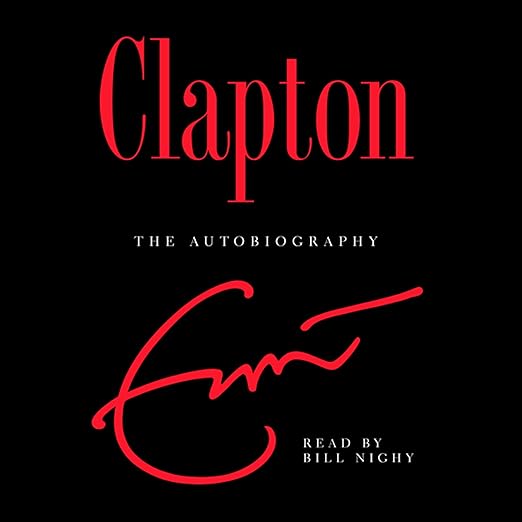
Honesty is the whole product here, and Clapton delivers more of it than most musicians would survive. Eric Clapton wrote a memoir that names his own drug addiction, his alcoholism, his years of self-imposed seclusion and the four-year-old son he lost in a freak accident, and he declines to arrange any of it into a redemption shape that would flatter him. The audiobook runs ten hours and thirty-one minutes, and one thing is worth settling before you start: the man whose speaking voice you may already know does not read a word of it.
What We Made of It
Born illegitimate in 1945 and raised by his grandparents, Clapton believed until the age of nine that his actual mother was his sister. That single fact organizes the book. Angela Briggs, in a five-star posted one week after this recording appeared, reads the entire arc through it: the passage from a child utterly rejected by his mother to a man struggling to be a good father to his daughters, with a boy in the middle who taught his fingers to say what he could not. The guitar was the solace, the blues became the lifelong love affair, and that response describes the blues as soul music that permeates and refuses to compromise, so that you either get it or you do not. Clapton, on the evidence of his own book, got it early and never looked for anything else.
Five ratings hold up a 4.3 average here, and the arithmetic will not close. Five whole-star votes can only produce a display in steps of two-tenths, which puts 4.2 and 4.4 within reach and leaves 4.3 unavailable at that count. Beneath the bar sit five signed responses grading five, four, five, five and five, an average of 4.8. Two of them are not in English, one filed from Spain and one from Germany, under a listing whose language field reads English. The likeliest explanation is several editions and marketplaces pooled into one product, which is ordinary retail behavior and still means the figure above these responses does not describe them.
The Best Parts of Clapton
Confession is a hard mode for a memoir and an easy one to fake. The Spanish-language five-star, from December 2021, describes an autobiography written without evasions and without ornament, an honest self-assessment by one of the finest musicians alive, and calls it essential for anyone drawn to blues and rock players rather than only for existing fans. That distinction is the real achievement. The music history is genuinely present, with Cream billed in the copy as the world's first supergroup and guest work alongside Jimi Hendrix, Bob Dylan, the Beatles, the Rolling Stones and George Harrison, and yet the book keeps refusing to let the discography carry the emotional weight for it.
Simon Vance holds the credit for all ten and a half hours, which makes this a first-person memoir read by somebody other than the person saying I. Treat that as a decision rather than a defect. A famous speaking voice arrives with its own associations, and an actor reading a musician's confession trades recognition for control: no self-consciousness, no protective irony creeping in around the ugliest admissions, no temptation to underplay the addiction chapters because they would be humiliating to say out loud. What the material asks for is restraint. The worst events in this book are set down plainly on the page, and any reading that reached for them would undo the effect the prose works to achieve.
What Might Not Land
Firelock, at four stars, wrote the most useful dissent on the page and titled it shallow man, great musician. That response enjoyed the book, calls it not the most slickly written autobiography, and then lists what Clapton willingly put on the record about himself: drug addict, alcoholic, womanizer, unreliable, at times very fickle and moody, and never really past his early childhood or the revelation about his mother. The objection holds. Candor is not insight, and this memoir supplies far more of the first than the second. Clapton tells you what he did with a steadiness close to unnerving and rarely stops to ask why, which leaves the analysis to you.
Grief is the other thing to prepare for. The death of Conor at four years old, in the accident the copy calls freak, sits in the middle of this book, and the account of it is what people carry away. The copy frames what follows as a turn toward music rather than back toward addiction, which is accurate and extremely compressed for what it is describing. Ten and a half hours leaves room for that material to land at full weight, and a listener who started this for the supergroup history will find the later stretches considerably heavier than the early ones. Plan the listening rather than stumbling into that section unprepared.
Who Should Pick Up Clapton
Put this on if you want a musician's life told with no press officer in the room. It suits listeners who came for the blues lineage and will stay for the wreckage, readers of addiction memoirs who have tired of the recovery-arc template, and anyone curious about what the inside of a sixties supergroup actually felt like to the person standing in it. The famous names are real and unavoidable, so the music history alone will reward a fan, and the book is better than its guest list and clearly knows it.
Avoid it if you want musicianship explained. Very little here concerns how the playing was built, and anyone hoping for craft talk will find feeling where the technique should sit. Avoid it too if the childhood material or the loss of a child would be hard to sit with at length, because the book does not signpost those passages and the listing carries no content note whatsoever. The German-language response from March 2014 states the appeal precisely: an interest in the person behind the image, and a confession unlike anything previously encountered, free of self-pity and of softening sentimentality. If that is what you want from a memoir, few supply it this readily.
Does Eric Clapton narrate the Clapton audiobook himself?
No. The reader credit on this recording, published in October 2007, belongs to Simon Vance. If you specifically want a musician's memoir delivered in the musician's own voice, check whether a later author-read edition exists before buying, because nothing on this page offers one or mentions the possibility.
How much of the audiobook is music history and how much is private life?
The copy splits it roughly in half. On one side sit Cream, the guest appearances with Hendrix, Dylan, the Beatles, the Rolling Stones and George Harrison. On the other sit illegitimacy, the sister who was his mother, seclusion, addiction and fatherhood. The private material dominates the later hours.
Do you need to know the discography to follow this audiobook?
Not at all. The story is anchored in family, addiction and relationships rather than in record releases, and the bands arrive as places where the life happened. Knowing the music adds recognition and detail, but no track list is assumed and nothing important depends on it.







