Quick Take
- Voice: Michael Pollan reading his own work brings a quiet authority to A Place of My Own - his pace is measured, his emphasis precise, and he handles the philosophical digressions with the same relaxed intelligence he brings to the physical-construction passages.
- Big ideas: Craft and architecture as philosophy, the human need for solitary space, connections between built and natural worlds
- Atmosphere: Contemplative, curious, and gently comic
- Worth it?: This audiobook rewards patient listeners who want to think alongside a writer as he figures out what a building is actually for.
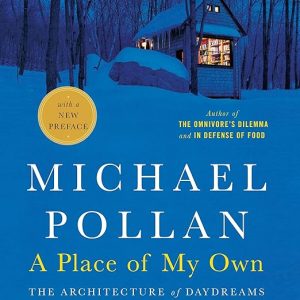
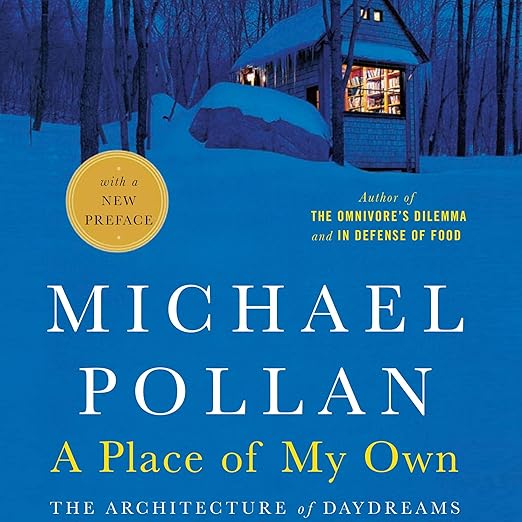
Michael Pollan's audiobook A Place of My Own, narrated by Pollan himself and running nearly ten hours, begins from an admission that might seem disqualifying: he has no particular skill with tools, no background in construction, and no clear idea what he is doing when he decides to build a small wooden writing hut on his property in Connecticut. That combination of ambition and incompetence is precisely the material he works with, and the result is one of the more interesting books about architecture available - not because Pollan is an architect, but because he approaches the whole subject as an intelligent amateur asking real questions.
The book was originally published in 1997 and this updated edition preserves its essayistic character. Pollan moves between the practical narrative of the hut's construction and extended philosophical detours into the history and meaning of shelter, drawing on figures from Thoreau to Mr. Blandings, from Vitruvius to the Japanese tradition of the tea house. The ratio one reviewer described as roughly half construction narrative and half philosophical exploration is accurate, and both halves are stronger for being interwoven.
An Outpost or a Refuge, By Placement
The central argument Pollan is working toward - that building something with your own hands creates a different relationship to space than simply occupying it - is stated quietly and arrived at slowly. He does not announce this thesis in the opening pages and then proceed to support it. He discovers it in the process of designing and building, and the audiobook structure lets you follow that discovery in real time. By the time he describes sitting alone in the finished hut for the first time, you have enough context - architectural, philosophical, personal - to understand what the moment means to him and why it matters beyond his own circumstances.
Pollan's treatment of placement is particularly good. He writes about how where a building sits relative to its surroundings shapes not just the view from inside but the psychological character of the space - whether it feels like an outpost or a refuge, whether it announces itself or tucks away. This is the kind of detail that a purely practical building book would skip, and it is also the kind of detail that makes a hut reader genuinely think about the small wooden room they always meant to build at the back of their yard.
Pollan Reads Sentences He Revises Heavily
The self-narration works for this book in ways it does not always work for literary nonfiction. Pollan is a writer who revises heavily, which means his sentences are constructed for precision rather than spontaneity, and hearing him read them preserves the architecture of the prose without the slightly airless quality that sometimes results when a voice actor over-smooths literary nonfiction. His delivery is unshowy - he does not perform the funny passages or linger on the melancholy ones - which gives the audiobook the feeling of a very good lecture from someone who has prepared carefully but is thinking through the material in front of you.
A Walden Echo and an Origin Document
Reviewers consistently note that the book made them want to build something, which is a meaningful effect. For an audiobook about construction and solitude, that desire is the correct response. One reviewer explicitly said it helped them understand why Thoreau's Walden has held its place in the culture - a sideways compliment that captures something true about the book's ambition. Pollan is not writing Walden, but he is in dialogue with that tradition, and he handles that positioning with appropriate humility.
For listeners who have followed Pollan's later career, this audiobook functions as a kind of origin document. The interest in how humans relate to the natural world through the things they make and consume - the question that runs through The Botany of Desire and The Omnivore's Dilemma - is here in its earliest sustained form, applied to wood and joints and the placement of a window rather than to corn and cattle. Hearing Pollan describe his architect, the skilled craftsmen he hired to compensate for his own limitations, and the specific design choices that shaped the finished hut is to understand where his habit of close, patient attention to material things came from.
Long on Digression, Redeemed by Dry Humor
The philosophical tangents are long. Pollan is generous with digression, which works beautifully in books like The Omnivore's Dilemma where the subject matter is naturally expansive, but in a book ostensibly about building a small hut, some listeners will find the extended meditations on architectural history slightly out of proportion. If you are listening for the construction narrative specifically, you will need patience for the stretches where the hut disappears for forty minutes while Pollan thinks through the phenomenology of thresholds.
The humor, when it arrives, is dry and self-deprecating. The scene in which Pollan's unhandy hands cause various small construction disasters is genuinely funny in a quiet way, and the audiobook format makes these moments land better than they would on the page because Pollan's slightly reluctant delivery suggests he is still faintly embarrassed by them. This is not broad comedy - it is the humor of a smart person acknowledging the limits of their competence.
Not for Listeners Wanting Fast-Paced Narrative Nonfiction
Readers who have followed Pollan's career and want to hear how his thinking developed before The Omnivore's Dilemma and In Defense of Food will find this audiobook illuminating. The connective tissue between building a hut and understanding food systems is not obvious from the outside, but Pollan's persistent interest in the relationship between humans and the natural world runs through all of it, and A Place of My Own is where that project began in its current form.
Architecture enthusiasts, writers in search of a room of their own, and anyone who has seriously considered building something by hand will get the most from this one. Listeners looking for fast-paced narrative nonfiction should look elsewhere - the nearly ten-hour runtime is earned through density rather than incident, and the audiobook rewards a slow, attentive pace that matches Pollan's own.
Do you need architectural knowledge to follow this audiobook?
No. Pollan comes to the project as an admitted non-expert, and the construction passages are written for general readers. The philosophical detours assume some familiarity with Thoreau and the Western tradition of thinking about shelter, but Pollan provides enough context that prior knowledge is not required.
Is this audiobook more about the philosophy of architecture or the practical experience of building?
Both, roughly equally. One reviewer described the split as about half each. The philosophical passages are substantive, not decorative, and the construction narrative is specific and honest about the physical difficulties Pollan encountered.
How does Michael Pollan's self-narration compare to his later audiobooks?
Pollan is a consistent and measured reader of his own work. His performance here is characteristically unshowy - he trusts the prose and does not over-perform. Listeners who have enjoyed his narration of The Omnivore's Dilemma or In Defense of Food will find the same quality here.
At almost ten hours, does this audiobook justify its length?
For listeners who enjoy essayistic nonfiction, yes. The length comes from the philosophical depth Pollan brings to what is, on the surface, a simple project. For listeners expecting a tighter construction narrative, the runtime may feel generous in the wrong places.