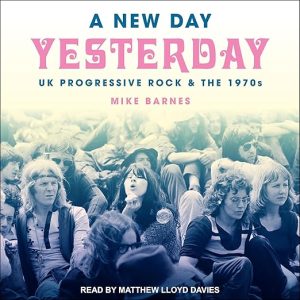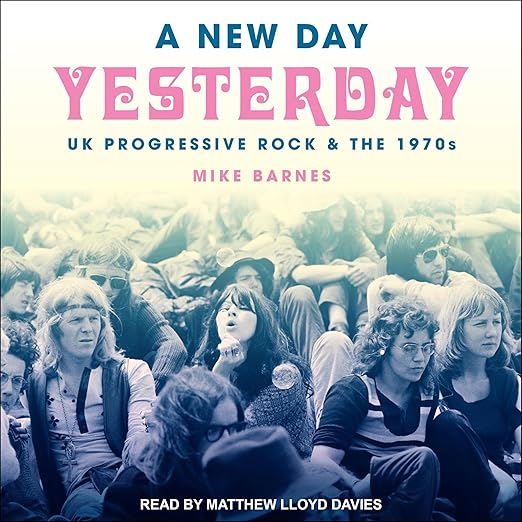
King Crimson's 1969 Hyde Park set, opening for the Rolling Stones in front of a quarter-million people, is the kind of origin-story moment Mike Barnes uses to anchor this sprawling audiobook history of British progressive rock. Barnes, a longtime contributor to MOJO, The Wire, and Prog magazine, traces the genre from the psychedelic ferment of 1967 through its early-1970s commercial peak, drawing on what the synopsis describes as hundreds of hours of his own interviews with musicians, industry insiders, journalists, and DJs who lived through the period firsthand. At twenty-seven hours and fifteen minutes, this is less a quick survey than a genuine social history, closer in scope to a definitive reference work than a casual music lover's overview.
The Myth That Punk Simply Swept It Away
Barnes previously wrote the acclaimed Captain Beefheart biography, and that same instinct for treating a musical scene as a genuine cultural ecosystem, not just a chronology of albums, shapes this book too. Rather than moving band by band through King Crimson, Pink Floyd, Genesis, and the rest, Barnes builds outward from the cultural conditions of the late 1960s: art school culture, the collapse of the psychedelic moment, and the specific economic and technological shifts that made extended, ambitious studio composition suddenly commercially viable. That contextual approach is what separates this from a straightforward band-by-band survey.
The 'myths and misconceptions' framing from the synopsis is not a throwaway line either. Barnes spends real time complicating the standard narrative around progressive rock, particularly the idea that punk simply swept the genre away overnight, replacing received wisdom with the more complicated, interview-sourced version of how individual bands actually evolved, splintered, or persisted through the mid-1970s. Listeners who know progressive rock mainly through greatest-hits compilations will find the book's insistence on nuance genuinely rewarding rather than academic for its own sake.
The book's own title is a small piece of genre literacy worth noting: 'A New Day Yesterday' borrows its name directly from a 1969 Jethro Tull song, off the same era as the band's 'Stand Up' album that overlaps with the book's opening chapters. It is a fitting choice for a history explicitly interested in how quickly the psychedelic sound of 1967 curdled into something else entirely by the turn of the decade, and it signals early that Barnes is writing for readers who already know the music well enough to catch the reference.
One listener review praises the book overall as 'thorough, temperate and well-adjudicated,' a useful description of Barnes's critical tone throughout: engaged and clearly knowledgeable, but not prone to either hagiography or contrarian takedowns for their own sake. That temperance is part of what makes the book credible as social history rather than pure fandom, even from a writer whose enthusiasm for the material is obvious on every page.
Davies Juggles Two Registers for 27 Hours
Matthew Lloyd Davies has to sustain two distinct registers across this audiobook's considerable length: Barnes's own analytical narration, which needs the measured authority of cultural criticism, and extended passages built from direct interview quotes, which need enough vocal variation to keep dozens of different musicians, journalists, and industry figures distinguishable from one another without turning into full character voicing. Managing that shift smoothly across twenty-seven hours is a real technical demand, and the material rewards a narrator who can move between registers without either one feeling like a performance.
One listener review calls the book 'THE story on progressive rock,' tracing its own praise from the 1967 psychedelic roots through King Crimson's rise to 'all the greats of the genre.' A second reviewer, quoting King Crimson's own '21st Century Schizoid Man' lyrics at length, gives a sense of just how deep this book's engagement with the music itself runs, not just the surrounding scene. For listeners who already love this era, that level of embedded detail is exactly the draw.
That same Captain Beefheart biography earned real critical praise for balancing exhaustive research with genuine readability, avoiding the trap of turning a music biography into either hagiography or dry academic cataloging. That balance is what this book attempts at a much larger scale, an entire genre and scene rather than one artist, and Davies's narration has to sustain it across dramatically more material without losing the individual voice that made the earlier book work.
Rooted Specifically in the British Scene
Twenty-seven hours is a genuine commitment, longer than most single-genre music histories, and this is not a book built for background listening during a commute. The density of names, band lineups, label politics, and overlapping scene history rewards close attention, and listeners who drift in and out risk losing track of which musician or journalist is speaking at any given moment across the many interview-sourced passages.
This is also a book squarely focused on British progressive rock specifically, following the UK-scene scope implied by the 'Omnibus Remastered' series framing. Listeners expecting equal coverage of American prog-adjacent acts, or of European scenes beyond the UK, should adjust expectations; Barnes's interviews and cultural context are rooted specifically in the British scene of 1967 through the early 1970s.
One reviewer's praise for the book 'nailing The Wall' is worth a small caveat: that section involves real critical engagement with Pink Floyd's later, more overtly political work, and listeners who prefer their music history kept separate from commentary on individual musicians' worldviews should know that kind of analysis is part of the book's territory, not an aside.
The 'Omnibus Remastered' branding is also worth understanding: Omnibus Press is a long-established UK music book publisher with an extensive catalog of artist biographies and genre histories, and 'Remastered' here signals an updated or reissued edition of Barnes's book rather than an entirely new title. Listeners who already own the original print edition should know this audio production may reflect updates made for the reissue rather than the exact original text word for word.
This Assumes Real Prior Interest Already
This audiobook is built for committed progressive rock fans, and specifically for listeners who already know the major acts and want the fuller cultural and historical context behind them. It also suits anyone interested in 1970s British music industry history more broadly, since Barnes spends real time on the business side, labels, management, touring economics, alongside the purely musical story. It is also a strong resource for anyone doing their own research or writing about the era, given the sheer density of primary-source interview material Barnes assembled specifically for this project, material that in many cases exists nowhere else in print.
Skip it if you want a breezy introduction to the genre or a starter's guide to a handful of essential prog albums; this book assumes real prior interest and rewards that interest with depth rather than easing newcomers in gently. At twenty-seven hours, casual curiosity alone is unlikely to sustain the commitment this audiobook asks for.
Before You Listen
Do I need to already know progressive rock bands to follow this audiobook?
Some baseline familiarity helps. Barnes assumes listeners already know acts like King Crimson, Pink Floyd, and Genesis by name and builds cultural context around them rather than introducing the music from scratch.
Does this audiobook cover American progressive rock, or only the British scene?
It is focused specifically on British progressive rock from 1967 through the early 1970s. Listeners looking for equal coverage of American or European prog scenes beyond the UK should adjust expectations accordingly.
How much of A New Day Yesterday is Mike Barnes's own analysis versus direct interview quotes?
Both are woven together throughout. Barnes draws on what the synopsis describes as hundreds of hours of his own interviews with musicians and industry insiders, blended with his own cultural and historical analysis.
Is twenty-seven hours a reasonable audiobook length for a single-genre music history?
It is genuinely long, longer than most music histories, and works best as a deep, deliberate listen for committed fans rather than a casual overview, given how much lineup, label, and scene detail it covers.