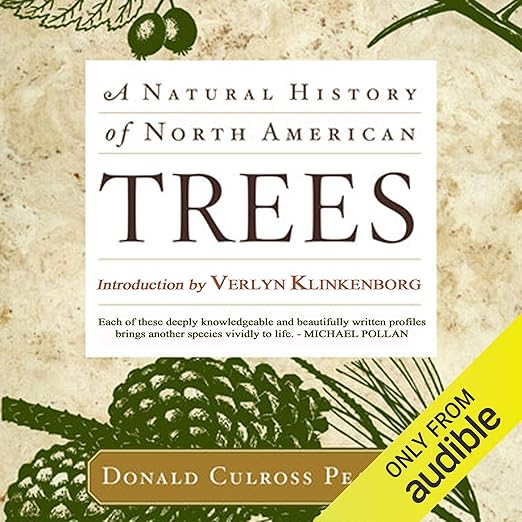
- Voice: Kevin Stillwell brings a measured, unhurried quality to Peattie's prose that matches the subject perfectly, never hurrying through the lyrical passages.
- Big ideas: Environmental grief, the cultural history embedded in native species, the intersection of commerce and ecology
- Atmosphere: Contemplative and elegiac, with flashes of genuine historical drama
- Worth it?: Peattie's writing holds up across seven decades, and Stillwell's reading makes eighteen hours feel like a privilege rather than a commitment.
Donald Culross Peattie's A Natural History of North American Trees is the audiobook I keep recommending to people who insist they are not interested in trees. That is not a clever rhetorical trick. Peattie, who wrote the two volumes collected here in the 1950s, was not primarily a botanist in the sense of a man cataloguing specimens. He was a writer who happened to understand trees the way a great biographer understands a human subject: as carriers of history, of grief, of the full complexity of what a civilization costs the land it occupies.
At eighteen hours and twenty-six minutes, this is a genuinely substantial commitment, and I want to be honest about what kind of listening experience it is. This is not background audio. Peattie's sentences demand attention. But if you give them attention, the reward is extraordinary: a picture of North America before industrialization that no history textbook has ever managed to construct, told through the lives of individual species.
Daniel Boone's Canoe and the White Pine War
The combination of natural history and cultural narrative is Peattie's great achievement. He moves without friction from the botanical details of a species to the stories of how humans encountered and used and ultimately destroyed it. The sycamore passage, in which he describes pioneers stabling animals in the hollow hearts of old-growth specimens before building their cabins, reads like something out of American mythology, except that it is simply what happened. Daniel Boone carving a sixty-foot canoe from a single tuliptree. New England colonists and the British waging an undeclared war over white pines for ship masts. These are not footnotes; they are the engine of American history, and Peattie knew it.
The passages on extinction carry a particular weight because the book was written before several of the losses it describes were complete. Peattie wrote about the American elm while it was still alive. He wrote about the passenger pigeon and the beech forest in terms of Audubon's painting, and the elegiac quality of those sections is not manufactured sentiment. He was writing about what was disappearing in real time, and listening now, from a further distance of additional decades of loss, is genuinely affecting in a way that the most self-consciously environmental books rarely manage.
Stillwell Reads at Peattie's Intended Pace
The audiobook format does something unexpected with Peattie's prose: it slows you down in exactly the right way. Reading on the page, there is always the temptation to skim the botanical passages toward the narrative ones. Listening to Kevin Stillwell's narration, you get them in the order Peattie intended, at the pace Peattie intended, and the effect is cumulative in a way that rushing through the text would destroy. Stillwell has a quality of patience in his reading that suits the material without tipping into the portentous. He reads the lament for the passenger pigeon at the same measured register as the commercial history of matchstick production, and the contrast makes both sections more powerful.
A reviewer with academic botanical training noted that while some information has changed over the seven decades since publication, Peattie's core approach remains sound: What has not dated at all is Peattie's attention to the relationship between a species and the human stories that accumulate around it. The white pine mast controversy between British authorities and American colonists reads like a genuine political thriller with a wooden protagonist. The story of the tuliptree and Daniel Boone's canoe is the kind of detail that makes you understand a landscape in ways that dates and battles cannot. These are not decorative historical anecdotes; they are the argument Peattie is making about what a tree is and what it means. "If the author was alive today, he would" update accordingly but the essential framework holds. That is the mark of writing that was never primarily about raw data to begin with. Peattie was after something harder to date than taxonomy.
Written From a 1950s White Naturalist's View
Listeners should know that this is a mid-twentieth-century text that was first published in the 1950s. The perspective is that of a white American naturalist of his era, and while Peattie is remarkably clear-eyed about the greed and waste that destroyed much of North America's virgin forest, the cultural framing is of its time. Indigenous relationships to the land and its species are not centered in the way a contemporary natural history might handle them. That is not a reason to avoid the book, but it is worth entering with awareness.
The commercial history sections, which cover everything from paper-making to furniture-making to airplane wing construction, are dense with specificity. For some listeners this will be exactly what they came for. For others, these passages may feel like they slow the narrative momentum. The book rewards patience throughout, and the eighteen-hour length means this is most rewarding when consumed across several weeks rather than in concentrated sittings.
Shelved Beside Macfarlane and Kimmerer
Natural history enthusiasts, environmental writers, anyone interested in the cultural history of North American land use, and readers who appreciate prose that takes its time will find this audiobook deeply rewarding. It sits alongside Robert Macfarlane's The Wild Places and Robin Wall Kimmerer's Braiding Sweetgrass as a book that uses the natural world as a lens for something much larger. Listeners looking for field-guide accuracy or contemporary ecological science should go elsewhere; Peattie was writing literature, not textbooks, and the audiobook experience makes that distinction clear within the first chapter.
Good to Know
Is this audiobook still accurate given that it was written in the 1950s?
Some botanical and ecological information has been updated by subsequent research, but reviewers with academic backgrounds confirm the core observations remain valid. The book is best approached as literary natural history rather than current scientific reference.
Does the audiobook cover both of Peattie's original volumes?
Yes. This edition collects both of Peattie's books on American trees into a single audiobook running just over eighteen hours, giving comprehensive coverage from the species of the East to those of the West.
How does Kevin Stillwell's narration handle the range from scientific passages to lyrical prose?
Stillwell maintains a consistent, measured tone that serves both modes well. He does not over-dramatize the elegiac passages or speed through the technical ones, which keeps the experience cohesive across a long listening commitment.
Can I listen to this audiobook without any prior knowledge of botany or dendrology?
Absolutely. Peattie writes for curious general readers, not specialists. The botanical information is always contextualized within historical narrative and cultural significance, so prior expertise is neither required nor expected.