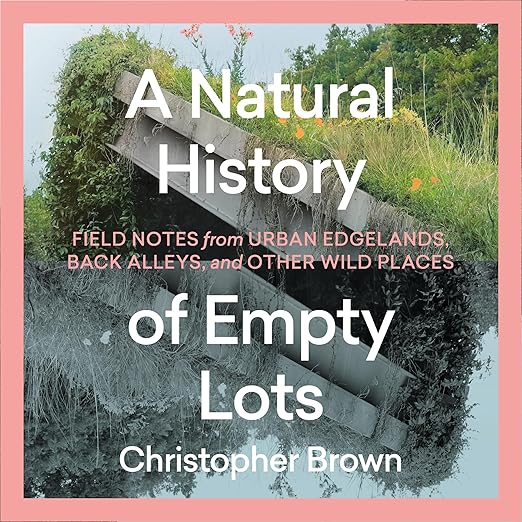
An abandoned, litter-strewn lot in an industrial stretch of Austin, Texas is where this audiobook actually begins, the property Christopher Brown bought during the real estate crash of the late 2000s when almost no one else wanted it. What follows is a twenty-year account of living inside that so-called ruined space and dozens like it around the city, watching wild nature reclaim ground that agriculture and industry had already abandoned once each. Brown narrates his own book, and that choice matters here in a way it does not for every memoir: this audiobook is built from two decades of direct, personal observation, not research conducted at a remove.
Rewilding the City, the Self, and Society
Jeff VanderMeer calls the book 'an instant classic,' and the synopsis frames it as a study for rewilding the city, the self, and society all at once, a triple framing that's a fair description of how Brown's narration actually moves. He shifts between field-notes-style observation of a specific plant or animal reclaiming a specific patch of ground, memoir passages about his own life inside these spaces, and broader argument about what damaged urban land can teach about resilience. Self-narration keeps those three registers from feeling like separate books stitched together, since the same unhurried, attentive voice carries all three without announcing a change in mode.
Buying Wrecked Land Cheap Because It Was Wrecked
That same downturn is not incidental detail; it is the actual mechanism that put an otherwise undesirable industrial lot within reach of a private buyer in the first place, and Brown is honest that his own presence on the land is itself a product of the same market forces that first industrialized and then abandoned it. That self-awareness, buying wrecked land cheap because the market had wrecked it, keeps the book from turning into simple pastoral escapism, the irony is part of the argument, not something the narration glosses over.
These lots carry a double history the book takes seriously rather than glossing over: the synopsis describes them as spaces once used for agriculture and industry, abandoned in one sense before they were abandoned again, awaiting redevelopment that in many cases never actually arrived. That layered history, farmland becoming industrial ground becoming vacant ground becoming, unexpectedly, a kind of wilderness, gives Brown's specific patch of Austin a depth most vacant-lot framing skips past entirely, treating emptiness as a stable condition rather than one stage in a longer, ongoing story.
Hope Cultivated in a Scrap Yard, Not a Park
The New York Review of Books, in its own assessment, wrote that Brown 'finds hope in cultivating the ruins of nature,' and situated the book less as a departure from traditional nature writing than as a welcome addition to it. That's a useful frame for what the audiobook actually delivers: not a polished nature-preserve narrative but an account of resilience in the least likely, least photogenic places: a drainage ditch, a scrap yard, a lot full of construction debris, rather than a national park.
Three Claims Inside One Rewilding Blurb
Michelle Nijhuis, author of Beloved Beasts, called it 'the nature writing we need now,' and Pulitzer Prize finalist Kelly Link's blurb is a single blunt word: 'incredible.' Those are strong endorsements from writers working in different corners of the same broader conversation about ecology and narrative, and they point at something the audiobook itself demonstrates rather than just claims, that a genre-bending mix of naturalism, memoir, and social manifesto can hold together across nine hours without the seams showing.
The blurb's own framing, rewilding the city, the self, and society, is worth taking seriously as three separate claims rather than one slogan. The city gets rewilded literally, weeds and foxes and second-growth trees reclaiming pavement. The self gets rewilded more slowly, as Brown describes his own habits and attention changing to match the rhythms of the land he is living on. Society is the largest and least resolved of the three, the book's closing argument that a damaged, ignored landscape might model a way to repair a damaged, ignored relationship between people and the places they live, without pretending the analogy solves anything by itself.
Two of Three Reviewers Know Brown Personally
Worth knowing going in: two of the three reviews attached to this listing come from people who say outright that they know Brown personally. One reviewer credits his weekly Field Notes newsletter with changing how he sees his own morning walks and says knowing Brown personally over the years has been part of that. Another writes, with the same disclosure upfront, that he is a friend of Brown's but would be writing the same praise regardless. That doesn't make the praise dishonest, personal friends can still be accurate critics, but it does mean the review base here is thinner and more personally invested than the professional blurbs from VanderMeer, the New York Review of Books, and Nijhuis, which arrive with no such disclosed relationship.
The book's structure asks for patience in a way some prestige-nonfiction audiobooks do not. A third reviewer, who had not finished at the time of writing, still felt confident calling the prose beautiful and said it changes how you think about these spaces, which is consistent with a book built more around accumulated observation than a driving plot. Listeners expecting a tight narrative arc, a mystery to solve or a single dramatic turn, should recalibrate: this is closer in shape to a long nature journal organized loosely around a specific twenty-year project than to a page-turner, and nine hours of that register rewards a listener willing to slow down with it.
No Villain, No Rescue, No Clean Resolution
Readers of Aldo Leopold's land-ethic tradition, or of contemporary nature writers working the margins between memoir and ecology, will recognize the territory Brown is working even as he stakes out his own specific corner of it: post-industrial Texas rather than wilderness. Anyone who has ever looked at a vacant lot, a drainage culvert, or an abandoned rail yard and wondered what actually lives there will find this audiobook answers that question in more detail and with more affection than expected.
A tight three-act structure is not on offer here, and neither is a villain, a rescue, or a clean resolution: this is observational and cumulative rather than dramatic. Listeners hoping for a science-heavy explainer on urban ecology with hard data and citations up front will find those elements folded into personal narrative rather than foregrounded, and the twenty-year framing means individual chapters sometimes range widely in mood, from wonder to something closer to grief about what got paved over in the first place. Approach it as a long, patient walk with a genuinely knowledgeable guide rather than a structured argument, and the pacing makes complete sense.
Before You Press Play
- Performance: Christopher Brown narrates his own twenty-year project, giving the memoir passages and field observations the same unhurried, attentive voice throughout.
- What it covers: Urban rewilding, ecological resilience, memoir grounded in a specific piece of land
- Feel: Reflective, patient, quietly hopeful
- Our call: A genre-blending nature memoir that rewards patient listening, strongest for readers already drawn to ecology and personal essay rather than plot-driven nonfiction.
Good to Know
Is this audiobook more memoir or more nature writing?
Both, deliberately. The book blends naturalism, memoir, and social argument, shifting between Brown's personal life on the land, close observation of specific plants and animals, and broader claims about damaged urban spaces, all across the same nine hours.
How is Christopher Brown's self-narration for this audiobook?
Well suited to the material. Since the book is built from his own twenty years of direct, lived observation, his narration carries real authenticity, though listeners should know he's an author narrating his own work rather than a trained professional performer.
Does the audiobook cover one specific lot or many different locations?
Many. While Brown's own Austin property anchors the book, he documents dozens of similar abandoned or overlooked spaces around the city across the full twenty-year project.