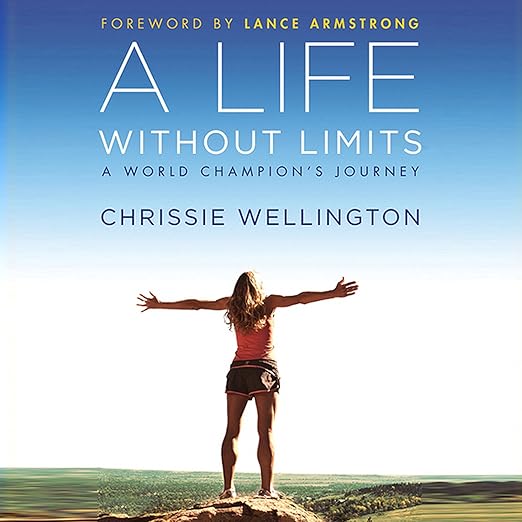
Chrissie Wellington had never won a major triathlon before she shocked the sport by claiming the 2007 Ironman World Championship in Hawaii as a total unknown to the press and the field alike, and A Life Without Limits spends nearly ten hours of audiobook explaining exactly how that happened. Wellington's memoir traces her rise from a childhood in England through training grounds that read like a world tour in themselves: the mountains of Nepal, the oceans of New Zealand, the trails of Argentina, before that first finish line in Hawaii that upended the entire sport's expectations about who its champions were supposed to be. This is not a career built on a lifetime of visible promise suddenly paying off; it is a genuinely unlikely, fast rise that the book works hard to make sense of honestly rather than mythologize.
The honesty extends well past the athletic achievements themselves. Wellington writes directly about anorexia, a near-drowning experience, and training under a coach the synopsis describes as controversial, refusing to smooth any of it into a clean underdog narrative. That willingness to sit inside the harder chapters, rather than treating them as brief obstacles on the way to triumph, is what distinguishes this from a standard sports-victory memoir. Reviewer Matthias Eriksson names this directly, thanking Wellington for her honesty and transparency, and specifically for sharing both the highs and lows of what he calls an incredible journey rather than editing out the difficult parts.
What We Made of It
A reviewer posting as Amazon Customer opens with a genuinely useful outsider's framing, describing triathletes generally as a very strange breed of athlete who work their bodies to the absolute limits of human endurance while remaining largely anonymous outside their own community, at least compared to more mainstream sports. That context matters for understanding why Wellington's 2007 win landed as such a shock: triathlon simply did not produce recognizable stars the way tennis or track did, which makes an unknown newcomer's championship run genuinely more remarkable than the same feat would be in a higher-profile sport. DC Carrie's review confirms the personal impact directly, describing herself as a huge Chrissie Wellington fan since 2007 and crediting the book with taking her own hero worship to an even deeper level of genuine inspiration.
That combination, technical respect for what triathlon actually demands physically, paired with genuine personal investment in Wellington as a specific athlete, runs through all three attached reviews. None of them treat this as a generic inspirational sports memoir; each one engages with specific, concrete details, her diet, her training methods, her mental approach to one of endurance sport's most punishing events. The reviews suggest Wellington succeeds at something genuinely difficult for athlete memoirs generally: making highly technical training content accessible to committed fans while still offering real substance for practitioners looking for legitimate insight into what actually built a world champion.
The Best Parts of A Life Without Limits
Polly Lee takes on material that swings between two very different registers within the same book: clinical, technical detail about training and nutrition, and genuinely vulnerable personal history involving disordered eating and a near-drowning experience. That range asks a lot of a narrator, since overplaying the vulnerable material risks tipping into melodrama that would undercut Wellington's own matter-of-fact honesty about it, while underplaying it risks flattening genuinely difficult material into the same neutral register as a training log. Getting both halves right, the technical rigor and the emotional candor, without letting either bleed into the other's territory, is the core challenge this specific memoir presents to any narrator taking it on.
At nine hours and fifty-four minutes, the pacing needs to sustain a listener's attention across both extended training-and-competition sequences and quieter reflective passages about identity and mental health. Given the reviewers' consistent praise for the book's honest, unglamorized tone throughout, the ideal narration choice here favors restraint over inspirational-speech energy, letting Wellington's own words carry the emotional weight rather than adding vocal drama on top of already-dramatic material. That approach tends to serve memoir generally better than a more theatrical reading would, particularly for a subject whose own reviewers consistently praise her directness above all else.
What Might Not Land
Only a single numerical rating is attached to this listing despite three substantive written reviews sitting beneath it, a data mismatch worth knowing about rather than reading as any real signal about quality. All three available reviews are strongly positive and specific, so the numerical score should not be mistaken for a small or divided reception; it more likely reflects how this particular audio edition has been logged and rated separately from the book's much broader reputation and reception elsewhere. Listeners should weigh the substantive written reviews here more heavily than the single numerical rating alone.
This memoir includes real, direct discussion of an eating disorder and a near-drowning incident, content that listeners sensitive to those specific topics should know about going in rather than encountering unexpectedly partway through. The synopsis also flags a controversial coach as part of Wellington's training history without fully detailing the nature of that controversy, so listeners specifically interested in that relationship should expect the book's own framing rather than outside context to shape how it is presented. Neither issue diminishes the memoir's value, but both are worth knowing before starting a nearly ten-hour listen.
Who Should Pick Up A Life Without Limits
This suits endurance athletes and triathletes specifically, who will find real technical substance in Wellington's training and racing detail, general sports memoir fans drawn to genuine underdog stories, and anyone interested in honest, unglamorized discussion of disordered eating within an elite athletic context. DC Carrie's description of herself as a humble mid-pack triathlete finding real inspiration here suggests this rewards committed amateur athletes specifically, not just the more casual sports-memoir audience, since much of the value sits in genuinely applicable training and mental-approach detail rather than pure entertainment value.
Skip it if triathlon and endurance sport hold no interest at all, since the technical training detail assumes at least some baseline curiosity about the sport itself rather than treating it as background color. It is also not the lightest listen given its honest treatment of disordered eating and a genuinely frightening near-drowning experience, so listeners wanting a purely celebratory sports memoir without harder material woven in should adjust expectations. For anyone drawn to unflinching athlete memoirs, though, A Life Without Limits earns the specific, detailed enthusiasm all three of its reviewers bring to it.
Before You Press Play
- Read by: Polly Lee handles the swing between clinical training detail and vulnerable personal history without tipping either into the wrong register.
- At its heart: Elite endurance sport, disordered eating recovery, unlikely underdog triumph
- Vibe: Honest, unglamorized, and quietly intense
- Short version: An unflinching triathlon memoir that rewards both dedicated athletes and general underdog-story fans.
Common Questions
How long is the A Life Without Limits audiobook?
Nine hours and fifty-four minutes, covering Chrissie Wellington's childhood through her unexpected 2007 Ironman World Championship win.
Does this audiobook cover Wellington's struggles with disordered eating?
Yes, directly and honestly, alongside a near-drowning experience and training under a coach the synopsis describes as controversial.
Is this audiobook only useful for triathletes, or does it work for general listeners?
Both. Dedicated endurance athletes will find real technical substance, while reviewers describe the underdog story itself resonating with general sports memoir fans too.
Why does this audiobook show only one numerical rating despite three reviews?
That appears to be a data mismatch rather than a reflection of reception; all three written reviews are strongly positive and specific.