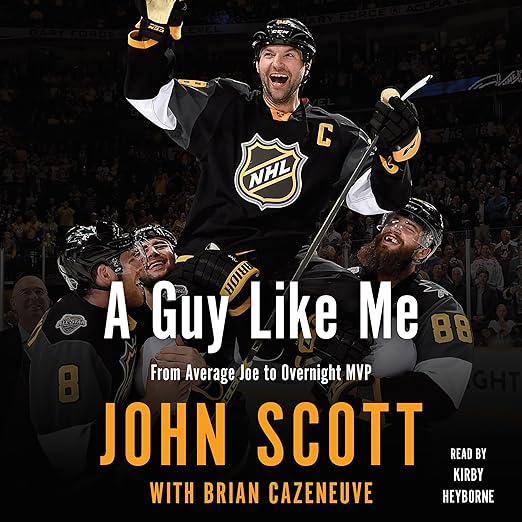
John Scott's audiobook A Guy Like Me reached me through a recommendation from someone who said explicitly 'I'm not a hockey person but I could not stop listening,' and that framing turned out to be exactly right. Scott is not a hockey legend by conventional measures. His stats are modest, his position as a fighter was always tenuous, and the 2016 NHL All-Star MVP story at the center of this memoir is built on a fan campaign that the league itself tried to prevent. That is what makes the book worth your time: not the hockey, but the story of what happens when ordinary people decide that a system's attempt to marginalize someone should be resisted loudly enough to force a response.
Where This One Lands
Scott writes, and Kirby Heyborne reads, with candor and humor that never tips into self-pity or self-congratulation. The NHL All-Star story is the narrative spine: Scott gets nominated as a joke, the league panics, his own team trades him to Montreal specifically to disqualify him from the game, Montreal demotes him to the AHL to close the loophole, and none of it works because the fans simply refuse to let the league win. All of this happens while Scott's wife is pregnant with twin girls, which adds a layer of personal stakes that the sports-politics dimension alone couldn't carry. Scott is honest about being devastated by the trade and the demotion. He is also honest about being aware that, in the scale of life problems, being sidelined from a hockey game is not a catastrophe. That self-awareness is what keeps the book from becoming melodrama and what makes his actual emotional investment in the outcome register as genuine rather than manufactured. The book's second half accelerates once the All-Star campaign begins, and the pacing shift is earned: by that point Scott has built enough character context that the stakes of the institutional maneuvering feel personal rather than abstract. Heyborne's narration matches this acceleration without overselling it.
Why A Guy Like Me Works as an Audiobook
Kirby Heyborne is a smart casting choice for this material. Scott's voice on the page is conversational, direct, and laced with the kind of humor that lands best when it sounds unplanned, and Heyborne delivers exactly that quality. The memoir's tone alternates between locker-room ribbing and genuine reflection on family, identity, and what it means to build a career as the player nobody expected to last. Heyborne handles both registers without strain. The audiobook runs six hours and forty-nine minutes, which is a comfortable length for a memoir of this scope: long enough to spend real time with Scott's story, short enough to finish across a weekend. Reviews consistently note the pacing as one of the book's strengths, and the audio delivery reinforces that quality through Heyborne's steady, unsentimental reading that lets the story land on its own terms rather than pushing you toward a particular emotional response.
What Gives Us Pause
The book's greatest asset is Scott's lack of pretension about his own skill level. He knows he was never the best player on any team. His job in the NHL was to drop his gloves and absorb punishment, and he is frank about both the culture that made that role possible and the physical and psychological cost of living it for eight-plus seasons. The sections on Scott's early life, the childhood and college years that shaped both the personality and the physical build that steered him toward the enforcer's path before he fully understood that was the path, are among the memoir's most honest passages. They contextualize the All-Star story not as an accident but as the logical outcome of who Scott is: someone whose likability, at scale, becomes a form of power the league underestimated. One reviewer who came to the book through the Radiolab podcast about Scott's story found the memoir matched their expectations completely; the podcast is worth hearing first if you want additional context, though the book stands fully on its own.
Who Should Pick Up A Guy Like Me
Non-hockey fans who want a genuinely entertaining sports memoir built around an institutional story rather than athletic achievement will find this audiobook satisfying without any prior knowledge of the NHL. The All-Star narrative is self-contained and Scott explains the relevant context generously. Hockey fans who followed the 2016 All-Star controversy will get an additional layer of texture from the inside account. This is not a book for listeners who want deep tactical analysis of the sport or institutional critique of professional hockey's culture. Scott is interested in telling his own story honestly, and the affection that story generates comes from that honesty rather than from any pretense about its significance. For coaching staff or athletic directors who work with athletes who struggle to find their identity within team structures, Scott's account of what he brought to the NHL beyond conventional skill offers a useful frame. His willingness to name his own limitations clearly, without false modesty or compensatory bragging, is a model of athletic self-knowledge that is rarer than it should be in the memoir genre. One aspect Scott handles with particular candor is the financial precariousness of a career built on a role that the NHL itself was beginning to phase out during his playing years. The enforcers who built careers in the 1990s and 2000s were operating in a shrinking market, and Scott's awareness of that context gives the memoir an economic realism that most sports biographies elide in favor of pure athletic narrative.
Questions Listeners Ask
Do I need to know hockey to enjoy this audiobook?
No. Multiple reviewers note coming to the book with little hockey background and finding it compelling anyway. The 2016 All-Star story is told with enough context that no prior NHL knowledge is required, and the memoir's core themes around family, identity, and persistence under institutional pressure translate cleanly regardless of sports familiarity.
Does the audiobook cover Scott's life beyond the 2016 All-Star Game?
Yes. The memoir covers Scott's full arc from childhood through his entire NHL career across multiple franchises, the All-Star controversy, and the family context that gave the professional events their personal weight. The All-Star story is the emotional peak, but the book is a complete memoir rather than a single-episode account.